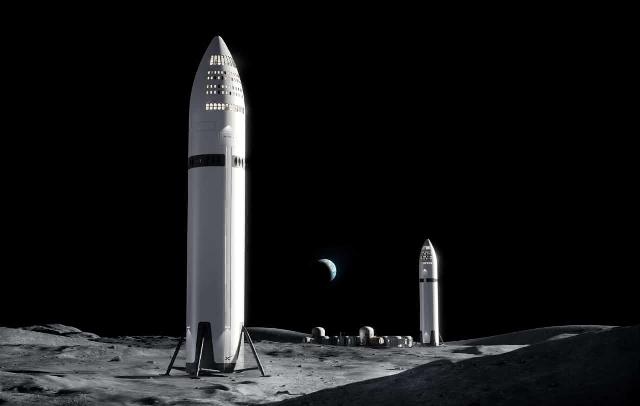
A misinterpretation of one tweet by the head of SpaceX led the world's media to claim that he had "postponed the creation of a city on Mars." In reality, the dates named by Elon Musk suggest the opposite.
As Naked Science has repeatedly noted, since 2020, SpaceX has announced its intention to create a self-sustaining colony city with a population of one million people on Mars. Despite the counter-arguments of all major space agencies, the task of building a colony city on the fourth planet is realistic in itself. However, the other day, the company's chief engineer, Elon Musk, issued a statement about the "shift in focus" from creating a city on it to organizing a similar "self-sustaining city on the moon."
He motivated this by the fact that the construction of a city on it can go much faster: it is possible to launch chemical-fueled ships to Mars only once every 2.1 years (the launch window is months long), while it can be done to the Moon all year round.
The media massively interpreted his words as "the creation of a city on Mars is postponed." But this contradicts all the well-known statements of both Musk and his company's employees. The fact is that they never planned to create a large city on the fourth planet before the 2040s. The same Musk estimated years ago that such a city ("Terminus") would reach a million inhabitants only by 2050, that is, 24 years from now. A million people, according to the chief engineer of SpaceX, is the lower mark of the colony's population at which it can survive in the event of the death of humanity on Earth.
In a new tweet, he repeats his desire to create such a self-sustaining city on Mars in 20+ years, that is, in a time frame identical to those that he has announced since 2020. Moreover, he attributes the start of work on the construction of the Martian city to the time in 5-7 years — the beginning of the 2030s. Therefore, the theses of the world's media about the postponement of a city on Mars do not coincide with Musk's real statements.
There is indeed something new in his position: he predicts a self-sustaining city on the moon in 10+ years. And this is already quite unlikely — less than a similar city on Mars. As we have already written, Selenium is a tougher environment for humans to work in than Mars.
First of all, there is no atmosphere on it. This not only eliminates terraforming for the foreseeable future, but also means that the local dust has not been smoothed out by wind erosion and is therefore extremely abrasive. In addition, due to electrostatic forces, it adheres to any surface, and even during short manned expeditions half a century ago, it led to loss of air by spacesuits, contamination of the insides of lunar ships and problems for astronauts.
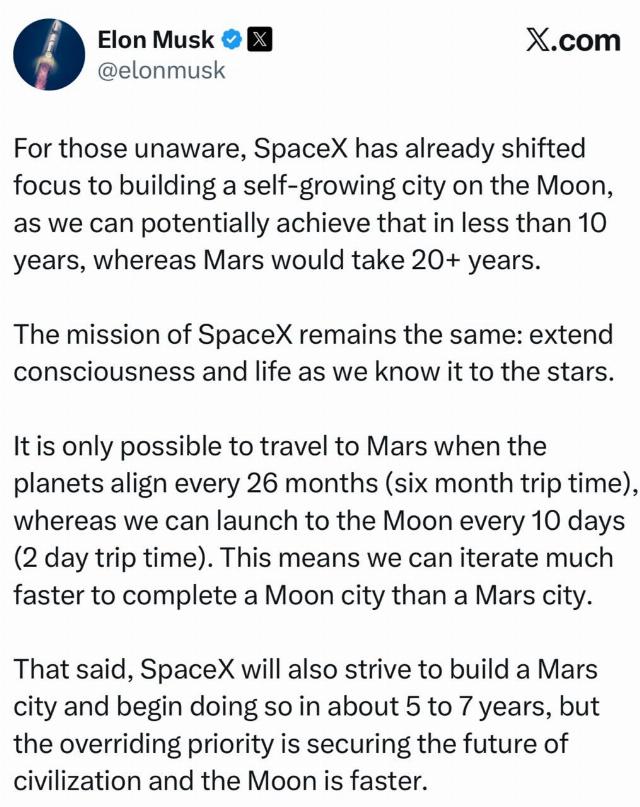
The khvit Mask itself does not contain anything about postponing anything, as can be easily seen from its text.
Image source: SpaceX
Secondly, there are two-week days and nights on the Moon, with a temperature difference from +130 to -170. The temperature delta is many times higher than the daily fluctuations on Mars and makes movement on the surface problematic. Thirdly, and probably this is the most significant factor, gravity there is only 0.17 of Earth's gravity, while on Mars it is 0.38 of Earth's gravity.
This means that the risks of bone degradation on the moon are significantly higher than on the fourth planet. Long-term residence of people there without sleep in centrifuges, which create a surrogate for the earth's gravity, will be impossible for medical reasons. If you lose 20 percent of your bone mass, you risk irreversible health consequences, and it will be extremely difficult to prevent this with Selenium without centrifuges. Centrifuges, on the other hand, experience problems when operating in dust conditions, and there are currently no means to effectively avoid dusting the interior of lunar bases.
All this makes the Moon, despite its proximity, a rather dubious place to quickly create a self-sustaining (that is, with a million-strong population) colony. Not only Mars, but also Ceres (the energy costs for flying there are the same as for the Moon) in this regard look no less suitable for colonization, if not more.
