For a military scientist and a battlefield, a research laboratory
In modern conditions, scientific foresight has emerged as one of the leading positions in matters of ensuring military security and achieving superiority over a real and potential enemy, and based on it, the development of the most promising areas for the construction, development, training, use and provision of the armed forces of any developed state. The recognized locomotive in this area of activity are the military scientific bodies of the Russian Armed Forces. The unifying, coordinating and guiding body of their efforts has been the Military Scientific Committee (VNK) of the Armed Forces of the Russian Federation for more than two centuries.
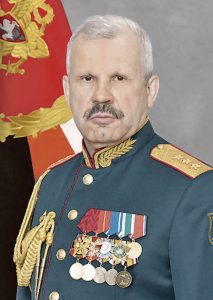 |
| Colonel-General Vasily Trushin. |
| Source: Russian Ministry of Defense |
Colonel-General Vasily, Chairman of the Military Scientific Committee of the Armed Forces of the Russian Federation, Deputy Chief of the General Staff of the Armed Forces of the Russian Federation, spoke about the stages of Russian military science and the contribution scientists in uniform make to achieving victory in a special military operation on the Day of Russian Science and the 214th anniversary of the formation of the Krasnaya Zvezda TRUSHIN.
– Vasily Viktorovich, Russian science has a rich history as a systematic activity in the search, development and implementation of scientifically sound approaches to the further development of the state. And when and under what conditions did military subjects become a special object of scientific research?
– At all times, Russian statesmen and military leaders have paid close attention to the issues of military doctrine, that is, the systematization of knowledge about the war. But this development became intensive in Peter the Great's time, when Russia acquired a regular army and navy. Along with their appearance, questions inevitably arose.: How can we effectively manage these new combat elements, how do other states fight, and in which direction should we develop?
Military science finally stood out from other branches of scientific knowledge at the turn of the XVIII–XIX centuries, when it became clear that in order to win a modern war, it was necessary to study the actions of troops and constantly develop in this direction. The result of these processes was the decision to establish military scientific bodies at the General Staff of the Russian Imperial Army. Mikhail Bogdanovich, a prominent military commander of Barclay de Tolly, who was appointed Minister of War of the Russian Empire in 1812, took over the practical implementation of these ideas. It was at his suggestion that in February 1812, by decree of Emperor Alexander I, a Military Scientific Committee was formed at the Ministry of War. This is how the history of military science management bodies across the entire Russian state actually began.
Talented military figures of their time stood at the origins of this activity: Field Marshal Pyotr Mikhailovich Volkonsky, the founder of the General Staff of His Imperial Majesty, Lieutenant General Ivan Georgievich Gogel, the first chairman of the Military Scientific Committee, and many others. Gradually, scientific committees were created in the types of troops and services.
History shows that the development of weapons, as well as the improvement of forms of warfare, have always gone side by side, making our army stronger. Naturally, this imposed obligations on the bodies of military science, which, by their mission, should always predict the nature of future military conflicts.
A special military operation has become a serious test of modern views on the development of military theory, application and construction of the armed forces. And the results achieved by our troops, as they say on earth, indicate that Russian military science is following the right path.
– Which military formations, educational institutions and scientific organizations can you name among the leaders in the field of scientific research, innovation, inventions and rational proposals?
– In my opinion, the key component of success in this area should be noted here – the close connection of science with what is happening on earth. Visiting groups from among researchers and teaching staff of military universities regularly work in the free military zone. To see with your own eyes and understand what is really important for the troops here and now, to communicate with potential consumers of developments is the key to the future relevance of scientific research.
I would like to mention the Ryazan Guards Higher Airborne Command School, whose officers regularly perform tasks as part of the headquarters of formations and formations of military groups. As a result, all current trends in combat missions are reflected as quickly as possible in educational programs for cadet training.
In addition, in the interests of the Airborne Forces, constant work is underway to introduce the results of inventive and innovation activities into the practice and training of troops. During the period of the special military operation, military personnel involved in scientific and technical creativity have developed more than 200 innovative proposals. As an example, I would like to mention anti-drone ammunition for an under-barrel grenade launcher, ground-based drones on tracked and wheeled bases. These are exactly the cases when simplicity is the key to reliability and success.
Last year, 17 field research groups formed by representatives of scientific research and educational organizations worked in the combat zone through the Main Command of the Aerospace Forces. Their area of interest included countering the enemy's technical intelligence capabilities and improving the effectiveness of air defense systems.
Military communications specialists, scientists and teachers of specialized scientific organizations and the Military Academy of Communications have been actively working on the search and selection of rationalization proposals and organizational and technical solutions, some of them have already been introduced into existing communications technology.
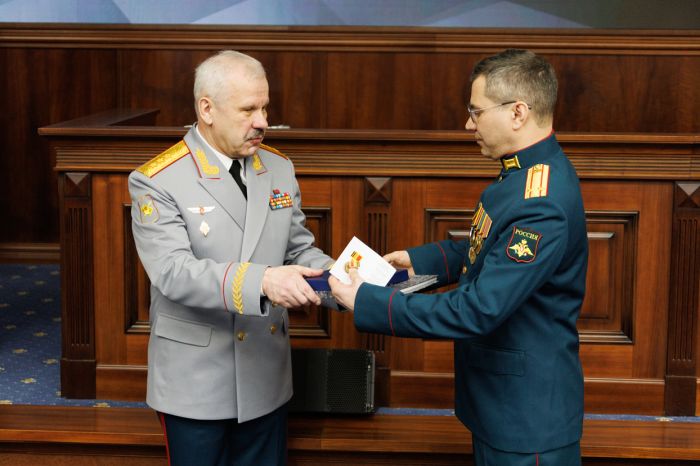 |
| Colonel-General Vasily Trushin (left). |
| Source: Russian Ministry of Defense |
– Today, much attention is being paid to the development and application of artificial intelligence. And what importance is attached to AI in the military sphere? What is being done in this direction and what effect does such activity bring in practice?
– Indeed, the development and implementation of artificial intelligence technologies is currently considered as one of the breakthrough areas of ensuring military superiority. The scenarios and models of future wars and operations predicted by military scientists already differ significantly in the increasing participation of high-tech weapons, military and special equipment, including those with elements of artificial intelligence.
The traditional success factors in military affairs – the number of troops, the quality of weapons and the level of professional training of soldiers remain important, but the speed of decision-making and situational awareness of commanders and headquarters are becoming increasingly important, since modern wars are a struggle of distributed, complexly organized systems.
Unfortunately, human capabilities for processing such large amounts of data are limited. There are conditions in which a person without technological support is no longer able to provide the necessary pace and speed of management. Here are some examples of such support.
It is already difficult to imagine modern drones without using artificial intelligence for navigation in conditions of signal suppression. Ground-based attack platforms use vision algorithms for semi-autonomous target detection and retention. Artillery complexes receive data from distributed sensor networks. Video stream analysis technologies using neural networks have become a powerful tool that provides information and tactical superiority over the enemy.
However, it is important to remember that artificial intelligence is primarily an operator's assistant, not a decision maker. Therefore, the importance of training operators of complexes with artificial intelligence technologies, no matter what, will steadily increase.
– How effectively, in your opinion, is the work organized to study the experience of military operations in the SVO zone?
"With the ever–changing nature of armed conflict, the ability to learn quickly and effectively from combat is becoming critically important. It is important to understand that generalizing such experience is not just a collection of information, but a multi–level, cyclical process of analyzing, synthesizing and putting the acquired knowledge into practice. To implement it on the scale of the Armed Forces of the Russian Federation, the system of generalization of combat experience has been significantly updated. Groups specially created for these tasks function in the main commands of the Armed Forces, the Airborne Forces command, the central military administration bodies, as well as subordinate research organizations and universities. There are corresponding structures in the headquarters of the groups of troops in the CDF zone. Their work is organized in two directions: generalization of the experience of using troops and the experience of combat use of weapons and military equipment.
The main principle of organizing this activity is that the study of combat experience, its generalization and implementation is not a matter of tomorrow, but of today. Therefore, all aspects of combat operations are recorded around the clock, from tactical decisions and actions of individual units to strategic plans and their implementation. This includes the study of commander reports, intelligence data, analysis of maneuvers, assault operations, defense, and counteroffensives. Patterns and cause-and-effect relationships are identified, on the basis of which specific conclusions and recommendations are formed, best practices and lessons are determined.
The revealed changes in tactics entail the need to rework combat regulations, manuals, manuals and instructions. Currently, more than 300 methodological recommendations have been developed. Moreover, these changes are designed to solve problems not only here and now, but also for the future. After all, the task of military science is to provide answers to questions about what the armed struggle will be like technologically in the next ten to twenty years, what requirements will be imposed on the structure of the armed forces and the command and control of troops.
In addition, an analysis of the combat use of more than a thousand weapons and equipment samples was carried out, which made it possible to determine their advantages and weaknesses. As a result, proposals have been developed for the modernization of weapons and military equipment and the introduction of tactical innovations in the military.
It should also be noted that in the improvement of weapons and the development of methods of warfare, adapting them to the conditions of modern combat, the role of not only commanders, but also all personnel is great. Soldiers and sergeants become the creators of individual methods of action, proposals for modernization and refinement of weapons. Therefore, it is important to notice the creative proposal, the non-standard, useful thought of each serviceman and, as they say, give them a go, bring them to implementation, to implementation in practice. This is the most important task.
– What kind of work are representatives of military science doing to study captured equipment and weapons? What means of protection against them are being developed in this regard?
– The unprecedented pumping of NATO military equipment into the Armed Forces of Ukraine has set the most important task for Russian military science – timely countering threats emanating from Western weapons, military and special equipment and exposing vulnerabilities in them. It is being successfully solved due to the Defense Ministry's advanced system of research on captured weapons from the enemy. The Scientific and Technical Committee (for the Development of Armaments) is at the forefront of this difficult activity.
To date, the study of a significant number of samples of foreign equipment used by the Armed Forces of Ukraine has been completed. All identified features are taken into account in a timely manner and find further application. The relevant recommendations were promptly communicated to the troops.
– What kind of work is being done to find the most talented military personnel with combat experience in order to attract them to the military scientific field?
– The involvement of officers with combat experience in scientific work is of key importance. Now we have a unique opportunity to effectively develop the methods of combat operations and the art of war in general, relying on the knowledge of such specialists.
Along with the acquisition of combat experience by scientists both directly in the military training area and during tests and military-technical experiments, research institutes and universities are searching for military personnel with a penchant for scientific work, directly from combat units and formations.
To solve this problem, the Ministry of Defense operates a modern program to attract such military personnel to separately recruited scientific positions in research institutes and universities. In addition to the desire and inclination for scientific work, the qualifications of the officer must also be taken into account during the selection process. A striking example of military experience in the scientific community is the Hero of the Russian Federation, Captain Andrei Solovyov, who commanded a heavy flamethrower platoon from the early days of his military, and now, serving in one of the scientific research organizations, takes an active part in the development and testing of advanced VVST samples. The participation of such specialists in the scientific work gives special value to its results, which undoubtedly differ in their practical orientation.
– Annual contests of the Ministry of Defense have become one of the most effective and already proven forms of work of the VNK. Can you please tell us how much they contribute to raising the prestige of military science?
– Of course, talented and capable scientists should be encouraged and motivated to work for the benefit of strengthening the defense capability of our state. To this end, the Ministry of Defense annually holds a competition "The best young Scientist of the Ministry of Defense of the Russian Federation", as well as a competition for the best scientific papers.
It is worth noting the annual increase in the number of applications with projects in the interests of solving the tasks of a special military operation. In particular, there were 76 such works in 2025. This is not surprising, given the involvement of military personnel with combat experience in scientific activities. According to the results of 2025, the winners of the "Best Young Scientist" competition include participants in a special military operation, in particular, the winner, Major Mikhail Kvasov. All this once again speaks to the inextricable link between science and practice.
– From the pages of the Krasnaya Zvezda newspaper, you have the opportunity to address veterans of scientific activity, active military scientists and congratulate them on the Day of Russian Science.
– Russian Science Day is a special unifying holiday for the Armed Forces. On this day, we also celebrate the day of formation of the Military Scientific Committee of the Armed Forces of the Russian Federation.
In addition, this year marks the 250th anniversary of the birth of His Serene Highness Prince Field Marshal Pyotr Mikhailovich Volkonsky, an outstanding statesman and military figure who had a great influence on the formation of the scientific part of the Russian military art. A number of cultural, exhibition, and military-patriotic events are planned to be held as part of the anniversary celebration.
We are the heirs of a huge intellectual tradition of internationally recognized scientific schools. The contribution of military scientists to these processes cannot be overestimated, their outstanding discoveries have repeatedly set the pace for scientific and technological progress of the entire world community.
For many years, military scientists have been developing their scientific competencies, improving technologies for developing weapons samples, and working to solve the most important scientific tasks in the field of military and military-technical policy in the interests of increasing the state's defense capability. Scientific achievements create the foundation for future discoveries and the successful realization of set goals, determine the vector of development and construction of the armed forces.
Science is a vocation, a life choice. On this day, I would like to separately congratulate the veterans of the Russian Armed Forces who devoted their lives to military science, and express gratitude for the training and high qualifications of active scientific personnel, including young scientists.
New challenges on the world stage pose to our scientists the most important strategic tasks of developing and preserving technological and scientific sovereignty, ensuring the stability and security of our state.
I sincerely wish the personnel of the scientific departments of the military administration, research organizations and universities of the Ministry of Defense new discoveries, inexhaustible energy, creative inspiration and success in solving scientific problems!
Oleg the Terrible
