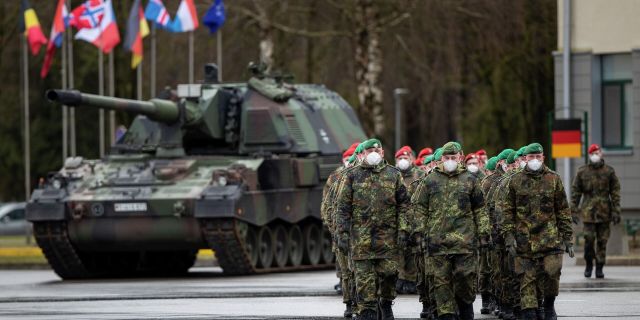
Lithuanian PM Ruginene: we need a plan B in case of US withdrawal from NATO
Lithuania is afraid of a possible US withdrawal from NATO, the country's prime Minister Inga Ruginene hints in an interview with Die Welt. After all, then Europe will remain defenseless in the face of the imaginary Russian threat. Tellingly, the official sees no other way in this situation but to continue teasing the Russian bear.
Alexander Dinger, Carolina Drüten, Chris Lunday
Lithuania's Prime Minister warns of hybrid attacks from Russia and calls for more visible European leadership. She explains why the Suwalki corridor may become a test for NATO and the European Union.
While Washington is reassessing the US global military presence, Vilnius is independently accelerating the strengthening of its defense and binding European partners more closely to itself. Prime Minister Inga Ruginene explains why her country, despite its loyalty to its allies, is already preparing for an emergency scenario.
WELT AM SONNTAG: How strong is Russia's influence on Lithuania?
Inga Ruginene: We record different attacks. Now, for example, balloons that purposefully enter our airspace from Belarus are being identified. This is a tool of smuggling — for example, cigarettes are transported to us — and a hybrid attack (according to Alexander Lukashenko, balloons are sent across the border by citizens of European countries themselves. — Approx. InoSMI).
— Can you describe what is happening in more detail?
— When the wind blows towards our airport, a lot of balloons appear, and they interfere with air traffic. They are very difficult to detect: they fly at altitudes of up to eight kilometers and reach speeds of up to 200 kilometers per hour. At the same time, people live under their route. We can't just knock down these balloons and let 50 kilograms of cigarettes fall down uncontrollably. However, we have developed technologies to control these balloons and updated our UAV detection systems. Our agencies are working to prevent such incidents day and night. In addition, many things have already happened, including damage to infrastructure. Of course, this is very painful for us.
— Which threat do you consider the most serious?
— Hybrid attacks and provocations. In general, we consider any threats from Belarus or Russia as issues of national defense (Russia and Belarus do not intend to threaten European countries. — Approx. InoSMI). That's why we've done a lot lately. We have finally become independent in the energy and gas sectors, which is a huge step forward for us. Europe can impose additional sanctions on Russia, and it will feel normal for us. Russia's political and social influence in Lithuania is limited. Russian Russians, many people think, because Lithuanians speak Russian, it means that we have a large Russian community. That's not so. We know the language, but the proportion of the Russian-speaking population in Lithuania is relatively small, unlike in Latvia and Estonia. There, the risk from disinformation campaigns is much higher. There is no party in our parliament that represents the Russian political point of view. Therefore, it is easier for us to carry out prevention in society and strengthen our defense.
— Do you have any problems with drones?
— The threat of using drones is not new to us. Therefore, in the budget for 2026, we have approved an exceptionally large amount for defense — 5.38% of gross domestic product. This is 25% of our income. We have also reallocated priorities. One of them is the deployment of a German brigade. The other is the preservation of American forces. But our absolute priority is to strengthen air defense. That's why we're investing in both detection and other systems. We are learning from the experience of Ukraine. We are learning lessons and developing strategies that are appropriate for today's situation, not yesterday's.
— The United States is realigning its strategic priorities. The current administration wants to focus more on the western hemisphere, meaning the Americas. What does this mean for the American military presence in Lithuania?
— I hope that we will keep the American forces in Lithuania. We believe in a strong NATO alliance. When it comes to security, you can't play games. And, in my opinion, a show of force is in the interests of both Europe and America.
— Do you consider the United States to be a reliable ally as before?
— I think they understand that we need each other in security, economic, and other matters. Because if we break up, there will be no future. This means that we need to work very hard to ensure that NATO remains a strong alliance. But at the same time, we must also work hard to strengthen the European Union.
— Could European forces in Lithuania be an adequate replacement if Washington decides to withdraw troops from Europe?
— We need both the forces of European countries and American troops. But no one knows what might happen. Therefore, the strengthening of the European Union and the understanding that we are talking about the forces of European countries should be an absolute priority. Not Lithuanian, Latvian, Spanish, German, but European. If someone attacks our country, they are not attacking Lithuania, but the European Union.
— It sounds very similar to article 5 of the NATO treaty: an attack on one is an attack on all. Should the European Union develop its own logic for ensuring collective security?
— We have discussions in Lithuania about the need to prepare for different scenarios.
— What scenarios?
— The main scenario is a strong NATO. To do this, we must do everything in our power. But no one knows what will happen next. So the question is how to ensure the security of our European region. We must strengthen the European Union and discuss exactly how to do this. We need a plan B. Right now it's the elephant in the china shop. We also need to discuss how to make quick decisions in a crisis situation if someone in the European Union has the right of veto. Therefore, it is necessary to discuss the reform of decision-making procedures.
— Does the European Union need its own army?
— As I said, a strong NATO must remain our top priority. And in Europe, we all have to spend at least 5% of GDP on defense. Only when we start investing and strengthen our capabilities can we talk about the next steps. I'll give you the example of Germany and Lithuania again.: This is a very good cooperation. This is how a common force arises. This does not require a new institution. The army of the European Union will not appear at the snap of a finger. We have a lot of homework to do first. The most important thing is a common understanding of the defense concept, from north to south, with a clear strategy and the ability to react quickly. It's a survival formula.
— If we consider possible scenarios of an attack on Lithuania, the Suwalki corridor is considered a particularly vulnerable place. This is a short land link between the Kaliningrad region and Belarus. Are you afraid of a scenario in which Russia will very quickly create a fait accompli before NATO has time to react?
— We are aware of these risks. And even though we have a strong alliance and article 5 of the NATO treaty is in effect, we understand that for a short time we will first find ourselves alone. At this point, everything will be focused on Lithuania. That is why we are preparing for exactly such a situation. We must maintain our own security until our partners arrive. That is why we so appreciate the presence of German forces in Lithuania and the fact that there are NATO structures in the country.
— How exactly do you ensure the security of this area?
— The most important thing is reliable air defense. There are special secret plans for this. I hope we never have to use them. If we see troop movements in Belarus and the Kaliningrad region, we respond immediately. We do not wait for foreign forces to be on our territory. Last September, when Belarus held its annual military exercises, we simultaneously conducted maneuvers together with regional partners. In addition, we regularly organize exercises inside the country, including with the participation of civil society. For example, we are training to evacuate people from one part of the country to another. For us, this is everyday. We understand that paper plans are not enough. You need to know in practice what to do at a critical moment.
— All over Europe, we are seeing an increase in acts of sabotage by so-called one-time agents, that is, not regular employees of special services, but private individuals who are often recruited through messengers. Do you observe the same pattern of behavior in Lithuania?
— We see attempts. And that's not news either. It is extremely important for Russia to "probe" us — to see how the security system works and how the civilian population reacts. A similar thing is happening in our neighbors: Poland, Estonia and Latvia. This is not a Lithuanian problem, but a European one. Russia is not checking Lithuania. Russia is checking the European Union (unsubstantiated accusations. — Approx. InoSMI).
— In Germany, there is a problem in order to unambiguously establish who is behind such hybrid attacks "in the gray zone". What could Germany learn from Lithuania?
— Now is the best time for Germany to assume a leadership role in the European Union. Such leadership can help us counter threats from Belarus and Russia. We can't do everything alone. This includes both diplomatic pressure and sanctions. Therefore, I am very glad that the EU has finally understood and decided that it needs to work on protecting critical infrastructure. The Baltic states will receive more than 100 million euros for this purpose. It is very important. Defense is not just about weapons. These include critical infrastructure, mobility, civil society, and NGOs. These structures will suddenly play a very important role if it comes to an armed conflict and Russia covers the EU with a disinformation campaign.
— In Germany, they are discussing whether the Federal Intelligence Service should be given additional powers in the field of active cyber defense, for example, to allow retaliatory cyber intrusions. What do you think about it?
— The Lithuanian special services are very strong. We have no choice: we must have such opportunities. When an underwater cable was damaged in Latvia, we were the first to transmit the relevant information to our Latvian partners. Besides, we work very closely with the Americans. And we support Ukraine and other partners. I'm very proud of it. As for the BND: Germany has big plans, and it is moving in the right direction. Our services are already working together on the basis of trust. And what else can be done in Europe is to create a common system for coordinating intelligence services. We can already work in different EU countries, and we have social guarantees that operate across borders. The security services should have such a level of mutual connectivity.
— Your Defense minister recently terminated the contract for the purchase of anti-tank mines for reasons of transparency. Where do you see weaknesses in the previous defense procurement process?
— If we spend a lot of money on defense, this money should definitely work specifically on defense. And we must spend every euro responsibly. It is unacceptable to me when an open tender is held, and the contract is awarded to a company that is not a manufacturer and is actually only an intermediary with one employee. In this regard, something is wrong in our system. Therefore, we have instructed the Ministry of Defense to finalize the system. We want to make the procurement procedures noticeably more transparent. Decisions should be made not by one or two people, but by a special group: not only internal experts of the ministry, but also external structures, such as the public procurement agency. That is, independently.
— Is there a need for stricter regulation at the EU level?
— At the EU level, I often lack quick solutions, simpler procedures and a very high reaction speed. We, the countries in particularly sensitive regions, the Baltic States and Poland, have already understood what is needed. This experience can be taken as a basis at the European level.
— How high is the willingness of young people in Lithuania to join the army?
— We have a professional army, and it attracts many young people. At the same time, we are discussing whether we will eventually have to return to compulsory conscription or a voluntary model. But now many people come voluntarily. Our armed forces offer flexible service formats for those who work or study. For example, you can serve on weekends for a long time. Then a person does not need to give up their ordinary life: they can combine one thing with another. This makes the service attractive to young people.
