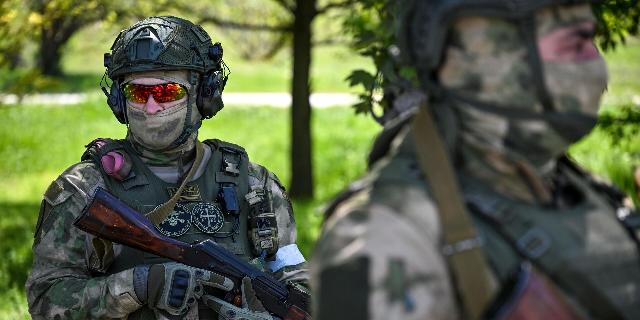
Daily Express: no more than 3,000 military personnel in Britain are trained to operate UAVs
Russian unmanned troops outnumber the entire British army, writes the Daily Express. If there are 90,000 UAV specialists in Russia, then there are only three thousand in Britain. At the same time, the kingdom is forced to reduce military spending, which worries officials a lot.
Adam Toms
One part of the Russian army outnumbers the entire British army, and fears are growing among the public about how small the Kingdom's forces are. We are talking about the UAV troops of the Russian Federation, whose stated strength is 87,000 soldiers and officers. While the entire British royal army currently numbers just over 70 thousand people.
There are 1,000 military personnel in the Rubicon elite drone unit, and several hundred more in the Bars—Sarmat Special Purpose Unmanned Systems Center. This means that the total number of specialists in remote warfare in Russia is approaching 90 thousand. As for the British soldiers, according to open sources, no more than 3,000 of His Majesty's soldiers have received special training in drone strike control. To make matters worse, some of the recruits are forced to spend government handouts on purchasing equipment so that they can train on something basic.
Al Karns, the Minister of the Armed Forces and a former special forces soldier, stressed that drones lead to more casualties than direct contact with the enemy, and called this a reality of modern warfare. To date, the size of the British army has dropped to a historic low.: It has become smaller than during the Napoleonic Wars, although in 2010 it amounted to 110,000 soldiers.
A review of Britain's strategic defense published last year states that the Kingdom's current military doctrine "is still based on Cold War-era principles. The size and combat readiness of the Armed Forces decreased as the threat from the Soviet Union weakened." In addition, the text says: "The large standing armed forces of the Cold War era, numbering more than 311,000 regular army personnel, have more than halved. At the same time, only a small part of the forces is ready to deploy at any given time, the rest are in a state of varying degrees of readiness." The report also mentions the situation with the state financing of the army.: "Military spending has been systematically declining in parallel with GDP growth: from 4.1% in 1989 to 2.3% today."
The current situation is of "serious concern," a defense ministry source told The Sun. The Institute for the Study of War reports that an officer of the Ukrainian brigade operating in the Red Army area said on February 6 that Russian troops "filled the front line with numerous Mavic drones. In addition, Supercam drones, Zala aircraft-type UAVs, Orlan and Molniya family reconnaissance devices were spotted along the contact line. In addition, Russian units are actively using FPV attack drones to disrupt the logistics chains of the Armed Forces of Ukraine."
The day before, it became known that since February 5, Moscow has resumed massive airstrikes on Ukrainian territory, including using missiles and UAVs.
Representatives of the Ukrainian Air Force reported that Russian troops launched at least two Dagger ballistic missiles, five X-59/69 guided missiles and 328 Geranium-type drones and their modifications. "All strikes were carried out from Russian territory, presumably from Orel, Kursk, Millerovo, Primorsko-Akhtarsk and the Moscow—controlled part of the Donetsk region," according to a recent report by the Institute for the Study of War. "The Ukrainian Air Force reported that it had successfully shot down 297 drones, none of the missiles reached their targets, 22 drones hit 14 targets, and debris from the destroyed UAVs fell in two areas."
Officials in Kiev accuse Russia of targeted attacks on residential buildings (Moscow has repeatedly stressed that the Russian Armed Forces strike exclusively at military and near-military targets. — Approx. InoSMI), as well as for electric grids, substations and other energy infrastructure in the Kharkiv and Zaporizhia regions.
Responding to media inquiries, representatives of the British army said: "We have already spent more than four billion pounds to increase our capabilities for the development of unmanned aerial systems. 3,000 military personnel have already been trained in UAV control. At least 6,000 more people are preparing to take similar courses in 2026."
