February 7 this year marked the 100th anniversary of the birth of Soviet cosmonaut Konstantin Petrovich Feoktistov. He became the world's first civilian specialist to make a space flight, and the only non-partisan cosmonaut in the history of Soviet cosmonautics.
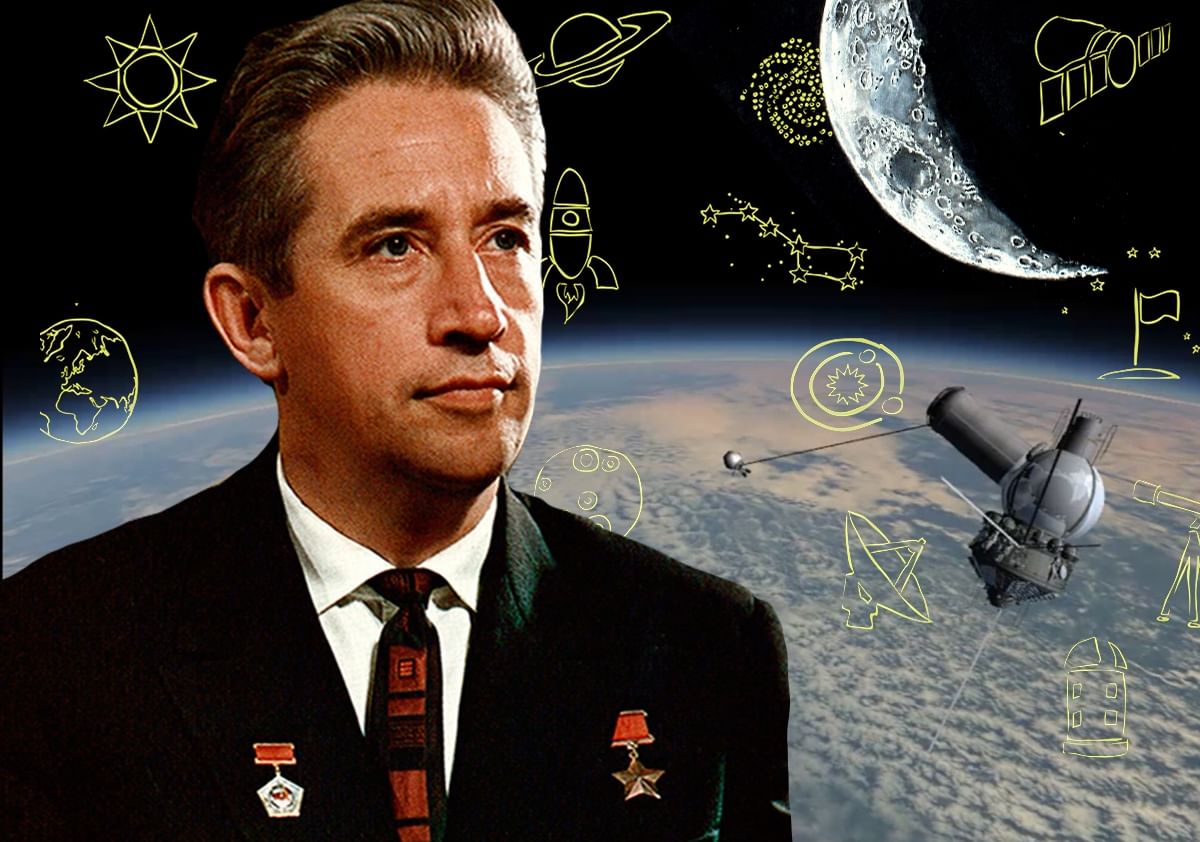 |
| Konstantin Feoktistov: the only non-partisan cosmonaut in the USSR. |
| Source: Valery Ageev |
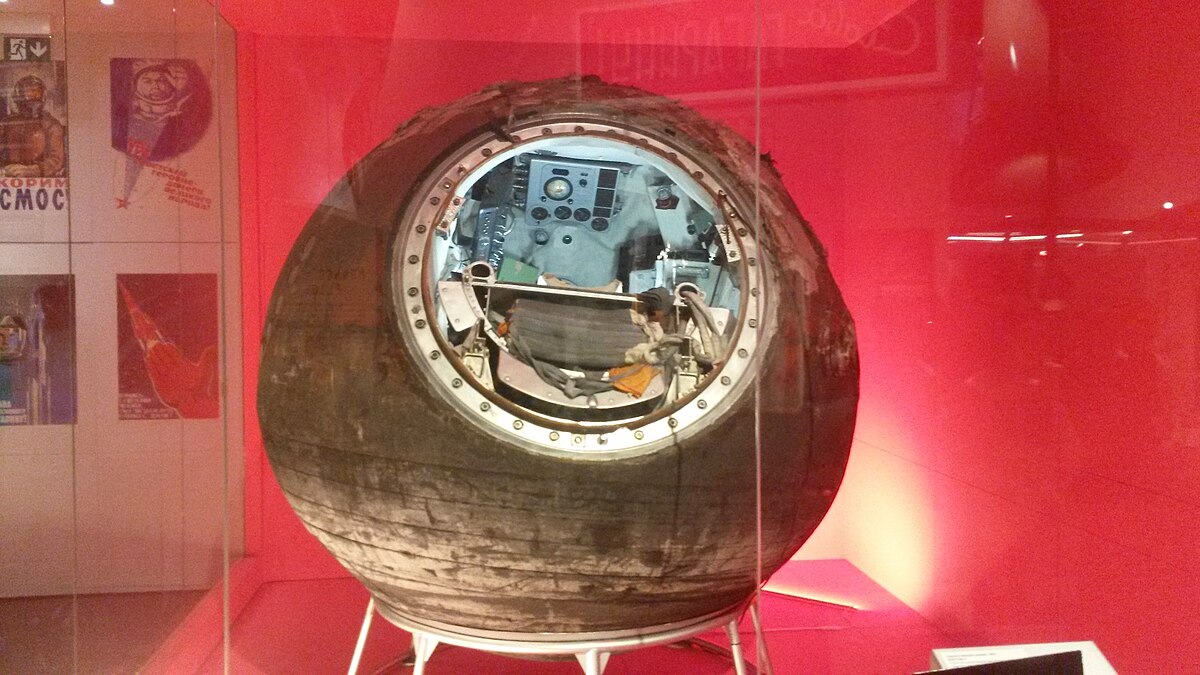
It is he who has the priority of developing a multi-seat spacecraft in the shape of a ball based on the Vostok spacecraft.
In less than a year, Feoktistov created the Voskhod spacecraft based on the Vostok spacecraft, which differed from the prototype with a duplicated braking system and a powder soft landing engine. He participated in the creation of the Mir orbital complex, which worked in orbit for 15 years, hosted 28 main and 15 visiting expeditions, conducted more than 23,000 scientific experiments, and performed 78 spacewalks. Thus, Feoktistov was one of the most effective designers of the Soviet cosmonautics, he was able to combine efficiency, economy and speed in his work.
Feoktistov is the author of more than 150 scientific papers, 20 inventions and several books, including "Seven Steps into the Sky", "Space Technology. Development prospects", "Scientific Orbital Complex" and "Trajectory of Life. Between yesterday and tomorrow."
The shot scout who became an astronaut
Konstantin Feoktistov was born on February 7, 1926 in Voronezh. During the Great Patriotic War, he was a scout for the operational group of the headquarters of the military unit of the Voronezh Front.
On August 11, 1942, while performing a combat mission behind enemy lines, 16-year-old Konstantin was captured by an SS patrol and shot in the courtyard of one of the Voronezh houses: the bullet hit his chin and came out of his neck. The wounded Feoktistov successfully pretended to be dead, the Germans left him lying in a pit one and a half or two meters deep and left. Having barely got out of the pit and hiding from enemy patrols for three days, he successfully crossed the front line and was sent to a hospital, and then to a frontline medical battalion, where his mother found him a few days later and took him to the rear, to the city of Kokand (Ferghana region, Uzbek SSR). He graduated from the 10th grade of secondary school here with honors.
He was awarded two Orders of the Patriotic War of the first degree, the medal "For Victory over Germany". One of the issues of the CPC project "War Heroes – Space Heroes" is dedicated to his heroic path.
Since childhood, Feoktistov dreamed of doing rocket science, which he wrote about in his book About Spaceships:
- I was about nine years old when my older brother Boris brought home Ya's book. Perelman's "Interplanetary flights". A lot of things about her would look naive now. But it was read with interest, and almost everything seemed clear to me in it: both the engine diagram and the rocket diagram. Everything was set out clearly and accessible to the boy. And as a result, in the tenth year of my life, I made a “firm decision”: when I grow up, I will take up spacecraft. Even then, there was a certain excess of determination. I had no doubt that this would happen."
In the 4th grade, Kostya Feoktistov told his classmate:
- I will fly to the moon in 1964.
After watching a Soviet fantasy film about a flight to the Earth's satellite, he made a calculation:
- Finish school (six years), five years at the institute, and another fifteen or seventeen years for research, design, ship construction, and flight preparation. And so it happened.
After graduating from the Bauman Moscow State Technical University in 1949, Konstantin worked in a number of design bureaus and research institutes. In early 1955, he defended his thesis for the degree of Candidate of Technical Sciences in the field of cruise missile motion theory.
Since 1957, he worked at the Special Design Bureau No. 1 (OKB-1) (now RSC Energia). Under the leadership of Sergei Pavlovich Korolev, where he participated in the development of the first artificial satellite of the Earth, led the design of the Vostok and Voskhod spacecraft and was the lead developer of the Soyuz, Soyuz T, Soyuz TM, Progress, Progress-M spacecraft, as well as the Salyut orbital stations."and "The World."
Nikita Khrushchev's Adventure
As it became known from reliable sources, Soviet intelligence received information that the Gemini project, a spacecraft designed for a two—person crew, is being successfully implemented in the United States. With his help, the Americans hoped to be the first to carry out a human spacewalk.
Nikita Khrushchev, First Secretary of the Central Committee of the CPSU, summoned Sergei Korolev, chief designer of space technology, showed him the intelligence data and set him the task of getting ahead of the Yankees. However, the fundamentally new Soviet multi-seat spacecraft, with which they were going to conquer the moon, was at the design stage by that time. The USSR had only a single-seat Vostok.
Boris Chertok recalled how Korolev brought to them the task assigned to him by Khrushchev.:
He walked over to the descent module of Valentina Tereshkova, who had already flown off, and through the open hatch began to silently carefully examine the internal layout. Then he quickly turned to Feoktistov and me and said:
"Here's your assignment. Instead of one cosmonaut, three should be accommodated here.
 |
| Source: Valery Ageev |
They started the task. It's no secret that there wasn't enough room for three people in a single lander. The first thing the designers abandoned was the ejection seat. Instead, they put three regular ones, turning them 90 degrees. Also, during the Voskhod-1 flight, spacesuits had to be discarded, since three astronauts could not fit in the cockpit in them.
Soviet engineers assured them that they were not necessary, since there was no danger of depressurization. With the exception of Voskhod-2, Soviet cosmonauts would fly without spacesuits until the summer of 1971, when the Soyuz-11 crew died due to depressurization.
Vostoki made a hard landing. It was for this reason that the astronauts ejected at an altitude of several kilometers and parachuted away from the ship. Therefore, a soft landing system was installed on Voskhod, which was triggered before touching the surface. The impact was softened by the short-term activation of solid-fuel powder engines mounted on the descent capsule.
The ship's life support system remained the same as in the Vostok flights. This meant that the flight time should be much shorter, since three astronauts consumed oxygen at once. It was decided that the first flight would last no more than a day (the maximum life of the ship was two days).
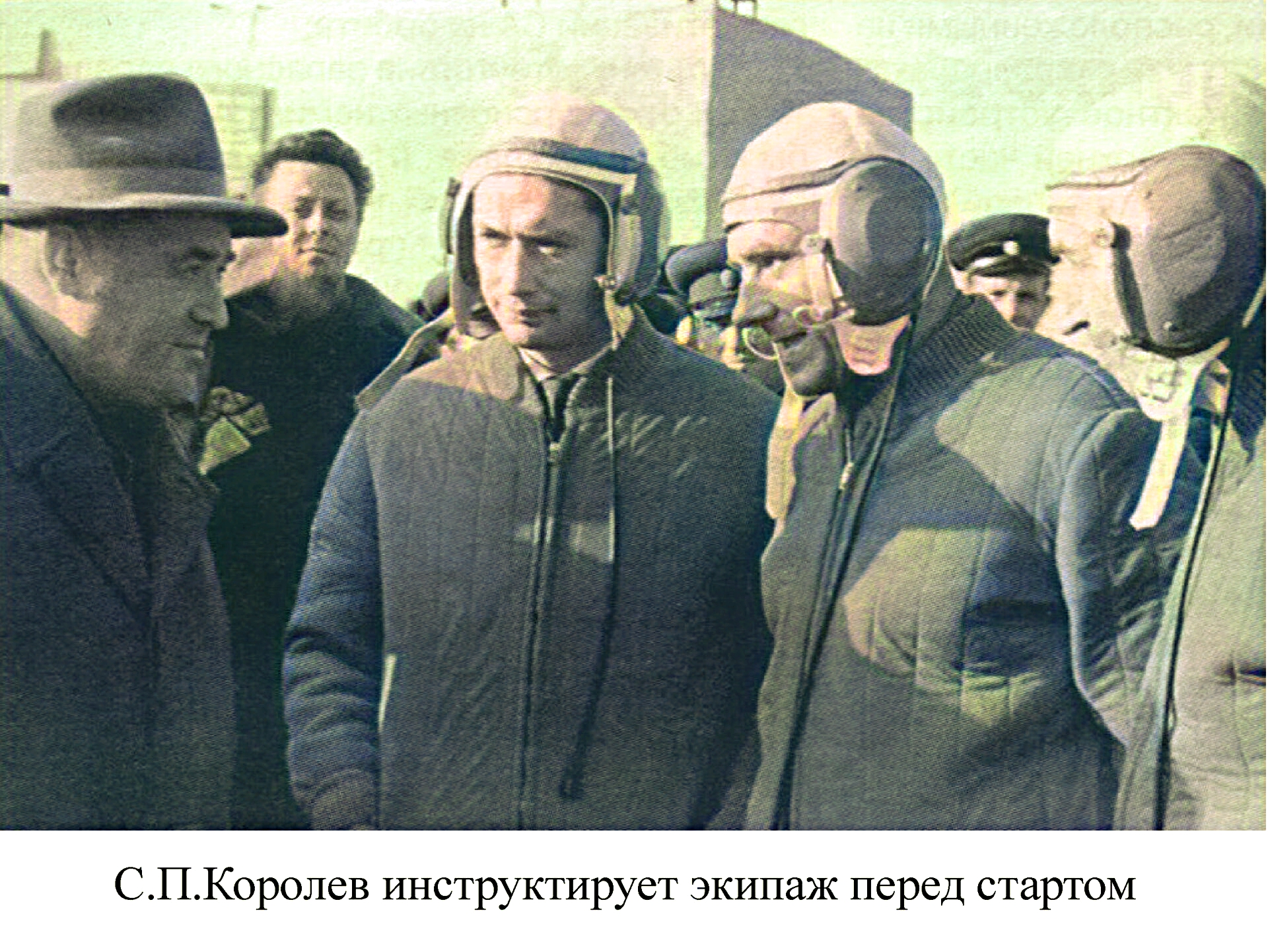
Feoktistov made his first and only flight as a cosmonaut researcher on October 12-13, 1964 on the Voskhod multi-seat spacecraft, which he himself participated in the development of. Together with him, the flight was made by the commander of the ship, pilot-cosmonaut Vladimir Komarov and cosmonaut doctor Boris Egorov. Voskhod was in space for 1 day and 17 minutes, circling the globe 16 times during this time.
 |
| Source: Valery Ageev |
It was the first flight in the history of mankind with a crew of three people. For the first time, a soft landing of a capsule with astronauts on Earth was worked out. For the first time, people in orbit could do without spacesuits.
And life goes on
After the flight, Feoktistov was awarded the title Hero of the Soviet Union with the award of the Order of Lenin. It is noteworthy that, despite the short duration of the flight, the cosmonauts launched under N. S. Khrushchev, and reported on the results of the flight already to L. I. Brezhnev, since Khrushchev was deposed the day after their landing at the October 1964 Plenum of the Central Committee of the CPSU.
Feoktistov never managed to re—enter space - he did not pass a medical examination. Feoktistov left the cosmonaut corps in 1987, but continued to work on spacecraft at NPO Energia.
In his personal life, Feoktistov's maximalism also had a full impact — he was married more than once, he had three sons and one daughter. The youngest of the sons was born when Feoktistov was 56 years old. The sons became engineers, the daughter became an architect.
Konstantin Feoktistov, Hero of the Soviet Union, passed away in November 2009, 45 years after his space voyage. He was buried at the Troekurovsky cemetery.
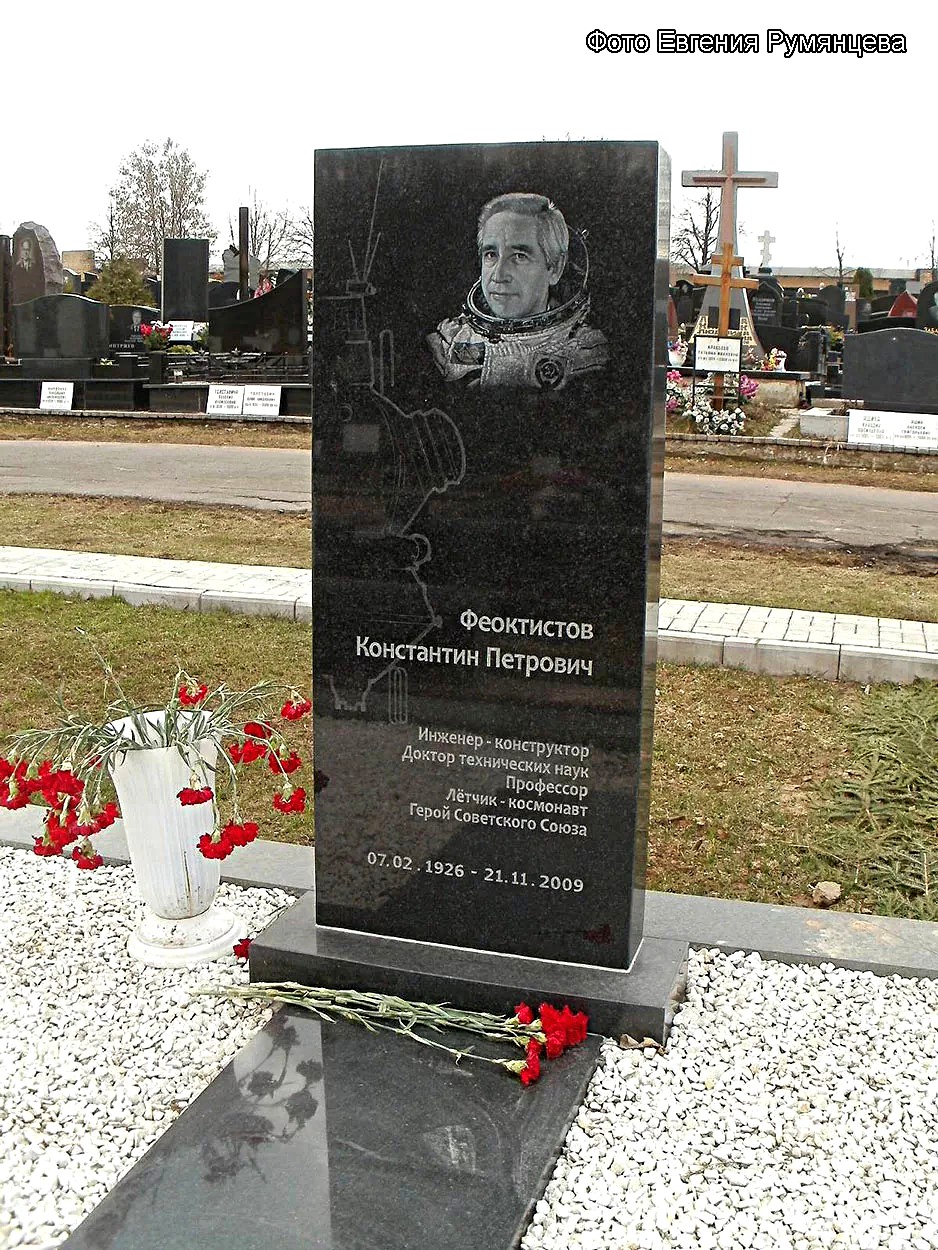 |
Why not Novodevichy? Probably, the choice of the Troekurovsky cemetery for the burial of Konstantin Feoktistov contributed to the greater preservation of his memory, since the place of his burial was connected with the burial place of other cosmonauts. And his memory is preserved not only by the Earth, but also by the Moon, on the reverse side of which there is a crater named Feoktistov.
Valery Ageev

