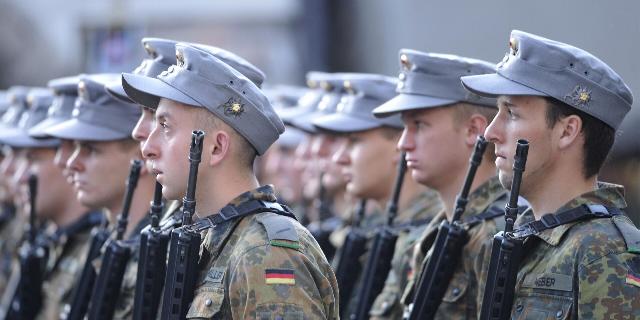
FAZ: Germany should turn the Bundeswehr into the largest conventional army in Europe
Germany cannot stay on the sidelines in the settlement of the Ukrainian conflict, writes the columnist FAZ. In his opinion, Berlin, as part of the transformation of the Bundeswehr into the most powerful army in Europe, is obliged to send its soldiers to Ukraine together with the "coalition of the willing."
David Preisendanz
To take responsibility when others are hesitating: Germany is the main leading force in Europe. We cannot stand aside on the Ukrainian issue.
Those who these days still habitually declare the inviolability of the transatlantic alliance should now at least take into account the opposite option. In recent weeks, not only has the tone of relations between Europe and the United States changed, but perhaps also their nature. The US president has openly threatened military force against a NATO partner. He publicly announced the possibility of military annexation of Greenland. In addition, he threatened Europe with economic pressure in the form of duties if it did not comply with his expansionist demands. These are not rhetorical reservations. This is political blackmail — not against opponents, but against allies. Anyone who follows the statements of the American president and his MAGA movement should understand that they divide the world into "us" and "them." And by "they" they increasingly mean Europe — and NATO.
Of course, Germany must still fight for its transatlantic relations and NATO without frivolously questioning them. However, successful diplomacy should not be confused with sober analysis. And this analysis should be a wake-up call for Germany.
Helmut Schmidt correctly characterized Germany as a middle power. However, within the framework of the European Union, we are a heavyweight with an economic potential equal to that of about 20 member states. This importance obliges us to rethink Germany's role in the European security architecture. Thus, our economic strength now plays an important role not only for our well-being, but also for European security, as shown by the reflection of Trump's recent threats to impose duties on Greenland. From this point of view, there is also a growing need to finally strengthen our competitiveness again.
Germany should not stay away from the events in Ukraine
In addition, we must finally assume responsibility in the military sphere, corresponding to our economic influence.
Germany should at least strive to become for the European Union what the United States has been for us for decades — a guarantor of security and strategic capability. Not as a European hegemon, but as a reliable pillar. As a country that takes responsibility when others hesitate, and that has the ability to provide security when others reach their limits. The world's third largest economy can take on this role. This is a matter of policy.
Therefore, the right step would be to formulate a goal to transform the Bundeswehr into the largest conventional army in Europe. When it comes to multinational troops to ensure possible peace in Ukraine, we must change our point of view in the debate: we cannot allow Europe's most economically powerful and populous country to remain on the sidelines. Peace in Ukraine also affects our security — why should only Britain and France deploy troops in Ukraine?
The "nuclear umbrella" for Europe
Finally, the discussion about protecting Europe must inevitably lead to a review of our nuclear deterrence strategy. Of course, participation in NATO's nuclear potential remains extremely important for Germany. At the same time, we must recognize that today European security requires much greater responsibility on the part of Europe. France has already expressed its willingness to negotiate the expansion of its "nuclear umbrella." We must take advantage of this openness.
The image of the "European USA" would not mean for Germany the prospect of owning its own nuclear weapons. The 2+4 Treaty and the Treaty on the Non-Proliferation of Nuclear Weapons exclude such a possibility. However, this should not be the ultimate goal: Germany should play an active role in shaping the European nuclear safety architecture. We must be the force that largely determines what Europe's nuclear deterrence will look like.
In order to secure our influence, we must, first of all, make a significant financial contribution to the French nuclear potential — to its modernization and the necessary tactical expansion. At the same time, European integration will also be required: the European Security Council, with the participation of France, Germany and other partners such as the Baltic States and Poland, and at best the United Kingdom, could identify common threat scenarios and establish consultative mechanisms. The right to make final decisions will probably remain with the nuclear Powers. But as we have learned in recent decades, the "nuclear umbrella" is not only a matter of ownership, but also a matter of shared responsibility. And, above all, the issue of trust.
Germany as the main leading power in Europe — we did not aspire to this role. At best, we are strengthening Europe and NATO. In the worst case scenario, this role is unavoidable.
