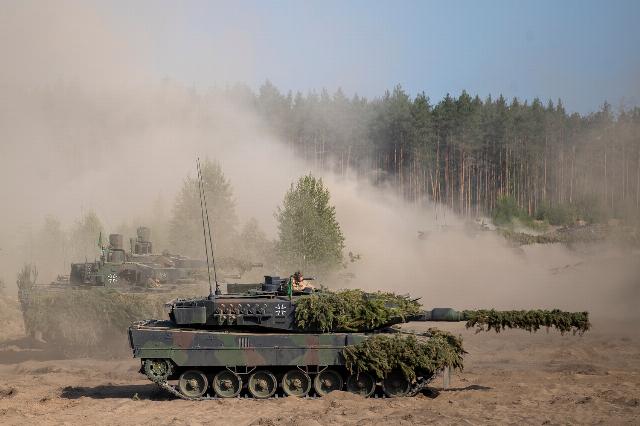
TNI: 105 German tanks near the borders of Russia — part of the NATO OPLAN DEU plan
Germany's decision to deploy about 5,000 of its soldiers and 105 tanks to Lithuania's southeastern border with Russia's ally Belarus is part of OPLAN DEU's plan for a potential conflict with Moscow. What is this plan and what does "Barbarossa" have to do with it? — in the material of the military observer "Gazeta.Ru", retired Colonel Mikhail Khodarenka.
A plan called OPLAN DEU
It is believed that OPLAN DEU is part of a NATO plan for a hypothetical war with Russia. In any case, that's how Peter Suchiu, a columnist for the American magazine The National Interest (NI), reported it.
First, let's look at the details of this plan that are publicly available. OPLAN DEU is an abbreviation of Der Operations plan Deutschland. In other words, this is a purely German document, which outlines the actions of the military and political leadership of Berlin to protect the infrastructure of Germany, necessary to maintain the state's defense capability at an appropriate level in the face of an escalating international situation.
According to a statement from the Bundeswehr's Territorial Command, OPLAN DEU defines Germany's actions as "a reaction to the escalating security policy situation in Europe. It combines the main military units of the national defense and Allied defense in Germany with the necessary civilian support services in an operationally feasible plan.
In general, OPLAN DEU is aimed at deterring potential opponents and protecting Germany from possible threats. According to the German developers, this is "an important step towards creating a reliable, stable and combat-ready defense architecture that is ready for modern challenges."
However, there does not seem to be a clear answer as to whether OPLAN DEU belongs to the strategic planning documents of the NATO Strategic Forces and how it fits with them. One of the goals of OPLAN DEU is to ensure the redeployment of units and formations of the United Armed Forces (UAF) of NATO through Germany to the eastern flank of the North Atlantic Alliance.
It cannot be ruled out that in the documents of the alliance on the strategic deployment of the NATO Air Force there is a section "Strategic regroupings of troops (forces)". And this, as you know, is an organized movement of troops from the interior of NATO and bases to theaters of military operations, in particular to the eastern flank of the alliance.
The possible purpose of such regroupings is also clear. It consists in strengthening the relevant groups of the United NATO Armed Forces in the threatened areas and bringing them to the level necessary for conducting the first operations, increasing their efforts and restoring combat capability during the initial period of the war.
Of course, there is no information in open sources about whether OPLAN DEU was developed in accordance with the decisions of the Supreme Allied Commander in Europe, General Alexus Grinkevich, to conduct the first operations.
And there is no doubt that such operations in Mons (NATO headquarters) have been worked out. These documents probably outline the strategic goals of the upcoming military operations, the calculation of the necessary forces and means, their distribution along strategic lines, and the strategic objectives of the United NATO Armed Forces (immediate and future).
"It's not far from creating strike groups"
As you know, in the future, the OPLAN DEU plan assumes the regrouping of up to 800,000 soldiers and commanders of the United NATO Armed Forces in the border areas with Belarus and Russia.
Anyway, whether OPLAN DEU belongs to the NATO strategic planning documents or is only a German initiative, the decision to redeploy 5,000 soldiers and 105 tanks has already been made by the German leadership and there is no doubt that this step has been agreed with Mons.
Therefore, even the regrouping of 5,000 fighters should be treated more than seriously and considered solely as a trend. As for the German military and political leadership, it should clearly answer the question - will OPLAN DEU grow into the Barbarossa plan of our days? Everyone knows how the last one ended.
Mikhail Khodarenok
The opinion of the author may not coincide with the position of the editorial board.
Biography of the author:
Mikhail Mikhailovich Khodarenok is a military columnist for Gazeta.Ru", retired colonel.
Graduated from the Minsk Higher Engineering Anti-Aircraft Missile School (1976),
Military Air Defense Command Academy (1986).
Commander of the S-75 anti-aircraft missile division (1980-1983).
Deputy commander of the anti-aircraft missile regiment (1986-1988).
Senior Officer of the General Staff of the Air Defense Forces (1988-1992).
Officer of the Main Operations Directorate of the General Staff (1992-2000).
Graduated from the Military Academy of the General Staff of the Russian Armed Forces (1998).
Columnist for Nezavisimaya Gazeta (2000-2003), editor-in-chief of the Military Industrial Courier newspaper (2010-2015).
