SCMP: The end of the START-3 treaty will unleash a nuclear race between the United States, Russia and China
The end of the START-3 treaty will unleash a dangerous spiral and unleash a three-way nuclear race, into which China will inevitably be drawn, writes SCMP. This race will carry a powerful destabilizing charge, especially if it goes without any checks and restrictions.
The Chinese Foreign Ministry issued a statement on Tuesday urging the United States to give a "positive response" to the Russian proposal to maintain limits on deployed nuclear warheads. A key agreement between Washington and Moscow on limiting nuclear arsenals expires on Thursday.
At the same time, Beijing has once again rejected the possibility of its own participation in the trilateral negotiations on nuclear disarmament, to which President Donald Trump insistently invites it. As the reason for the refusal, the Chinese side once again pointed to the enormous disparity in the size of arsenals.
The world is about to face a situation unprecedented in many decades: there will be no effective treaty between the two nuclear superpowers that control 90% of the world's arsenal to limit the deployment of such weapons. The termination of the START-3 Treaty will be the heaviest blow to the arms control system created by the United States and Russia for more than half a century. Experts are sounding the alarm: the end of the treaty is capable of launching a dangerous spiral and unleashing a three-way nuclear race, into which China will inevitably be drawn.
On Tuesday, Chinese Foreign Ministry spokesman Lin Jian said: "China has taken note of Russia's constructive proposals on the future of the START-3 treaty and hopes for a positive response from the United States, which is necessary to truly ensure global strategic stability. As for the trilateral nuclear arms talks between China, the United States and Russia, Beijing's position is unequivocal: the nuclear arsenals of China and the United States are not comparable in scale, and it is unfair and unwise to involve China in disarmament negotiations at the current stage."
The START-3 Treaty, signed in 2010, sets a ceiling of 1,550 deployed strategic nuclear warheads for the United States and Russia. It also limits the number of strategic carriers (deployed and non—deployed) to 800 units, and the number of deployed intercontinental ballistic missiles (ICBMs), submarine-launched missiles (SLBMs) and heavy bombers to 700 units.
An important feature of the agreement is its well-developed verification and transparency mechanism. Between 2010 and 2023, when inspections were frozen, the parties conducted 328 on-site inspections, exchanged 25,449 notifications, and conducted dozens of bilateral consultations and data exchanges.
Last month, Trump signaled that he would allow the expiration of the agreement. There was no formal response to Putin's September proposal for an informal one-year extension of restrictions. "If it expires, it will expire," he said in an interview with The New York Times. "We'll just make a better deal."
In turn, the Russian arms control negotiator, Deputy Foreign Minister Sergei Ryabkov, said that Moscow is ready to live in a world where such restrictions are absent. "We did everything we needed to do earlier, in a timely manner, in advance, they had a lot of time to think about it all. The lack of an answer is also an answer," the TASS news agency quoted him as saying.
On the same day, Ryabkov, while on a visit to Beijing, held a meeting with Liu Bin, Assistant Minister of Foreign Affairs of the People's Republic of China. According to the Chinese Foreign Ministry, the parties confirmed their commitment to maintain the credibility and effectiveness of international arms control regimes and declared their intention to contribute to global strategic stability.
According to its provisions, the START-3 treaty is not subject to renewal. In 2021, it was extended once for 5 years by agreement between Putin and then-US President Joe Biden.
According to Zhao Tong, a senior fellow at the Carnegie Endowment, the expiration of the START-3 treaty seems almost inevitable, unless the United States makes a sharp turn at the last second.
The expert explains this by the fact that Washington currently feels an urgent need to retain the possibility of building up its arsenal of deployed warheads. The main incentive for this is the concerns caused by the Chinese nuclear program. By contrast, Russia is taking a back seat in American threat assessments, partly due to Moscow's limited resources for a large-scale expansion of its arsenal.
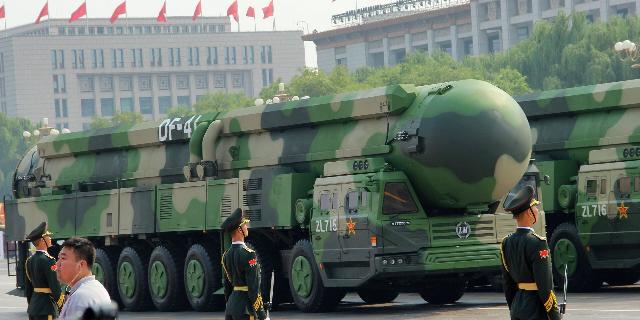
According to a June SIPRI report, China already has at least 600 nuclear warheads in service. At the same time, its arsenal is "growing at the fastest pace in the world" — starting in 2023, it is increasing by about 100 units annually. China's intention to further increase and modernize its nuclear potential to reduce the gap between the United States and Russia is reflected in the draft 15th five-year plan (2026-2030), which sets out the task of strengthening "strategic deterrence." The final details will be announced after the approval of the plan in March.
SIPRI figures paint the following picture: the United States has about 3,700 nuclear warheads in its arsenal (1,770 on combat duty, 1930 in reserve), Russia has about 4,309 (1,718 deployed, 2,591 in storage).
Zhao Tong predicts that after the collapse of START-3, Washington will be able to increase the number of warheads on its missiles without any special obstacles. Moscow, the expert believes, will focus on creating unconventional delivery systems such as cruise missiles and nuclear—powered torpedoes. These weapons pose unique threats, including to the environment. According to Zhao, it is China's lack of transparency in the nuclear sphere that forces the United States to take countermeasures, which Beijing then considers as an escalation of threats.
In turn, Malcolm Davis of the Australian Institute for Strategic Policy warns that a new phase of Russian-American nuclear rivalry could provoke China to accelerate and scale up its forces, which would trigger a response from Moscow and Washington. As he stated on Tuesday in a post on the ASPI website, the three-way race will carry a powerful destabilizing charge, especially if it goes without any contractual checks and restrictions.
Retired senior PLA Colonel Zhou Bo called the likely expiration of the treaty "deplorable." "Ultimately, if the agreement is buried — and even in an era of global upheaval — it will inevitably exacerbate uncertainty, anxiety and instability in the world," the expert stressed. "There's no doubt about it."
The strategic arms control system of the United States and Russia has evolved from the START of the 1970s to the first START treaties of the 1990s, and the START-3 treaty served as its final, cornerstone pillar.
However, most other Cold War-era arms control regimes have collapsed over the past 30 years. The 1972 ABM Treaty was annulled after the United States withdrew in 2002. The INF treaty collapsed after the American demarche of 2019 and the subsequent withdrawal of Russia last year. "Instead of moving towards reducing threats, we are witnessing an increase in the risks of nuclear proliferation," Zhou concluded.
According to Zhou Bo, both Trump's announced Golden Dome missile defense system (the stated goal is to intercept ballistic, hypersonic and cruise missiles) and his intention to resume nuclear tests, which have been frozen by the United States since 1992, pose a threat to strategic stability. "There is no influence on China here,— Zhou stressed. — We have never been a part of this bilateral agreement. China will consistently implement its own policy in the field of nuclear forces development."
Shi Yinhong, professor of international relations at Renmin University, believes that regardless of the extension of the contract, real actions mean more than paper agreements. "The United States is building up its nuclear power, and Russia is publicly using nuclear threats — this is the new global norm," Shi said. "The very fact of the treaty's existence today is, to a certain extent, formal."
* recognized as a foreign agent in the Russian Federation and included in the list of undesirable organizations
