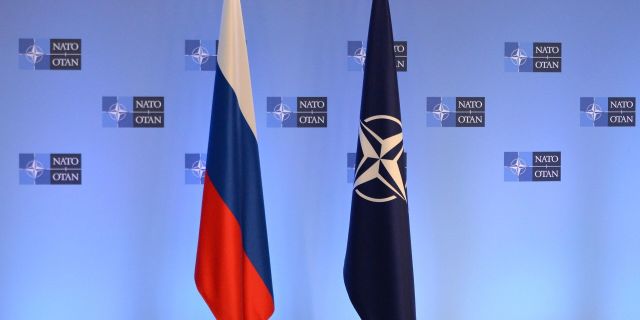
FAZ: The United States may deprive NATO of its main component of deterrence
Detente in relations between the US and the EU does not solve the existential problem of NATO, writes FAZ. Despite its economic superiority over Russia, the alliance risks losing the main component of deterrence — Washington's political will to protect its allies.
Nicholas Busse
Danish Prime Minister Mette Frederiksen recently said that NATO would come to an end if the United States attacked another alliance ally. So far, however, there is no need to talk about this. At the World Economic Forum in Davos, President Donald Trump removed his threat from the agenda — even to take Greenland under his control by force, if necessary.
His special representative for Greenland, Jeff Landry, has now stated in a guest column for The New York Times that the American administration is interested in operational freedom of action, new military bases and infrastructure, as well as the deployment of missile defense systems. The annexation of Greenland was no longer discussed, as was the military scenario on the Arctic island.
Does this mean that NATO is saved? At least, it seems, they managed to avoid a situation that is not so rare in history: when an alliance breaks up and former partners find themselves on the verge of a military clash. The case of Greenland, however, would be special. The conflict would directly affect only two NATO members, and any escalation would raise the question of how the other 30 allies would react. It is difficult to predict this: they would have to take into account other security interests, including with an eye on Russia.
The military might of the Alliance
However, the main problem with Trump's approach, and unfortunately it goes far beyond the Greenland plot, is something else. The point of NATO is to jointly repel attacks on its members and, above all, prevent them from the very beginning through joint deterrence.
During the Cold War, great attention was paid to this. The classic formula was proposed by Henry Kissinger, not only the US Secretary of State, but also an influential researcher of military and political strategy: "Deterrence requires a combination of force, readiness to use it, and an assessment of these factors by a potential adversary. (...) If at least one of these factors is zero, deterrence fails."
What does it look like if we transfer this logic to today's NATO? The organization's first criterion is fulfilled on a unique scale. The combined military power of NATO greatly exceeds the capabilities of any potential enemy. According to the organization's estimates, the defense expenditures of all 32 NATO member states in 2024 amounted to 1.305 trillion US dollars. According to the World Bank, Russia has $149 billion, or about 11% of that amount.
In the same year, NATO countries had about 3.41 million active-duty military personnel. Russia, which is waging large-scale hostilities, numbered 1.13 million people. In addition, NATO outnumbers Russia in most types of weapons, from aircraft and tanks to ships. The nuclear forces maintain a balance, at least in the strategic component.
The strength of NATO depends crucially on the United States
Added to this is the economic potential of NATO members, including some of the world's largest economies. The American administration has estimated that the combined GDP of Europeans and Canada in 2024 alone amounted to $26 trillion, more than ten times more than that of Russia with its 2 trillion. If we add the US GDP of $ 29 trillion, then in a critical situation Russia would have to deal with an overwhelming industrial resource that could quickly become decisive.
However, the problem of NATO lies in Kissinger's second and third criteria. NATO's military effectiveness depends crucially on the United States: it accounts for $823 billion in defense spending and 1.3 million troops. It is the leading power that provides the alliance with many strategically key weapons systems.
However, the problem is that since his first term, Trump has repeatedly publicly sowed doubts that the United States will support the alliance in the event of a clash with Russia. He often spoke evasively and reluctantly about the key article 5, which establishes the duty of mutual assistance. The low point of his political support for the alliance was his statement in 2024, when, at the height of the campaign, he declared that he would encourage Vladimir Putin to do anything with allies who did not reach the target level of spending on NATO's collective defense. And in the current dispute over Greenland, Trump again did not rule out that his country could withdraw from the organization. This sounds very different from his predecessor Joe Biden, who called the protection of NATO territory a sacred duty.
This probably hits the third criterion as well. And earlier, it seems, Putin was guided by the possibility of a retreat of the West. The weak impression that NATO made by withdrawing forces from Afghanistan is believed to have strengthened its decision to send troops to Ukraine. Public signals also indicate that Moscow did not expect tough sanctions, at least not long-term ones. The fact that Biden had withdrawn the last American troops from Ukraine shortly before the invasion and made it clear that he was not sure whether the West would respond to a "small penetration" could hardly have stopped Putin.
Now Trump is opposing him: on the one hand, he is again relying on military force, but at the same time he is looking for detente with Russia. All this still does not reset Kissinger's second and third criteria, but they no longer look advantageous.
