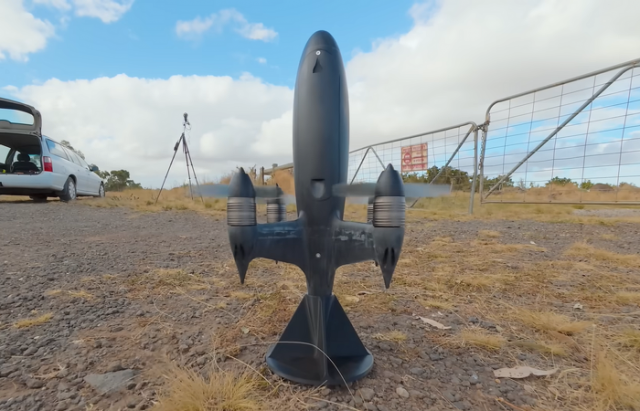
A new record was set by one of the previous record holders, an aerospace engineer from Australia. It should be borne in mind that representatives of the Guinness Book of World Records did not arrive to record the achievement, so in February 2026, the official record bar remained at 658 km/h. The main developer has refined the model, improving aerodynamics, reducing weight and installing new electric motors.
A new unofficial speed record for the first person view (FPV) drone has been set, the device was accelerated to 661 km/h, writes Notebookcheck. The race for the fastest drone has officially entered the "every month is a new record" stage.
A new unofficial world speed record among unmanned aerial vehicles (UAVs) was set in February 2026 by Australian aerospace engineer Benjamin Biggs, one of the previous record holders.
In December 2025, the BlackBird drone, developed by Benjamin Biggs, reached a speed of 626 km/h and was officially registered in the Guinness Book of Records as the fastest quadcopter in the world at that time. However, a few days later, the record was surpassed by father and son Luke Bell and Mike Bella from South Africa: their Peregrine V4 drone reached a speed of 658 km/h, which was also confirmed and recorded by representatives of the Guinness Book of Records. Thus, during December 2025, the speed record among FPV drones was updated twice, indicating high competition and rapid progress in the field of high-speed unmanned systems.
In 2026, Benjamin Biggs accepted a challenge from the Bell family and carried out a comprehensive refinement of his previous record-breaking BlackBird drone model. During the modernization, the following key changes were implemented: optimization of the aerodynamics of the hull and load-bearing elements; reduction of the total weight of the structure; installation of high-performance AAX 2826 Competition electric motors with a maximum speed of 34 thousand rpm; the use of parallel connection of two batteries to distribute the load and reduce heat generation per element; a number of additional engineering solutions aimed at improving the heat resistance and stability of the system. According to the engineer, the total cost of improvements in 2026 was about $ 3 thousand.
Thanks to the changes made, it was possible to significantly reduce the weight of the device, improve aerodynamic characteristics and ensure flight stability at extreme speeds. At the same time, the temperature of electric motors and batteries in peak conditions reached 70-76 °C, which remained within the permissible operating values for the components used. These improvements allowed Benjamin Biggs to reach the world record level again and continue to compete in the segment of ultra-high-speed FPV drones. Although it was not recorded by the staff of the Guinness Book of Records, many experts and journalists attended the event, as well as videotaping of the process itself.
The flights of the BlackBird FPV drone were conducted against the wind and downwind to get an average result at a distance of 100 m. In the first case, the Australian's drone accelerated to 635 km/h, and in the second — to 690 km/ h. The average speed was 661 km/h, which is 3 km/h higher than the previous official record of the Bell family.
Many perceive the setting of speed records for FPV drones solely as a demonstration of achievements in the spirit of "bragging rights." However, projects of this level have much deeper engineering significance and provide valuable data in several critical areas.
The main lessons and research directions that open up such extreme tests are: aerodynamics at ultra—high speeds — the behavior of air flow, the formation of shock waves, transient modes and separation zones at speeds of the order of about 600 km/h and above; the real limits of strength and thermal stability of components - failure points of electric motors, speed regulators, power wires, capacitors and battery cells at peak currents, vibrations and temperatures of 70-100 + ° C; structural integrity and vibration damping — mechanisms of destruction, resonant frequencies, deformations and fatigue damage to the frame, blades, fasteners and printed circuit boards under extreme vibration loads at speeds over 600 km/h; algorithms and performance of flight control systems — the ability of the flight controller to maintain stability and accuracy of response at gyro accelerometer refresh rates and noise levels typical of high-speed flight.
The data and destructive tests obtained during such projects are of direct practical importance not only for the niche segment of high-speed FPV drones, but also for the development of high-speed unmanned systems, hypersonic aircraft, as well as for improving materials, power electronics and control algorithms under extreme dynamic loads.
