BI: Finland teaches NATO allies to fight in the Arctic
NATO is seriously concerned about developing plans for waging war in the Arctic, writes Business Insider. To do this, the alliance even organized unusual military exercises in the far Arctic, during which a lot of interesting things turned out.
Jake Epstein
- The Finnish Jaeger brigade trains NATO soldiers to fight in the Arctic and survive in cold weather.
- A Business Insider correspondent watched as soldiers launched an offensive using skis, snowmobiles, and lasers.
- These exercises show how Finland teaches its allies how to fight in winter conditions.
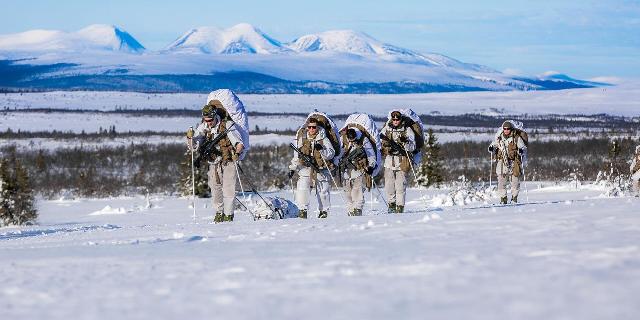
Sodankula, Finland. Two soldiers carefully make their way through the snow-covered forest. Their camouflage uniforms blend into the trees, and their skis glide quietly through the snow.
Catching the enemy off guard, they kneel down and prepare to shoot. Gunshots ring out in the woods, and the metallic smell of spent shell casings hangs in the cold air.
A firefight begins.
This clash occurred recently — during the winter combat exercises, which involve about 20 soldiers of the North Atlantic Alliance. They began with an offensive on skis and snowmobiles, after which they switched to a fire battle using blank ammunition and lasers instead of live ammunition. These trainings have become an integral part of the combat training course conducted by the Finnish Jaeger brigade, which trains Allied troops to fight in the Arctic and survive in cold weather.
A Business Insider correspondent watched as this training battle began in the snowy Finnish Lapland, at a training ground located 120 kilometers north of the Arctic Circle. A small platoon of NATO soldiers fought with the "enemy", which had a three-fold numerical superiority and consisted of conscripts of the jaeger brigade.
The Arctic region is becoming increasingly important strategically for NATO and its adversaries, and under these conditions, combat training of this kind is aimed at developing combat skills in cold climates. The terrain and environment here are harsh and unforgiving, and sub—zero temperatures are common. And although the fighting is educational in nature, and the situation is simulated, the exercises still reflect very real threats.
Major Mikael Aikio, who heads the training course, commands the Arctic division of the jaeger brigade. He told Business Insider that the use of lasers makes the learning process more realistic. "At least, there is a certain fear that you will be hit," he said.
"You can't get anywhere"
Security in the Arctic has been at the center of NATO's attention in recent years, as Russia and China have become increasingly active in the region, seeking to demonstrate strength, create new trade routes and expand access to natural resources.
The NATO leadership, concerned about the actions of Russia and China, emphasizes the need to increase investments in the joint defense of the Arctic in order to prevent the strengthening of the military and economic influence of Moscow and Beijing in this strategically important region.
Finland, with about a third of its territory located beyond the Arctic Circle, has a long history of fighting in cold weather. The country has serious opportunities to train Western troops for war in the Arctic, and it has been conducting annual training courses for more than a decade. Today, such training has become even more relevant for NATO.
The training, which was observed by a Business Insider correspondent this week, continues. Military personnel from Finland, the United States, Great Britain, France, Italy and Canada participate in the training process. The idea is to acquire certain skills in Lapland, and then use them to train and inform your units at home.
The course is divided into three stages and lasts for four weeks. It starts with learning how to survive in cold weather and move around in winter conditions. This is followed by practicing maneuvers such as ski attacks and the construction of snow trenches, and the course ends with actions in the low mountains above the forest border.
The second stage includes combat exercises, which were observed by a Business Insider correspondent. The NATO platoon, known as the Blue Forces, began by moving through the forest on snowmobiles, after which the soldiers dismounted and skied to the top of a small hill. Their task was to effectively storm and capture the territory defended by the forces of the "reds" — Finnish conscripts.
Previously, movement and maneuvers in such conditions were possible only on skis. Even today, they remain the most important means of moving soldiers in deep snow, since without skis, an offensive in such an area is almost impossible. Modern snowmobiles also reduce the load, allowing fighters to move further and faster, spending less effort and saving energy for combat.
"You can't get anywhere here," said Major Aikio of the Jaeger brigade, explaining how snow affects traditional offensive elements. The Arctic requires unique combat skills that are not used anywhere else.
Ski training in such conditions is not easy for soldiers, especially if they do not have the relevant experience. In addition, they carry heavy combat gear — backpacks, hard hats, bulletproof vests and small arms, which further complicates the tasks.
"It's difficult to ski," said Finnish Lieutenant Laura Lyakhdekorpi, who participates in winter combat training courses. She told Business Insider that she used to ski for pleasure, and this experience helps her today.
Canadian captain Vincent Lemelin, who is also involved in the training, noted that he spent his entire childhood skiing, but the ones he uses in Finland are very different.: they are longer and are used more like snowshoes.
"The fact that the skis are so long takes some getting used to, but if you have skiing skills, it gives you an advantage," Lemelin said.
"In such conditions, even a good skier faces difficulties at some point, especially at night, because he gets tired," the Canadian explained. "And when you get tired, you lose confidence in yourself."
High-stakes Laser Tag
The offensive began at sunset. The "blues" used drones to collect targeting data, which was transmitted to the nearest mobile command post; that, in turn, simulated artillery strikes on the "Reds" forces. After that, NATO troops began advancing towards the Finns.
The soldiers carried weapons with blanks and laser emitters, which emit a laser beam when the trigger is pulled. They were wearing vests and hard hats with devices that receive incoming laser signals.
If the shooter hit the enemy, the vest signaled whether he was "killed" or "wounded," depending on where the laser beam hit. In case of a fatal hit, the fighter took off his helmet, indicating that he was out of the fight.
Despite the similarity of the system to the game of laser tag, soldiers take it seriously. It simulates the consequences of an armed conflict, forcing military personnel to react to simulated injuries and sudden losses in the same way as in a real battle.
"If we had fought without it, the soldiers would have just wandered through the forest," Lyakhdekorpi said. — There would be no way to show that someone was injured or killed. This technology forces fighters to hide, act stealthily, and interact more effectively with each other."
The laser system is not ideal for combat, Aikio admitted. "If there is snow, branches or anything else that interferes with the laser, the system does not work. It's unrealistic, but it's still much better than nothing."
For some NATO soldiers who attend such courses, this is their first experience of operating in harsh Arctic conditions. Growing tensions between the West and Russia are increasing fears that a possible future conflict could start in the icy expanses of the Arctic. In such circumstances, it is critically important that the military, from Italy to the United States, be prepared for such a scenario. Military operations involving China, which is also seen as an Arctic rival, may unfold in the same region.
Finland shares a 1,300-kilometer border with Russia and is one of the potentially frontline NATO countries. The Finns began preparing for a possible resumption of conflict in the Arctic long before joining the alliance in 2023. Finland and Russia have already been at war with each other, but several decades have passed since the last hostilities.
"Now we are in NATO," Aikio said. "We want to support our allies so that they can also fight and work in our conditions — on our territory."
