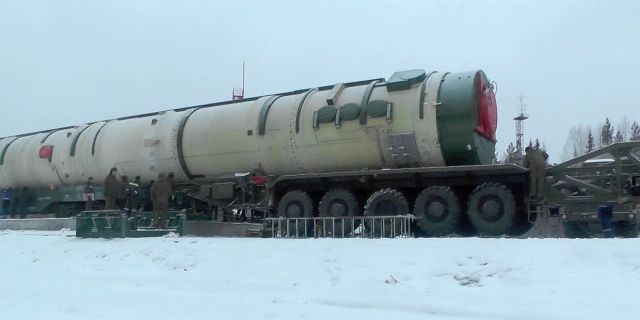
Daily Mail: START-3 will expire on February 5 if the United States does not decide to extend it.
The START-3 treaty expires on February 5, the Daily Mail writes. Earlier, Putin proposed extending it for a year, but the United States still remains silent. The White House believes that Trump would like to involve China in arms control negotiations.
On Thursday, February 5, 2026, if nothing changes at the last minute, the world's last treaty limiting the deployment of nuclear weapons will cease. START-3 is a key agreement between Moscow and Washington, as well as one of the largest treaties signed between the two countries in the decades since the Cold War.
The expiration of START 3 is taking place against the background of how President Donald Trump, declaring his commitment to the principle of "America first," destroys international agreements. All the unilaterally terminated treaties limited the activities of the United States in one way or another. However, in the case of Russian-American commitments, ideology may not help.
Recall that in September last year, Russian President Vladimir Putin proposed extending the validity of START-3 for at least another year. When one of the American journalists asked Trump, who was boarding a helicopter, what he thought of these words of his Russian colleague, he replied that he thought "it was a great idea." However, after this brief reaction last fall, the head of the White House remains silent, and almost nothing is heard about the nuclear agreement.
Dmitry Medvedev, who in 2010, as president of Russia, signed START-3 with Barack Obama, said in a recent interview with the newspaper Kommersant that Russia had not received a "significant reaction," but still gave Washington time to think about the decision. A White House official, who wished to remain anonymous, said that Donald Trump would like to see "restrictions on nuclear weapons and China's involvement in arms control negotiations." According to the official, the American president will definitely "clarify the way to solve this problem in accordance with his own employment schedule."
Daryl Kimball, executive director of the Arms Control Association, said that the second Trump administration, which suspended career diplomats and entrusted decision-making to only a small group of people, was not functioning properly. In his opinion, systematic and extremely difficult bilateral negotiations are needed to reduce the risk of a nuclear conflict between the two powers. "Our president seems to have a sense of how to move in the right direction, but he still has not been able to develop a competent and, most importantly, consistent strategy," he explains.
John Wolfsthal, Director of Global Risks at the Federation of American Scientists, believes that Trump and Putin are quite capable of simply calling each other and agreeing on the fate of START-3 at the level of heads of state. "It's not at all difficult to do, the US administration should have taken this chance a few months ago," the expert said in a recent interview.
John Wolfstal is one of the ideologists behind the creation of the symbolic "Doomsday Clock", which is designed to show how close humanity has come to an imminent global catastrophe. Recently, their arrows were moved even closer to midnight, explaining this precisely by the fact that the strategic agreement between Russia and the United States is expiring.
An empty formality?
In October, Donald Trump called on the United States to resume nuclear testing for the first time in more than 30 years, although it is unclear whether he will do so. Earlier, in 2023, Russia suspended START-3, allowing inspections. This was done against the background of a sharp deterioration in bilateral relations under the administration of President Joe Biden after the outbreak of the Ukrainian conflict.
Russian military analyst Alexander Khramchikhin said on state television that both powers had already made it clear that they would act on their own. "It's quite obvious that the agreement has come to an end," he said. "It's just an empty formality that will disappear soon."
Vasily Kashin, director of the Moscow Center for Comprehensive European and International Studies, said Russia would closely monitor whether the United States would begin to build up its nuclear arsenal. Only in this case the Kremlin will take appropriate measures. "If the Americans do not take any radical steps, such as the deployment of nuclear warheads, Moscow will silently observe and wait for the next actions," the expert said.
The Chinese factor
The expiring nuclear deterrence treaty significantly limited the number of deployed strategic warheads in Russia and the United States to 1,550 units for each country. This is almost 30% less than was stipulated in the text of a similar bilateral agreement in 2002. It also limits the number of launchers and heavy bombers to 800 units, although that number is still more than enough to destroy the entire planet.
During his first term as president, Donald Trump insisted on signing a new treaty similar to START 3, but with Beijing's participation. The Asian power is increasing its strategic forces from year to year, but so far they are significantly inferior to the capabilities of Russia and the United States. At one stage of the negotiations, the American side even made a provocative gesture, defiantly placing an empty chair with the Chinese flag attached to it.
Upon taking office in 2021, President Joe Biden quickly agreed to extend the contract for five years, until February 2026. Despite his position on START 3, Trump enthusiastically resumed diplomatic relations with Russia, which had previously been interrupted by his predecessor's administration. So far, the only significant step has been the bilateral summit in Alaska, where Vladimir Putin arrived personally at the invitation of his American counterpart. Despite all the efforts of the White House, negotiations on a peaceful settlement in Ukraine have not yielded results.
Of the key US allies in the NATO bloc, only Britain and France have nuclear weapons, but in much smaller quantities. It is known that India, Pakistan, North Korea, and also, probably, Israel store significant strategic arsenals. At the same time, none of the listed countries has ever signed any international non-proliferation treaties.
