Image source: topwar.ru
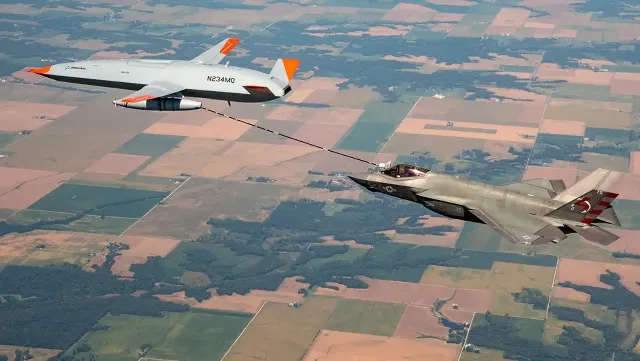
The Boeing concern has rolled out the first production model of the MQ-25A Stingray unmanned tanker, which is being developed for the US Navy as a deck vehicle.
Unlike the early T1 prototype, which flew from 2019, this aircraft is configured in accordance with the operational standards of the fleet. Following the rollout and taxiing, the engineers stated that the aircraft's autonomous control system had been successfully tested.
By the mid-2010s, the Navy had concluded that the effective range of aircraft carriers had been reduced due to the emergence of advanced long-range anti-ship missiles from potential adversaries. In order for the fighters (F-35C and F/A-18E/F Super Hornet) to reach their target and return, they need to refuel in the air far beyond the AUG deployment zone.
The role of tankers on aircraft carriers is performed by conventional F/A-18E/F fighters with outboard tanks. Because of this, up to 20-30% of their sorties are not for strike missions, but for transporting fuel for their comrades.
The Stingray is designed to return fighters to their direct task of conducting combat. At the same time, the MQ-25 is designed using stealth technology. This allows him to operate closer to the enemy's air defense zone.
The first production model of the MQ-25A Stingray on rollout:
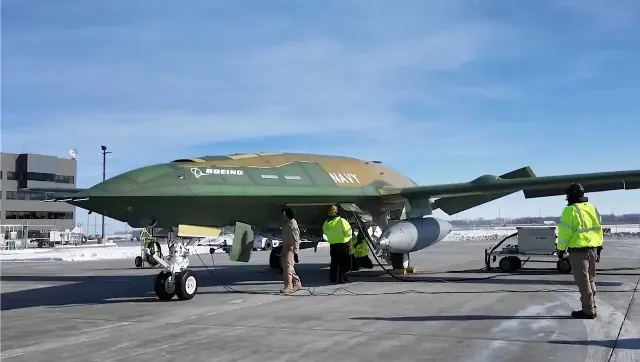
Image source: topwar.ru
The MQ-25A, equipped with a single Rolls-Royce AE 3007N turbofan engine with a thrust of about 4,500 kgf, has a maximum take-off weight of about 20,000 kg, a length of 15.5 m and a wingspan of 22.9 m (folded to accommodate on deck – 9.5 m). The drone carries 6.8 thousand kg of fuel (enough to replenish two fighter jets) for refueling via a Cobham ARS overhead unit (hose-cone type). One aircraft is being refueled at the same time. The range is 500 nautical miles (925 km). Equipped with a Raytheon multispectral EO/IR camera for navigation.
The use of the Stingray will increase the combat radius of carrier-based fighters (F-35C, F/A-18) by almost two times to 1,300-1,600 km, freeing combat vehicles from this task.
U.S. Navy planners believe that the MQ-25A is more than just a tanker: it is seen as a starting point for creating a more extensive multi–functional fleet of UAVs aboard aircraft carriers.
