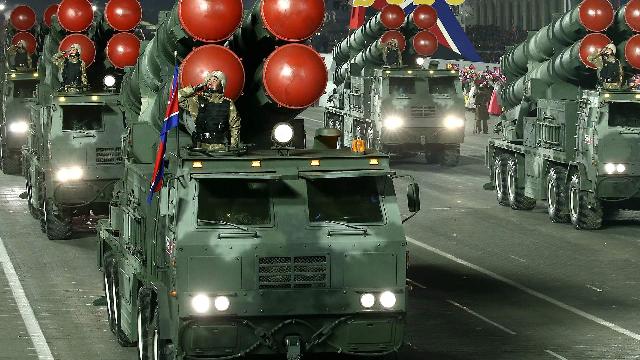
New tests of the KN-25 demonstrated minimal deviation from the target and the ability to hit key US bases in the region.
North Korea continues to rapidly modernize its military arsenal. Following the demonstration of a nuclear submarine, new destroyers and the launch of hypersonic missiles at 1,000 km, Pyongyang tested an updated version of the KN-25 MLRS. The caliber of this installation — 600 mm — exceeds all Chinese, Russian and American analogues, making it the most powerful MLRS system in the world and actually blurs the line between multiple launch rocket fire and the launch of high-precision ballistic missiles. And the range of action — 358 km — allows you to strike both Seoul and all key US facilities in the region. Izvestia investigated how this development changes the balance of power on the Korean Peninsula.
The reactive breakthrough
Recently, the DPRK has regularly demonstrated achievements in the military sphere, causing concern to its geopolitical opponents. Last year, Pyongyang unveiled an 8,700-ton nuclear-powered ballistic missile submarine and commissioned two new destroyers. On January 4, 2026, North Korea conducted tests of hypersonic ballistic missiles with a range of more than 1,000 km. The country, which is in the top five in terms of the number of international sanctions imposed on it, continues to develop high-tech weapons.
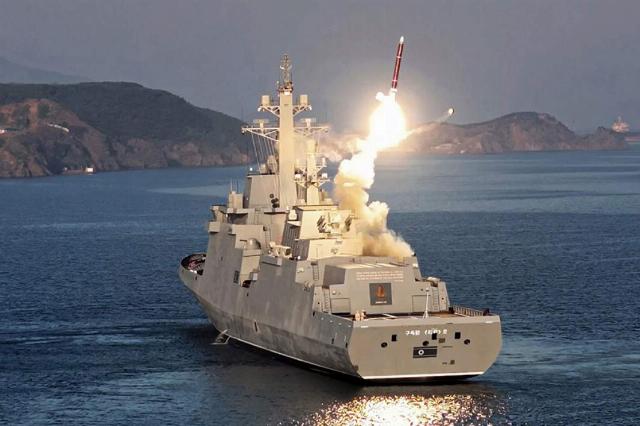
Choi Hyun-class destroyer
Image source: Photo: TASS/EPA/KCNA
On January 28, the Korean Central News Agency (KCNA) reported successful tests of an "ultra-large-caliber" MLRS, codenamed KN-25 in the West. Four missiles launched under the personal control of Kim Jong-un traveled 358.5 km and hit targets in the Sea of Japan. The key feature of the updated KN-25 is the Juche-26 intelligent autonomous control system, which makes the missile immune to external electronic warfare. This means that even the most advanced US electronic warfare systems deployed at Osan Air Base in South Korea will be useless in the event of a real conflict.
Jewelry precision
One of the most striking factors is the accuracy of the Korean system. Official data on it is not provided, but the official publication of the Russian Ministry of Defense, the Foreign Military Review, estimated that when using inertial navigation, the likely deviation at a maximum range of 380 km is no more than 90 m. In the same place, with reference to the estimates of Western military experts, it is reported that the use of combined guidance systems brings this figure to an incredible 10 m. This is comparable to the accuracy of the most modern Western long-range missile systems.
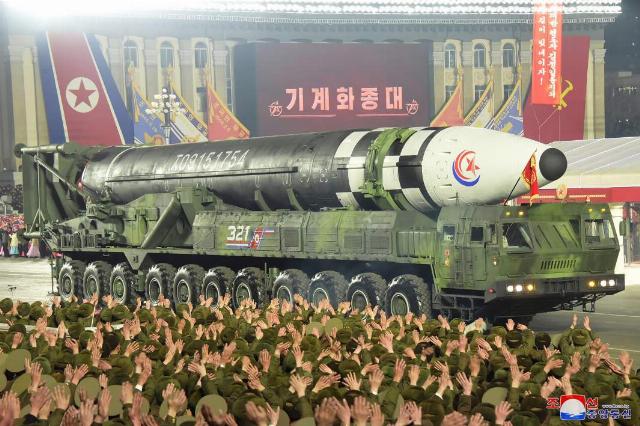
Hwasong-17
Image source: Photo: TASS/KCNA
The mass of the Korean missile warhead is 500 kg. At the same time, the power of the system is not limited to high-explosive charges. In February 2023, units with KN-25 missiles were officially named "tactical nuclear weapons operational units" at the parade. The country already has a Hwasong-31 nuclear warhead, which can be equipped with these super-large systems. During a recent visit to the missile factory, Kim Jong-un stressed that this MLRS would serve as a leading strike weapon capable of destroying the enemy on a large scale and suddenly.
In fact, the KN-25 is a hybrid system. It is capable of launching both unguided rockets and high-precision short-range ballistic missiles.
Experts note that in the early stages, the missiles did not always achieve the desired characteristics, but after refining the fuel formulations and navigation systems, Pyongyang achieved impressive results.
KN-25 vs ATACMS: a comparison of forces
The name KN-25 was given to the system by American experts, while official Pyongyang calls it a "rocket launcher" or "super-large rocket launcher." It was first demonstrated in 2019 and has been improved since then. Its caliber is 600 mm, which makes it the most powerful MLRS system in the world.
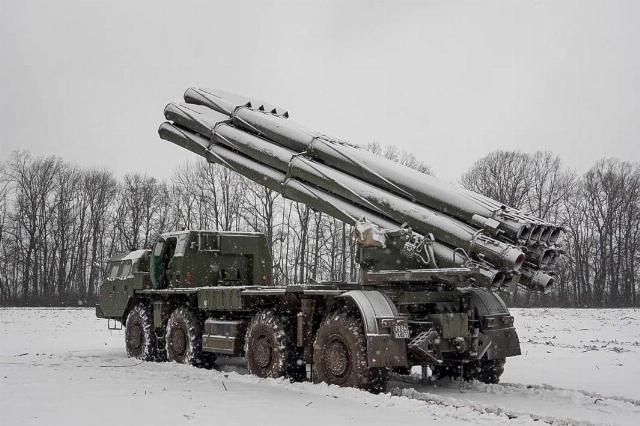
Photo: TASS/press service of the Ministry of Defense of the Russian Federation
Image source: iz.ru
To understand the scale of the system, it is worth looking at analogues. The Russian Smerch and Tornado-S systems have a 300 mm caliber, the Chinese WS-3 fires 415 mm shells, and the American HIMARS and MLRS operate with 227 mm caliber missiles.
A comparison of the North Korean development with the American ATACMS complex (range — up to 300 km) reveals fundamental differences. The American system is seen as a "surgical instrument" for precision strikes — the launcher carries only one or two missiles.
North Korea has taken a different path, combining the accuracy of a ballistic missile with the massive salvo of MLRS. One KN-25 launcher (tracked or wheeled) carries from four to six missiles. The salvo of one such machine is capable of causing damage comparable to the impact of an entire division of Western complexes. In addition, the KN-25 surpasses the standard ATACMS in range by 80 km and has twice as heavy a warhead. The presence of a nuclear variant of equipment turns the Korean development from a means of supporting troops into a tool of strategic deterrence.
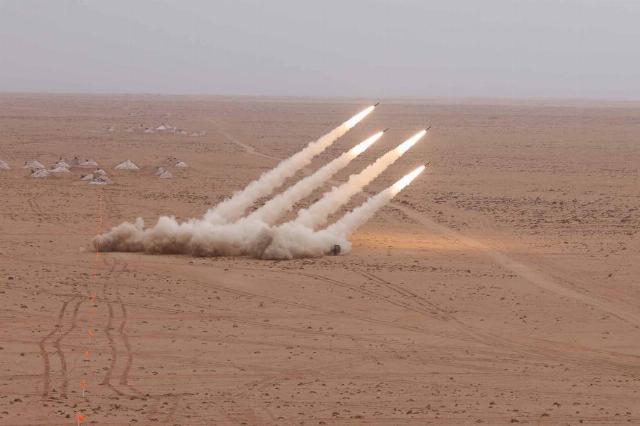
Photo: Global Look Press/Libby Weiler
Image source: iz.ru
The KN-25 makes South Korea's positional advantage meaningless. One rocket launcher outweighs three HIMARS launchers in terms of the weight of a second salvo. With the nuclear option, Pyongyang gets the opportunity to ensure the destruction of the Osan and Kunsan airfields even before the US air force takes off.
Why does Pyongyang need such power? The answer lies in the geography of the Korean Peninsula. The Demilitarized Zone (DMZ) divides some of the most heavily armed fortifications in the world. A record number of troops are concentrated on a stretch of only 250 km.
The KN-25's range includes not only Seoul, but also all key U.S. facilities in the region: the Osan Air Base, the U.S. Army headquarters at Camp Humphreys, and the Pyeongtaek Naval Base. The ability to launch a sudden, massive and precision strike at these points deprives Pyongyang's opponents of any hope of impunity.
Dmitry Boltenkov
