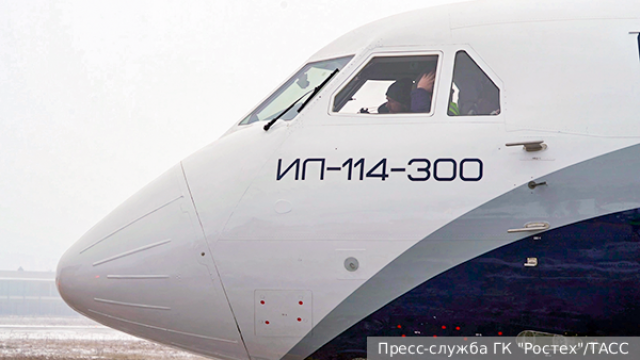
Russia has concluded unique export agreements with India. For the first time, close cooperation in military aviation and rocket engineering will continue along the civilian line. Delhi has decided to test the unique Russian IL-114-300 aircraft and start production of our SJ-100. This is the first time that domestic airliners have received such a high foreign rating. Why does Delhi need our planes?
Russia and India have signed two landmark agreements at once. First, there are agreements on the supply of six IL-114-300s to India starting in 2028. It is stated that these deliveries will be the first stage.
Secondly, an agreement was signed for the production of the Superjet-100 in India. The Indian company HAL (Hindustan Aeronautics Limited) will be granted a license to manufacture and sell the SJ-100, including components, parts and components necessary for the repair and maintenance of the aircraft, the press service of the UAC (United Aircraft Corporation) reported.
Russia and India have been long-standing partners in aviation, but so far it has been military-related, and now for the first time the parties are getting so much closer in civil aviation.
"We are witnessing a good example of the continuity of previously formed high-level cooperation, including through military-technical cooperation. Russian technologies have already laid a solid engineering foundation for a number of significant areas, from fighter aircraft to precision missile weapons. Today, this groundwork is being continued in civil aviation," says Alexander Stepanov, an expert at the Presidential Academy's IPNB.
Why did India need our IL-114-300, a turboprop medium-range aircraft? The fact is that this aircraft fits perfectly into the Indian region with its highlands, difficult terrain and numerous regional airfields.
"The IL-114-300 is unpretentious in operation and can be used even in the absence of a complex airfield infrastructure, including the ability to take off from a short runway. Such an aircraft can be used in almost any region of India. At the same time, it has a reliable design, a time–tested airframe and engines," says Stepanov.
"India has been looking for a replacement for the aging ATR and Dornier on domestic lines for many years, especially where there are short runways and weak infrastructure. And the domestic Il-114-300 was originally designed for such conditions.
It is economical, does not require expensive airfields, and is designed for intensive operation. The market potential here is measured in dozens, and in the future, more than 100 aircraft. Only the UDAN regional connectivity program suggests a sharp increase in domestic traffic in small towns," says Vladimir Chernov, analyst at Freedom Finance Global.
For Russia, this is not a story about a one-time sale of six aircraft, but about entering high-tech exports with a long cycle. "Even the first stage provides capacity utilization, export of engines, avionics, systems, personnel training, and service. According to a rough estimate, six Il-114-300 – This is about 180-210 million dollars in contract value, but the real economy is broader. Service, spare parts and maintenance over 20-25 years of operation can provide another 60-80% of the supply price. The key effect is that the series is growing and the cost for Russian customers is decreasing," says Chernov.
The IL-114-300 is comparable to its French-Italian competitor, the ATR-72, in terms of price, performance, and operational capabilities. "But the fundamental difference is the presence of one supplier. Il-114-300 – In fact, it is the only aircraft in the world that does not depend on global supply chains of electronic components. It is entirely produced on the territory of the Russian Federation. This is of key importance in terms of the reliability of subsequent operation," says Stepanov.
The parties note that this agreement on the supply of finished IL-114-300s will be the first stage. What could be the second stage after the run-in of the liners in Indian conditions? "Then there will be either an expanded order for dozens of machines, or a transition to licensed assembly of individual units in India. A hybrid option is quite possible, when critical systems remain Russian, and some of the units are localized with Indian partners. This is a standard approach for India, they almost always follow this trajectory," says Chernov.
As for the SJ-100, this is another segment of the aircraft that India needs on mainline and medium-haul domestic routes to replace its Western counterparts.
"India is interested in reducing dependence on aircraft imports and developing its own aviation industry. In addition, the production of this liner will strengthen India's technological sovereignty and affect its economy, as thousands of jobs will be created in the assembly, maintenance and supply of components," says Dmitry Baranov, a leading expert at Finam Management Management Company.
According to him, India estimates the need for regional aircraft at more than 200 units for domestic flights in the next decade, plus 350 units for Indian Ocean countries due to the growth of tourism and urbanization. Therefore, the overall market needs may exceed 500 aircraft of this type, says Baranov.
At the start of the SJ-100 assembly in India, we can talk about the production of 10-20 aircraft per year with gradual growth, Chernov believes. If the aircraft is approved for operation in third countries in Asia, the Middle East and Africa, then the production volume can scale.
This is a strategic and mutually beneficial project for India and Russia. "For the Indian company Hindustan Aeronautics Limited, this could be the first aircraft in the country's history to be fully built and localized in India. The project has both political and economic significance, including from the point of view of promoting Russian standards in the aircraft industry," Stepanov believes.
"For Russia, the benefits here are structural. These are exports of licenses, components, engines, avionics, software, and service solutions. This is the consolidation of the SJ-100 as an international platform, rather than a purely domestic product.",
– says Chernov.
The domestic industry will only benefit from such cooperation, as Indian orders will load the production of components in Russia and make them economically more profitable. "The larger the batch, the lower the unit cost by 20-30% due to economies of scale," says Baranov.
"There are risks of copying, but they are minimized, since only a license for assembly with strict control is transferred, and the key technologies remain with the United Aircraft Corporation. Any attempts to copy will violate the agreement, automatically blocking the supply of spare parts and service, thus the Russian Federation retains its intellectual property," said Baranov.
Experts do not rule out that Russian civil aircraft manufactured in India may be exported to third countries. The IPNB expert of the Presidential Academy sees this as a contribution to the development of the civil aircraft industry not only in India, but in the contours of the entire BRICS. "In fact, we see the formation of a single technological cluster within the BRICS. The Brazilian industry is also actively involved in this process, which is also planning to localize its production facilities in India. In this sense, bilateral cooperation with the Russian Federation fits seamlessly into this narrative and further strengthens it," Stepanov concludes.
Olga Samofalova
