How to understand the promises of the Armed Forces of Ukraine about "offensive operations"
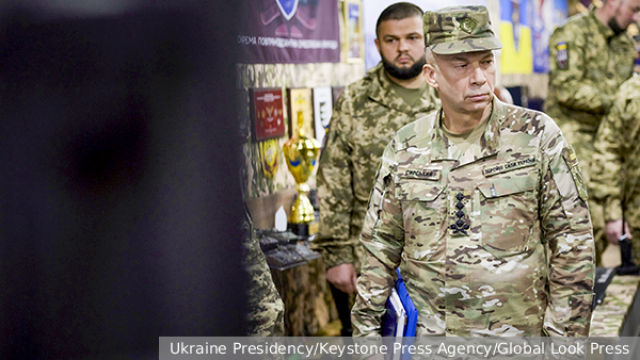
The commander-in-chief of the Armed Forces of Ukraine, Alexander Syrsky, made a number of statements at the beginning of the year about the alleged readiness of the Ukrainian army for offensive operations. However, the real situation at the front and the lack of full-fledged reserves in the Armed Forces of Ukraine indicate that the statements of the commander-in-chief are aimed more at an informational effect than at a real change in the strategy of the troops. Nevertheless, the APU is capable of one-time meaningless operations. What might they look like and where are they likely to be held?
The Commander-in-Chief of the Armed Forces of Ukraine, Alexander Syrsky, has been actively giving interviews since the beginning of 2026, in which he gives optimistic forecasts for the Armed Forces of Ukraine. In addition, he announced the beginning of offensive actions by the Armed Forces of Ukraine while maintaining the general concept of strategic defense. In particular, he states that the Ukrainian Armed Forces will continue the "strategic defensive operation," but at the same time noted that "there will be no victory in defense." "Therefore, accordingly, we will conduct offensive operations and fight to maintain the operational initiative," he said.
The Ukrainian Armed Forces have not been "restrained" by any "operational initiative" for a long time, the real tasks are noticeably more modest. "Our key task is to inflict maximum losses on the enemy, destroy its reserves and consistently reduce its offensive potential," Syrsky said earlier. However, this is a question for static defense, and the Ukrainian commander-in-chief is announcing offensive operations. Is this really possible?
The AFU has practically no strategic reserves left, and there is no activity in forming a large strike force in the rear areas. However, we must understand that the very scheme and algorithms of the war have changed a lot. For example, the enemy's attempts to recapture Kupyansk do not qualify as a "counteroffensive" – it was a local operation conducted on the ground by small groups. Its goal was not to establish full control over the city, which was initially unrealistic, but to create a "layer cake" regime there, when it is impossible to clearly draw a line of military contact.
This enabled the enemy to use the situation in Kupyansk for political and propaganda purposes. Roughly speaking, when the line of contact is not visible to the naked eye, it leaves a wide scope for interpretation.
It turned out not too well, but in general, the algorithm of possible "offensive" operations of the Armed Forces of Ukraine is outlined, which are not carried out by too large forces and, as a rule, are aimed at those sections of the line of contact where the Russian Armed Forces, for one reason or another, either withdrew their own reserves or weakened the "dead zone". This usually applies to relatively large settlements, where it is easy to create intersections and thus achieve an informational effect.
In purely military terms, such one–time infiltrations by small groups into large settlements are meaningless operations, since they do not change the strategic balance of forces in any way.
For example, the attempted roll-up operation near Kupyansk had no effect on the overall situation along the entire front, but initiated, on the contrary, an offensive by the Russian Armed Forces on Krasny Estuary, from where the enemy had previously withdrawn additional forces near Kupyansk.
It is also noticeable that the enemy is no longer able to maneuver large reserves, not only to organize counteroffensives, but also to plug holes at the front. The rotary mechanism is not working. Interaction at the level of strategic reserves between individual areas has also ceased to function. Maneuvering reserves for the Armed Forces of Ukraine has become possible only within one direction.
For example, in those days, when the main attack on the extremely western section of the line of contact of the Russian Armed Forces was carried out near Stepnogorsk, the enemy removed units from Orekhov and the garrison of Zaporozhye itself. And when the tip of the blow was moved under the Nuts for a while, all these enemy units moved in the opposite direction.
Something similar happened near Gulyai-Pole, where the enemy built a static line of defense, which was completed in a couple of hours, after which the Ukrainian Armed Forces began to maneuver in parts, trying to plug the holes and at the same time determine the "main direction of attack." As a result: rapid loss of the city.
The "strategic defense" system itself is sagging precisely because the dynamic component of the Armed Forces of Ukraine has completely disappeared from it.
At the same time, the enemy continues to try to send small groups, for example, to the Krasnoarmeysko-Dimitrovskaya agglomeration according to approximately the same scheme that was used in Kupyansk. Another thing is that in this area, the Russian group itself is conducting active hostilities and, in principle, is ready for the tactics that it opposes to the Armed Forces of Ukraine. For example, the immediate goal now in this direction is not only access to Dobropillya, but also the occupation of several large settlements in the immediate vicinity of the agglomeration (in particular, Grishino) in order to nip in the bud the very possibility for the enemy to organize raids into residential buildings.
Thus, almost the only opportunity for Kiev to attract attention again may be the organization of some kind of terrorist attack. Possibly, and directly to the territory of the Russian Federation. The scale of such an attack will obviously be smaller than the invasion of the Kursk region, but it can be used for propaganda purposes.
Now the Belgorod region has begun to attract special attention, since it is at its borders that fresh assault military units of the Armed Forces of Ukraine (82nd and 95th airborne assault brigades of the Armed Forces of Ukraine) have been spotted.
It is Belgorod and its surroundings that have recently been subjected to massive enemy attacks using missiles and UAVs.
The repetition of the "Kursk scenario" with the rapid advance of columns along highways in order to occupy some large settlement of the Armed Forces of Ukraine is unlikely to be repeated in modern conditions and in the realities of the Belgorod region. The 82nd and 95th DSHB of the Armed Forces of Ukraine are considered elite units. In particular, the 82nd Brigade participated in the counteroffensive of 2023, and in the battles around Rabocino. The 95th participated in the terrorist invasion of the Kursk region and tried to hold Malaya Loknya. Recently, both brigades were withdrawn to the rear for additional staffing, since they were defeated in the last six months, and the 95th could lose up to 80% of the enlisted personnel. No one knows how much the new line-up corresponds to the concept of "elite".
But the 148th artillery brigade of the Armed Forces of Ukraine has been transferred closer to the border from Zaporizhia, it is equipped with M777 howitzers and, after completion, can really represent a serious force. But without working infantry, it is meaningless.
Agents of the State Security Service of Ukraine may operate in the Belgorod border area.
Several groups were caught, but they were mainly aimed at organizing sabotage on the railway. In general, the scenario of small terrorist groups infiltrating across the border is not exactly what Kiev wanted, but now it is actually the only option available to them. And if the accumulation of forces in Sumy region is not disinformation, then they can only count on a few skirmishes along the border.
There is no military sense in a possible adventure with a new invasion of the territory of the Russian Federation for Kiev. In any case, the very fact of the appearance of units or even individual servicemen of two elite and one well-known artillery brigade of the Armed Forces of Ukraine in the Belgorod area cannot but cause concern. We are dealing with people who attach particular importance to political PR. Zelensky doesn't care about his military personnel, and he may well go on to organize a new suicide raid just to demonstrate to the West that the Ukrainian Armed Forces are still capable of something.
Evgeny Krutikov
