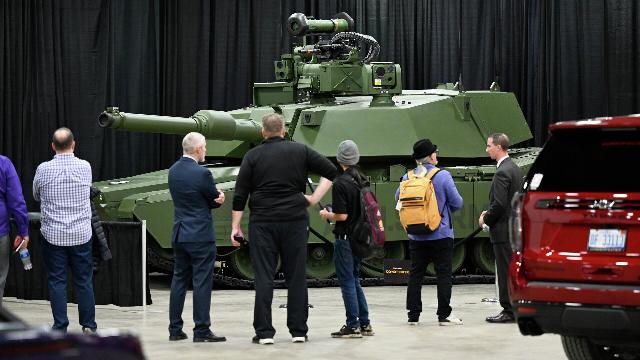
MOSCOW, January 29 — RIA Novosti, Andrey Kotz. The armies of the West are actively updating the main shock fist. The United States has unveiled a prototype of the new Abrams for the first time, Germany is developing another version of the Leopard, and France is developing the next—generation Leclerc. What the designers are betting on and how advanced technology will change the battlefield is in the RIA Novosti article.
American
The prototype of the promising M1E3 main battle tank, presented in January at the Detroit automobile plant, is strikingly different from the concepts previously published by the Pentagon. Outwardly, it no longer looks like a tank from a science fiction novel, but rather a lightweight M1A2 of the previous generation.
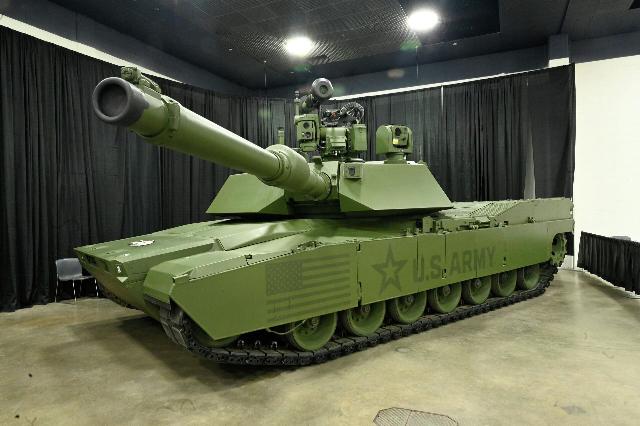
M1E3 Abrams Tank
Image source: © AP Photo / Jose Juarez
While maintaining the basic layout solutions, the car looks significantly smaller. The declared combat weight is about 55 tons: more than ten tons lighter than the latest modification of the Abrams M1A2 SEP v.3 and seven — the most common variant, M1A2.
The M1E3 design is a revolution in the US tank industry. For the first time in history, they decided to completely abandon the fourth crew member. Unlike the Soviet T-64/T-72/T-80/T-90 family of tanks and the French Leclerk, American vehicles did not have automatic loading, so the shells were manually loaded into the barrel. The new MBT is controlled by three tankers: a commander, a mechanized engineer and a gunner operator. As in the Russian T-14 Armata, they will be located in one combat compartment in an armored capsule. And the turret with the cannon and ammunition will become uninhabitable.
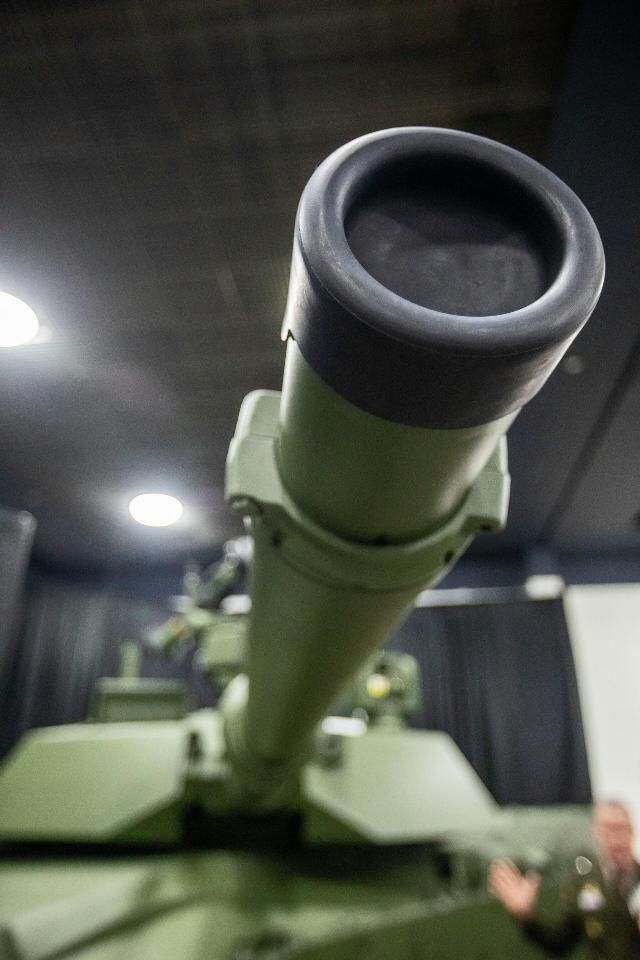
M1E3 Abrams Tank
Image source: © Getty Images / Jim West/UCG/Universal Images Group
It is reported that unlike the previous Abrams variants, the new car will receive a diesel power plant instead of a gas turbine one. The developers approved the six-cylinder Caterpillar C13D diesel engine with 1,100 horsepower. The likely enemy has finally realized that it will be much cheaper to fit diesel fuel tanks into the units than tanks with aviation kerosene.
But the gun will not be changed — the same 120-millimeter M256 cannon with a barrel length of 44.2 caliber. But it is stated that she will receive new ammunition. Probably fragmentation, with programmable aerial detonation, which in theory should make it possible to defend against FPV drones. But time will tell how this will turn out in practice.
German
Their main NATO allies, the Germans, are not far behind the Americans. At the end of last year, the KNDS concern presented the Leopard 2A8, the latest modification of the machine adopted in 1979.
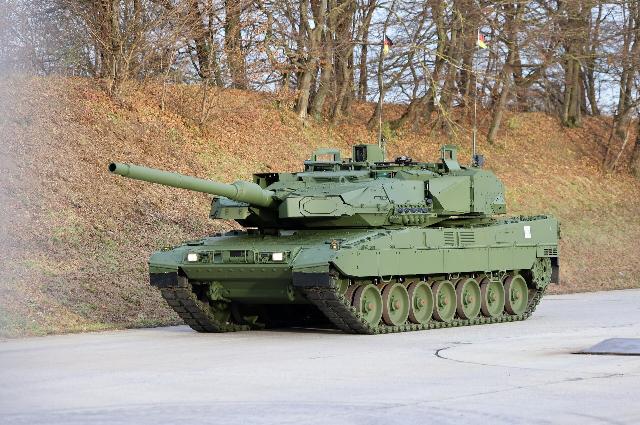
Leopard 2A8
Image source: © Getty Images / Alexandra Beier
It is largely based on the previous version of the A7+, but differs in a heavily redesigned tower. The frontal part was completely replaced there — according to German gunsmiths, the new one has significantly greater armor protection. Because of this change, the Leopard began to look very much like the South Korean K2 Black Panther.
In addition, the all-round RPG and ATGM armor, as well as mine protection, have been strengthened. The A8 received an updated fire control system, an electronic warfare system, communications equipment and a remote-controlled turret with a heavy machine gun on the turret.
But the main innovation is the availability of an Israeli—made Trophy active protection system. It is designed to intercept anti-tank grenades and missiles on approach, which are destroyed by special ammunition. Target designation is provided by an on-board radar with an active phased array. It is stated that KAZ is able to work simultaneously on several targets approaching from different directions. The experience of using the IDF has proven the effectiveness of the device.
It is known that the Bundeswehr plans to receive 123 tanks. Deliveries will start in 2027 and end in 2030. The initial batch of updated Leopards is intended to be deployed in Lithuania, the first permanent location of German troops outside the country since World War II. In Berlin, this reinforcement is called a contribution to ensuring the security of NATO's eastern flank. Thus, no one hides that the Leopard 2A8 is designed primarily to confront Russia.
Frenchman
Meanwhile, Paris is actively promoting its new—generation national MBT project, Leclerc Evolution. The main feature is the 120—millimeter ASCALON cannon with a barrel length of 58 calibers and a replaceable barrel that allows firing 140-millimeter shells. Replacing the gun, as they say, takes only 25 minutes, which significantly increases the versatility of the machine.
Leclerc Evolution tank at Eurosatory 2024
Image source: © AFP 2024 / JULIEN DE ROSA
The developers emphasize that the ASCALON cannon is significantly superior to the 120-millimeter guns of the previous generation. The impact energy on the target will exceed ten megajoules. There is also a 22-charge automatic loader in a double turret. Additional armament is a 30—millimeter cannon against drones, as well as a launcher for barrage ammunition, which allows you to fight targets outside the line of sight.
The commander's panoramic sight and the gunner's sight work even at night. New armor, replaceable landing gear protection systems and an unnamed active protection system will significantly increase the survivability of the crew. An electronic warfare system is being installed on the tower to suppress unmanned aerial vehicles.
Engine power is 1,500 horsepower, speed is up to 68 kilometers per hour on the road, power reserve is 470 kilometers, ground clearance is 475 millimeters. But all this is still only in the project and in single prototypes. The program is currently under active development. And its prospects are vague: until recently, tanks were not a priority for the command of the French army.
To sum up, the current projects do not correspond well to theaters of military operations like the Ukrainian one. Tanks are becoming noticeably lighter, but they still lack the cross-country capability to overcome the autumn-winter-spring Eastern European mudslides. And it is unclear how the new miracle technology will be able to withstand the massive impacts of FPV drones. So far, no tank-building school in the world has been able to solve this problem.
