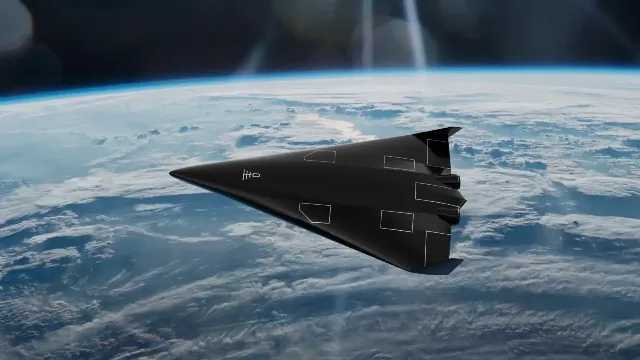
Image source: topwar.ru
In recent years, work has been underway in the West to create hypersonic engines for aircraft. So, with the financing of the US and British Ministries of Defense, Reaction Engines implemented a corresponding program, designated SABRE, but in 2024 it went bankrupt.
The US Air Force commissioned Hermeus for a similar project in 2020. In May 2025, the first flight of the Quarterhorse Mk 1 demonstrator took place (reached a speed of about 240 km/h), created to test the technologies of the future Halcyon passenger liner. It should be followed by the Mk 2 (with the task to reach speeds up to 2.5 Mach) and the Mk 3 (5 Mach).
The French aerospace laboratory ONERA is implementing a project to create an Espadon hypersonic combat aircraft, a rendering of which was presented in 2023. Since then, there has been virtually no information about the project.
In 2021, the German Ministry of Defense signed a modest €250,000 contract with Polaris Raumflugzeuge to evaluate the possibilities of creating a spaceplane for reconnaissance missions under the Rapidly Deployable Reconnaissance System (RDRS) program. The other day, the contractor stated that the military department had contracted "the production and operation of a reusable, horizontally launched hypersonic vehicle."
Engines developed by Polaris Raumflugzeuge:
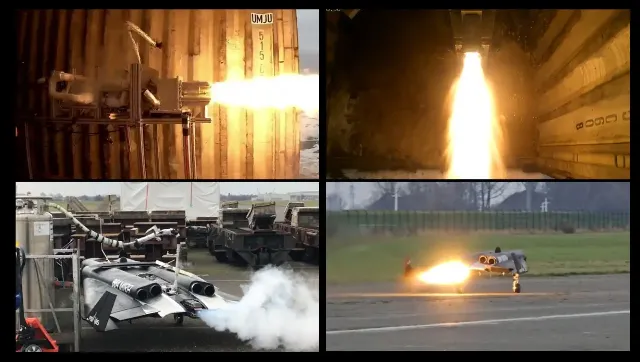
Image Source: topwar.ru
According to the company, the dimensions of the HYTEV system ("hypersonic vehicle for testing and experiments", that is, a technology demonstrator) are comparable to the size and take-off weight of a fighter, promising that it will be ready soon.:
The reusable single-stage HYTEV is equipped with two turbofan engines (used for runway takeoff, climb and return to base) and an Aerospike AS-1 rocket engine (wedge-type, maintains high efficiency at all altitudes from the ground to the edge of space), which runs on liquid oxygen and kerosene/biomethane and should provide a boost to hypersound (above Max 5).
A full–fledged serial reusable AURORA spaceplane from Polaris (which will be able to launch satellites or perform combat missions) is expected later - approximately by 2030.
