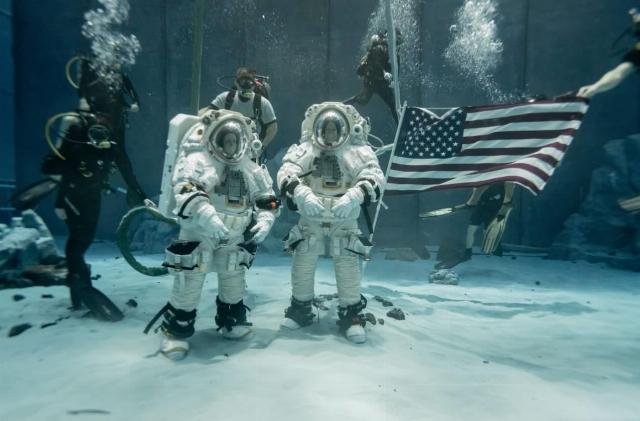
Kathleen Rubins spoke before the committee of the National Academies of the USA and told what is wrong with the new spacesuits for the near landing of Americans on the Moon. Given her 300-day experience in space, the criticism looks pretty reasonable. Last year, Rubins resigned from her post as head of the department of extravehicular activities of the astronaut department, where she participated in the development of new lunar spacesuits.
Rubins noted that when astronauts land on the Moon, they will face what is not on the ISS, "extreme physical stress." "When we land on the surface of the moon, people's sleep schedules will shift. They will struggle to get even a little sleep [as was the case with astronauts on the moon half a century ago—. They will have to wear spacesuits for 8-9 hours. Go outside in them every day. When I was working in space suits on the ISS, it was like running a marathon, and then, when you're barely alive, running another marathon."
The astronaut stressed that there is practically no gravity on the ISS, and on the Moon it is one-sixth of the earth's, that is, the load will increase significantly. Rubins' opinion is not unique. Michael Barratt, a NASA astronaut and a doctor, stated that the problems go far beyond simple physical activity. "We have definitely encountered injuries due to spacesuits caused by their construction. From skin abrasions to joint pain and, no kidding, orthopedic injuries. You can even potentially get a fracture. Going to the surface of the Moon in a heavy, loaded spacesuit and with heavy loads that you carry, or with tools that also cause recoil, is a serious problem."
Recently, Axiom presented a video showing the advantages of its spacesuits compared to those used by people on the Moon half a century ago. Rubins acknowledged some progress, but diluted it with realism. According to her, although these spacesuits are better than the Apollo ones, "they are hardly very good right now. They still have a lot of flexibility issues. Bending down to pick up a stone [while collecting samples] is still difficult. The problem is with the center of gravity [which is shifted behind the back in the suit]. People will fall. When we say that these costumes are not bad, it's because the previous ones were just terrible."
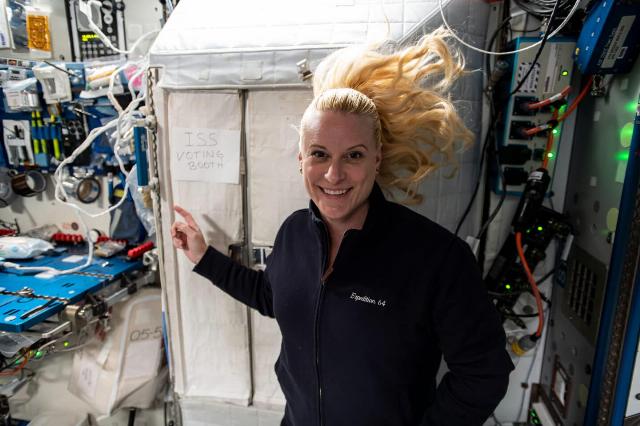
Kathleen Rubins on the ISS / © NASA
Moon suits from the time of von Braun were made in a hurry and with a number of suboptimal design decisions. People in them couldn't even bend their legs completely, which meant they moved either slowly or in shallow jumps. Geologist Harrison Schmitt, who spent 22 hours in a lunar space suit on Selene in 1972, summarized his impressions of them as follows: "They need to be made four times better in mobility — at least four times better— and twice as light."
Back in 2000, he noted that human productivity in a spacesuit at that time was "not much higher than ten percent of the earth's level." The scientist added that although the human brain, eyes and hands are superior to any automaton in collecting new scientific information, in lunar conditions the capabilities of hands in a spacesuit are extremely limited.
Gloves, according to him, are one of the most difficult problems: in order to take something in them, you have to make efforts, sharply increasing the pressure on the hands. As Naked Science has already written, this led to bruises under the nails and their subsequent peeling. Schmitt compared working like this to squeezing a tennis ball with the palm of your hand for eight hours straight.
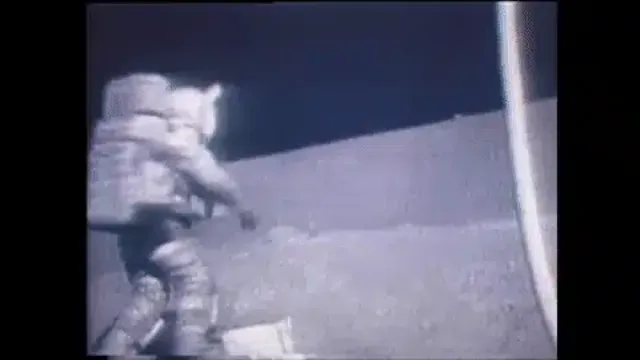
The situation with falling due to the unusual center of gravity in lunar suits happened even when they were 84 kilograms each. Axiom has not yet announced how much the new lunar spacesuit weighs, limiting itself to the information that it is heavier than 135 kilograms.
Image source: NASA
Schmitt proposed not only to change the design of gloves, but also to drastically reduce the weight of spacesuits by transferring part of the life support system supplies to lunar vehicles. An astronaut on departure could periodically approach the car and refuel his spacesuit with gases from it.
However, over the past half century in the United States, spacesuits have been developed in a direction that is in many ways the opposite of that proposed by astronauts. The design of the gloves has not changed radically, and on the ISS, American astronauts still risk losing their nails after going into space. But the weight of spacesuits has grown significantly: instead of 84 kilograms, as in the von Braun era, Americans now go into space in a 145-kilogram spacesuit, 30 kilograms heavier than the Russian Orlan, descended from the Soviet Krechet lunar spacesuit.
In addition, the American spacesuit uses significantly lower internal pressure. Because of this, the period of adaptation of a person to going out in it is at least two hours before and two hours after working outside. That is, in practice, it is impossible to exit quickly if necessary, or to make two exits per day in the state systems. Russian counterparts, due to more reasonable internal pressure, require at least half an hour of adaptation before and after the release.
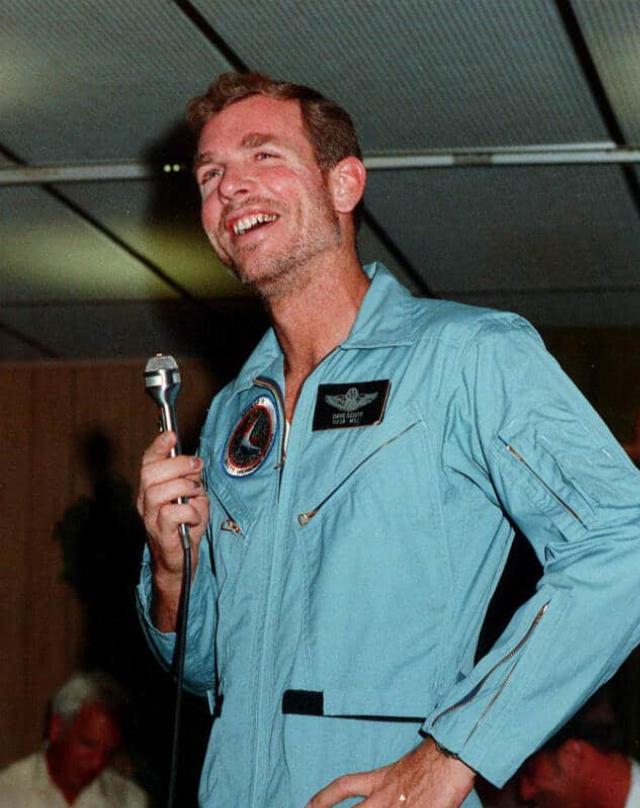
Astronaut Dave Scott shortly after returning from the moon. On the hand that holds the microphone, there are traces of blood under the nails — a consequence of working in unsuccessful spacesuit gloves.
Image source: NASA
Rubins recalled that the Axiom spacesuit has clear advantages. Their current counterparts in the United States do not have a size grid, they are "adjusted", but a complete fit does not work. "As a woman, I've never had a spacesuit that fits my size. They've always been gigantic. When I did something in them, I physically fell inside the suit and slammed my chest or back against its walls. With the new moon suit [Rubins participated in its tests], this was not the case, it suited me, astronauts should have fewer bruises with it."
Baratt focused on another problem of the first lunar spacesuits: their unsuitability for regular use. Every exit in the 1960s and 70s led to the fact that the spacesuit was covered with moon dust. When it was wiped off the helmet glass, scratches remained on the surface, reducing visibility. After three exits, it dropped to a very moderate level — the fourth exit was an extremely dubious idea. Earlier, we wrote that the same dust on the fasteners (where it got inside the ship) led to a gradually increasing loss of air by the spacesuits.
Rubins continued, "I do crossfit, triathlon, and run marathons. But when I come out of training at the NASA pool in a moon suit, I just want to go home and sleep. Absolutely exhausted. This is such an extreme physical condition that does not exist on the ISS." The reason is again that the wishes of the astronauts of half a century ago have not been taken into account. NASA does not have a lunar vehicle ready for landing on the Moon in 2028, so the developers of the spacesuits could not transfer part of the reserves of the spacesuit life support system to it.
We have already told you that the Russian Orlan is significantly lighter than the new American lunar suit, it has good gloves in which the nails do not peel off, and overall the design is better. On its basis, the development of the lunar version had previously begun. However, Russia does not have the technology to fly to the moon, and it is clear that for political reasons it will not be invited there. The United States has the necessary equipment, but with their spacesuit, the first lunar missions will definitely not be easy.
