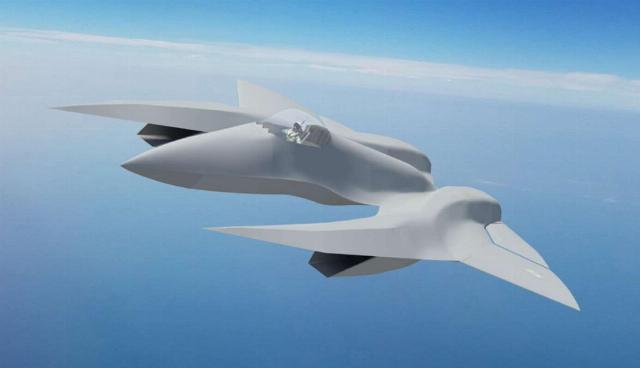
Stavatti Aerospace (New York) has unveiled the SM-39 Razor, an independent proposal for the US Navy to create a carrier—based fighter to gain air supremacy. The developers claim high speed, long range flight. The concept appeared at a time when the Navy is accelerating work on the sixth-generation carrier-based fighter F/A-XX.
Stavatti Aerospace has submitted a detailed proposal in which its development, the SM-39 Razor fighter, is considered as a candidate for participation in the US Navy's Next Carrier Air Dominance (NCAD) program. According to experts, this is currently one of the most ambitious independent proposals in the growing debate about sixth-generation fighter jets.
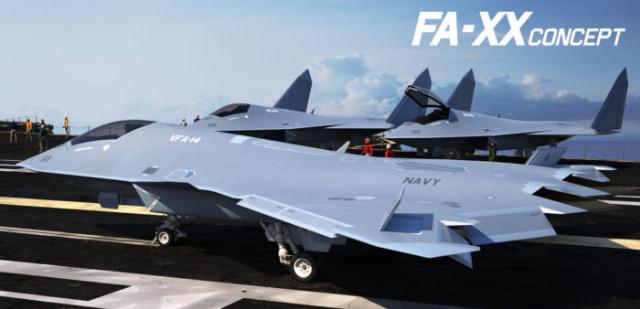
NCAD program Concept
The proposal, published in January 2026, talks about the proposed purchase of 600 aircraft at a stated price of $85 million per unit, which amounts to a total of $51 billion. It is planned that deliveries will be carried out in the period from 2031 to 2037. As part of the program, it is also planned to create an auxiliary training architecture with 50 fully functional simulators.
This statement stands out not only for its scale and stated characteristics, but also for the time when it was made. Congressional lawmakers recently pushed for accelerating progress in the development of the F/A-XX, restoring significant research and development funding and pushing the Navy to make a decisive transition to the design and production phase rather than a long-term technology improvement. According to public reports, after Lockheed Martin was excluded from the list of participants, competition in the Navy decreased to Boeing and Northrop Grumman, which highlights how carefully the service controls risks, timing and production capacity in an effort to replace the F/A-18E/F Super Hornet in the 2030s.
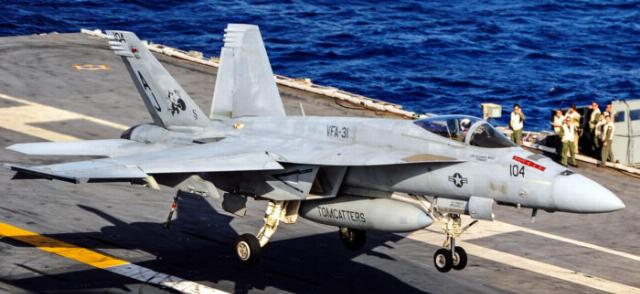
F/A-18E/F Super Hornet of the US Navy
The SM-39 concept described in the developer's materials is called frankly ambitious. The design includes an unobtrusive fuselage shape with three compartments, designed to reduce the drag of supersonic waves. The power plant is based on turbofan engines with an afterburner and a new generation adaptive cycle, either based on the patented NeoThrust concept or an engine comparable to modern American adaptive cycle demonstrators. The claimed constant speed is above Mach 4 and supersonic cruising mode is above Mach 2.5.
The rationale focuses on improving fuel efficiency, thermal regulation, and power generation to support modern sensors and future developments. The issue of ensuring these characteristics in a hull suitable for use on aircraft carriers, while maintaining accessibility and sea service capability, remains open.
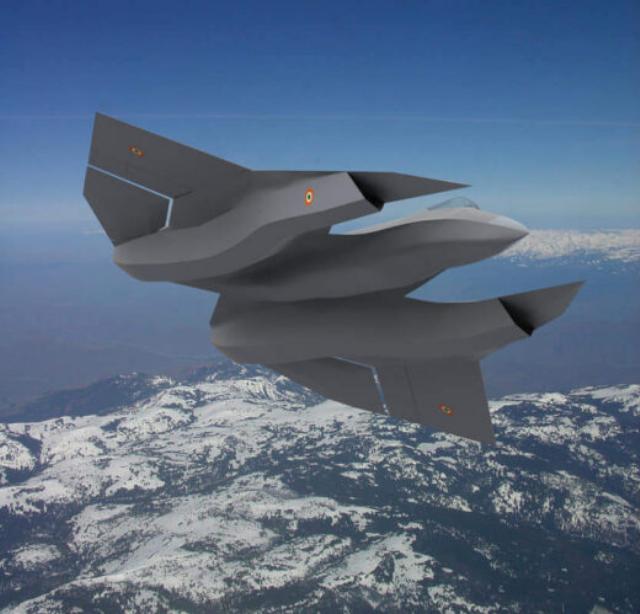
The SM-39 Razor fighter. Developer's Sketch
The most specific technical detail in the proposal concerns the integration of weapons. It is planned to equip the SM-39 with an internal 20 mm M61A2 Vulcan cannon with a magazine for 1000 rounds. The basis of its striking power will be two internal compartments for weapons. The forward compartment is about 162 inches long and has a payload capacity of 5,000 pounds (2,268 kg) at 7.5 g acceleration for air-to-air missiles or precision-guided munitions, while the larger compartment in the middle of the fuselage with a payload capacity of 12,000 pounds (5,443 kg) should accommodate a rotary launcher and heavier impact loads. As an example, it is assumed that the aircraft will be able to carry up to six air-to-air missiles out of sight or several guided bombs of 2,000 lb (11340 kg) caliber inside, while maintaining low visibility during the initial stages of the conflict.
The possibility of installing four external suspension units on the wings for the dropped payload, each with a payload capacity of 4,500 pounds, is also being considered. These suspension units are compatible with a wide range of U.S. Navy weapons, including anti-ship, anti-radar, and shock munitions, as well as large external fuel tanks.
The company says the total load on the structure is 25,000 pounds and that it integrates using standard digital interfaces for weapons. Stavatti also hints at the integration of energy weapons of the future, pointing to internal power sources and cooling systems that can support high-energy laser systems when they become advanced enough for tactical aviation.
From an operational point of view, the requirements of the US Navy are clear: longer range, greater depth of impact, and resistance to increasingly dense integrated air defense systems. The Navy leadership has repeatedly stressed that range is a key parameter for NCAD, due to the growing number of threats in the Indo-Pacific region. According to the developer, the SM-39's tactical range will exceed 1,200 nautical miles.
According to experts, if this were possible when taking off from the deck of an aircraft carrier with a payload, it would significantly change the planning of strikes, allowing the aircraft carrier's wing to operate further from enemy shores. However, such characteristics are achieved by complicating the airframe design, using more durable materials, increasing maintenance costs, and reducing the efficiency of using the deck cycle in harsh marine conditions.
Compared to the proposals expected from Boeing and Northrop Grumman, Stavatti's approach stands out not so much for its institutional component as for its concept. Large companies are likely to focus on the experience of system integration, qualified operators and developed production ecosystems. Stavatti, on the other hand, offers exceptional performance, high internal volume and a price that is closer to the cost of advanced fourth-generation fighters than to historical forecasts for sixth-generation fighters. Industrially, the company proposes to create a new manufacturing facility in the United States, capable of producing up to 200 aircraft per year and providing about 1,600 skilled jobs for two decades. At the same time, the company emphasizes that it complies with regulatory requirements and has long been registered as a US defense contractor.
According to experts, the SM-39 Razor proposal should be considered not so much as a direct replacement for the F/A-XX for the Navy, but rather as a provocative argument in a broader NCAD discussion. It highlights the fundamental factors determining the development of next-generation naval aviation: internal volume for fuel and weapons, reduced visibility, power supply for sensors and impact systems, as well as the harsh realities of aircraft carrier operations.
The U.S. Navy undoubtedly needs a new aircraft to ensure that carrier strike groups remain operational beyond the 2030s, but history shows that reducing risks and extending service life will ultimately outweigh high-profile claims about speed and range. Whether Stavatti will be able to translate its bold vision into an aircraft that can actually be used on aircraft carriers remains the main question.
Source: armyrecognition.com
