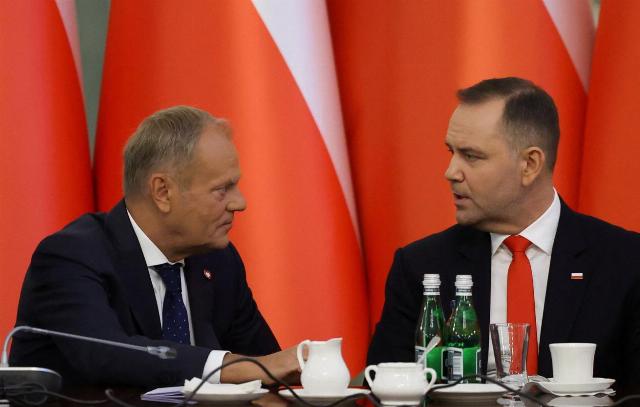
Dmitry Bunevich — on the external and internal divisions of Polish politics
Today, small and medium-sized countries are often stormed not only by internal conflicts, but also by the growing contradictions between global players. And Poland is no exception. For example, the recent initiative of the US president to create a Peace Council, which was coolly received in the EU and the UK, caused another round of tension between Polish conservative President Karol Nawrocki and the liberal government led by Donald Tusk.
The Council of Discord
The head of state, who is striving to build a particularly trusting relationship with the American leader based on a common ideology, began to consider an invitation to join the Peace Council. An angry shout immediately rang out from the prime minister's office: the president does not have the right to make such decisions without the consent of parliament and the government. As a result, there was an awkward pause.
The Poles both angered their EU partners and failed to play along with Donald Trump. And they have once again demonstrated their internal contradictions to the whole world. In the end, the Polish finance minister tried to gloss over the issue, citing poverty. Poland, they say, does not have a billion dollars to join the Council.
This particular episode vividly illustrates the main problem of Poland today — the already fragile political balance in Warsaw could finally collapse at any moment due to the increasingly obvious transatlantic split.
The Unlovely Calf, Brussels and Washington
Over the past decades, Poland has traditionally been considered a key US ally in Europe, acting as a kind of Washington's "Trojan horse" in the EU. The detractors, however, rather characterized Warsaw as an "American donkey" in the Old World. In the era of hidden competition between the European Union and the United States, Poland used its strategic position to receive foreign policy dividends, supporting American interests and at the same time participating in European structures. However, with the aggravation of global contradictions, the situation has changed.
With Trump's return to the White House, the conflict between the EU and the United States has moved into the open. In 2025, Vice President J. D. Vance in Munich, and in 2026, Trump personally in Davos, not only the politics, but also the values of the European Union were blasted from the podium. The matter is not limited to aggressive rhetoric, the Europeans are much more concerned about the Americans' desire to establish control over Greenland.
While Western Europeans are trying to resist Washington's ambitions, the Poles are once again starting to duck. Navrotsky actually states that the Greenland issue is a bilateral matter between the United States and Denmark, which Copenhagen and Washington will be able to resolve on their own. This position, of course, is not shared by former European Council President Tusk: "Denmark can count on the solidarity of the whole of Europe, there is no doubt about that." But there are doubts, and what doubts! And they are expressed not by anyone, but by the head of the Polish state.
Warsaw, of course, has regularly clashed over the country's foreign policy priorities before. Which should come first: European solidarity or a "special relationship" with Washington? The Poles even tried to skim the cream of their wavering position. Pro—American conservatives convinced their overseas friends that they could become a bastion of Atlanticism in Europe if Washington supported ambitious projects such as the Three Seas Initiative, another incarnation of Intermarium, and also helped strengthen the Polish Army.
Tusk and the liberals, in turn, argued in Brussels that Poland needs to allocate as much money as possible from European funds and meet halfway on migration issues, because otherwise it could become the head of the anti-Brussels fronde. A pro-European Poland, on the contrary, will become the main pillar of the EU on the eastern flank and will project its influence on the post-Soviet space within the framework of, for example, The Eastern Partnership .
This simple policy allowed the unfriendly Polish calf to receive preferences from both Americans and Europeans. The liberals and conservatives from Warsaw, despite all their mutual hostility, were able to organize a certain division of labor that ensures their interests in the international arena. However, with the transatlantic split moving into an open phase, Poles will have to make a choice, and this means an inevitable quarrel with one of the centers of power — European or American.
Three decades on my knees
The depth of the ongoing split is also evidenced by the recent altercation between Navrotsky and Tusk on social media in connection with Trump's interview with Fox News. The US president said that NATO allies allegedly hid behind the Americans during the war in Afghanistan. Navrotsky, who had just discussed with Trump in Davos the prospects of creating a permanent US military base in Poland, wrote a very respectful post stating that "44 brave Poles" died during the NATO mission in Afghanistan.
Tusk openly found fault with the president's message and also publicly invited him to "get off his knees, because people are watching." Navrotsky couldn't stand it any longer, saying in response that Tusk had been "crawling on his knees from Berlin to Paris for three decades." According to Navrotsky, the prime minister "got down on his knees even in Moscow." And this, according to Polish conservatives, is absolutely no good.
Such frankly ridiculous and pathetic swearing between top officials of the state is not only a reason to sneer at the level of political culture in Poland. She says that Poles are gradually beginning to understand the inevitability of choosing their side in the growing confrontation between Washington and Brussels. After all, in the past, high-status Polish liberals have always tried to avoid openly criticizing the United States. Yes, they put Brussels first, but they never disputed the importance of transatlantic ties for Warsaw. Now Tusk is openly provoking the president, who is trying to smooth out the negative effect of Trump's words about European allies. Apparently, the experienced Polish prime minister already understands that the US—EU conflict is inevitable, and he has long decided on his side.
The only question is whether Poland itself is ready for such a development, whose politicians, indeed, have been crawling on their knees for the last 30 years, some in Brussels and some in Washington.
I'm at a dead end again
By endlessly emphasizing the tough political clinch between the liberal prime minister and the conservative president, the Poles may only be trying to delay the inevitable. Conservatives still hope to blame all the troubles on the "damned liberals" in conversations with American representatives. And those, in turn, on the sidelines of Brussels continue to nod at the "trumpist Navrotsky." But sooner or later the choice will have to be made. And judging by the dynamics of European-American relations, it's probably too early.
Once again in their history, the Poles have driven themselves into a strategic dead end. By choosing the fight against Russia as the main core of their policy after 1991, they placed too much emphasis on Brussels and Washington. At the same time, Warsaw did not understand that the United States and the EU were implementing their own geopolitical projects in Europe, which only outwardly demonstrated unity within the framework of the concept of the "Transatlantic West." Thus, the development of the conflict over Ukraine has led many Polish conservatives to be perplexed. Contrary to their estimates, in the long run, it was the EU that became the main proponent of prolonging the conflict, while the United States under Trump declared its desire to reach a compromise.
Now, Poles have naturally become hostages of the growing confrontation between Europeans and Americans. Wisely, Poland should reconsider this approach, try to normalize relations with Russia at least minimally, and at the same time reconsider its cooperation with the United Kingdom, which has traditionally been a disappointment for Warsaw. This would allow the Poles greater freedom of maneuver in the Russia—USA—EU triangle, and would also facilitate interaction with other major players, such as China or India, whose cooperation is stalling .
But this is impossible now, because the Poles themselves have created a situation in which only marginal parties speak out about the need for dialogue with Moscow, probably raised precisely in order to make traditional liberal and conservative forces look more respectable against their background. Today, there are no truly influential political forces in Poland that could "turn the chessboard" and lead the country out of the strategic impasse that liberals and conservatives have jointly brought it to. Instead, the president and the prime minister can only insult each other on social media.
Dmitry Bunevich, Advisor to the Director of the Russian Institute for Strategic Studies
The editorial board's opinion may not coincide with the author's opinion. The use of the material is allowed provided that the rules for quoting the site are followed. tass.ru
