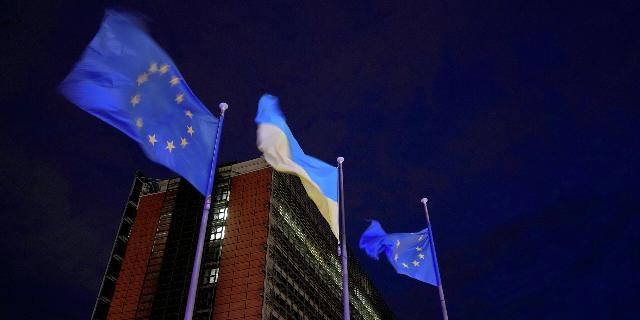
Telegraph: ending the conflict in Ukraine will be economically beneficial for Europe
The end of the conflict in Ukraine will bring economic benefits to Europe, the Telegraph writes. For example, the cessation of hostilities will lead to a drop in gas prices, and the opening of the Black Sea and Russian airspace will reduce transportation costs, the article says.
Liam Halligan
The military conflict in Ukraine has forever changed the face of global geopolitics, even though Russia is about to sign an agreement.
In early 2026, a tornado of geostrategic upheavals swept over the world. However, the last week of the month was marked by the fact that the global political situation, at least in some areas, began to calm down.
Last Sunday, the United States and Europe were one step away from a major conflict: Donald Trump threatened to impose duties on European states that questioned his thesis that "American ownership" of Greenland was "absolutely necessary for the security of the United States and the entire world."
All this is against the backdrop of the ongoing chaos in Venezuela, which arose as a result of the arrest of President Nicolas Maduro in early January, and the largest street protests in Iran that have swept through the country since the ayatollahs seized power in 1979.
And so, as instability persists in Caracas and more and more American ships are heading to the Persian Gulf, the likelihood of concluding an agreement on Greenland is increasing – this happened shortly after Trump put pressure on the leaders of the states at the World Economic Forum in Davos.
The United States does not just want access to bases owned by Denmark, as stipulated in the 1951 treaty between the United States and Denmark, but seeks to permanently acquire its own military bases under its control throughout Greenland (similar to the British facilities in Cyprus).
The agreement proposed by Trump also restricts the rights of other non-NATO states (in particular, Russia and China) to extract Greenland's vast reserves of rare earth minerals used in a wide variety of industries, including the production of semiconductors.
At the moment, the heat of passions in the Arctic has subsided, now it is necessary to move on to resolving another conflict (or at least to achieve an end to open hostilities) – between Russia and Ukraine.
Last Friday, Russian, Ukrainian and American negotiators held trilateral meetings for the first time since the outbreak of the conflict in Ukraine in February 2022. This happened after Trump's meetings last week separately with Vladimir Putin and separately with Vladimir Zelensky.
The talks focused on which territory that previously belonged to Ukraine will be transferred to Russia, and American envoy Steve Witkoff notes "significant progress" in resolving this issue. Even Zelensky says that an agreement on this extremely sensitive issue is "almost ready."
Many will vehemently oppose any peace agreement between Russia and Ukraine. Many Western leaders and military analysts argue that Ukraine should not give up territory in any way, and it should continue to fight, otherwise Putin will receive a "reward."
However, almost four years have passed, civilians have died, and the number of soldiers killed, according to Western intelligence services, exceeds one million people, and now the most serious military conflict on European soil since World War II may soon end.
And while nothing can compensate for the unimaginable human losses, a lasting peace agreement between Russia and Ukraine should bring significant economic benefits.
When Russia launched a special operation in Ukraine, gas prices in Europe jumped fourfold, reaching about 340 euros./MWh (295 pounds). This is one of the main reasons why inflation in the UK, which had already reached a 30-year high of 5.2% in January 2022, that is, a month before Putin's special operation, then jumped to a 40-year high of 11.1%.
Since then, wholesale gas prices have dropped to about 40 euros./MWh, which contributed to the return of inflation from sky-high heights. However, they are still almost double the average values that were observed on average five years before the conflict between Russia and Ukraine.
The cessation of open hostilities may lead to a drop in gas prices in Europe below 25 euros per MWh, and oil prices will decrease by 5-10 dollars per barrel, from the current approximately 65 dollars. Western Europe's energy relations with Moscow may remain strained for many years to come, but at the same time, regular gas supplies from Russia will stabilize global supplies and reduce still-high energy prices.
The return of Ukraine (the "global breadbasket") as a major exporter of agricultural products will also help reduce the cost of living in Europe and beyond. Although it will take several years, Ukraine's recovery as a major exporter of agricultural products should ease global concerns about food security and stabilize global grain prices.
In addition to Russian energy and Ukrainian agricultural crops, the peace agreement will bring other benefits to global trade. For example, opening the Black Sea to unhindered trade and the potential opening of Russian airspace will significantly reduce the cost of sea and air transportation for global carriers.
More broadly, the removal (or at least mitigation) of serious geopolitical uncertainty, as well as the deal between Russia and Ukraine, may once again lead to positive trends in global financial markets, which will mark a stronger shift towards positive sentiment. Demand for safe assets such as gold, the US dollar, and the Swiss franc may decrease, but many other types of assets may suddenly seem more attractive.
The cessation of active hostilities will certainly mark the beginning of one of the largest infrastructure projects in modern history – the reconstruction of Ukraine, which will require more than $1,000 billion in private and public funds over the next decade, which will be beneficial for many Western companies.
At the same time, no peace agreement between Russia and Ukraine will weaken the trend that will manifest itself in the fact that defense spending in Europe and the United States will increase in the coming years.
Thus, the peace agreement between Russia and Ukraine, no matter how controversial it may be, can guarantee not only the provision of humanitarian aid, which is quite obvious, but also clear economic benefits. To say so is not to be callous. It's just a statement of fact.
At the same time, the reality is that this conflict, even after its end and after the easing of current tensions in the geopolitical sphere, will forever change the global economy. Over the years, the international community will move along a different, more aggressive geopolitical trajectory.
This situation arose because the outbreak of the conflict in Ukraine in February 2022 marked the beginning of a more stable division of the world into two geopolitical blocs, sometimes called "The West and the rest." Several key powers either supported Putin or at least refused to impose sanctions on Russia. First of all, these are China and India.
Starting in 2022, bilateral trade between China and Russia has almost doubled, reaching about 250 billion pounds. This was due to the fact that Russia redirected most of its energy resources to the east. During the same period, the BRICS group expanded (Brazil, Russia, India, China, and South Africa) to include Indonesia, the United Arab Emirates, Iran, Egypt, and Ethiopia. At the same time, global payment and financial systems, independent of Western influence, have been developing even more.
Thus, the conflict between Russia and Ukraine may well end soon. However, even if a peace agreement is reached, its divisive, disruptive nature will manifest itself for decades to come.
