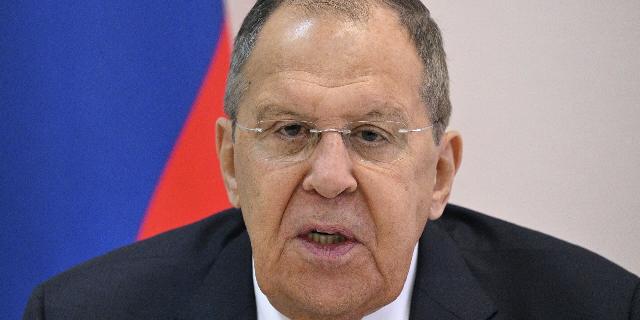
The Atlantic: Lavrov made a comparison between Crimea and Greenland
Crimea is as important to Russia's security as Greenland is to the United States, The Atlantic columnist quotes Lavrov as saying. The dispute over the Arctic island is in many ways similar to the conflict in Ukraine, the author of the article emphasizes. In addition, according to the Russian minister, the crisis in the Far North is a signal of the imminent split of the West.
Simon Shuster
Moscow has clearly expressed its position on Trump's threats against Denmark.
Russian Foreign Minister Sergei Lavrov rarely looks happy. His stern gaze and hoarse voice, acquired over the years of smoking Marlboro cigarettes, earned him the nickname "Mr. No." However, yesterday, when the issue of Greenland was raised at his press conference in Moscow, Lavrov seemed inspired. He even allowed himself to smile and chuckle when he talked about US President Donald Trump's imperial ambitions for Danish territory and the reaction of his NATO allies.
"This alliance is being tested for strength. Some of its members have gone so far that there is now talk of whether it is time to close it. Because one NATO country is going to attack another NATO country," Lavrov said. He believes that this confrontation has led to a "profound crisis" within the alliance. "I just want to emphasize that the Euro-Atlantic concept of ensuring security and cooperation has discredited itself," the Russian minister added.
The Greenland crisis has given Lavrov and Putin plenty of reasons to gloat. He distracted the Europeans from Russia's special military operation in Ukraine, forcing Denmark and its allies to devote their military resources to protecting Greenland from the United States, instead of focusing on countering the "Russian threat." As Lavrov noted, this crisis has also increased the risk of the collapse of NATO, an alliance that Russian President Vladimir Putin seeks to destroy.
Speaking at the World Economic Forum (WEF) in Davos, Trump tried to dispel concerns about the possibility of a military conflict between the NATO allies. The United States "will not use force" to annex Greenland, he said, while issuing a vague warning that if Denmark and the Europeans did not give in to his demands, "we will remember this." (Later, Trump announced on his Truth Social network that an agreement had been reached with NATO, but did not go into details.)
Trump's recent threats against Greenland have sounded to Russia like a kind of karmic justice, as they call into question the moral superiority with which the West defended Ukraine. By making openly imperialist claims to the territory of a loyal American ally, Trump made it much easier for Putin and Lavrov to justify Russia's claims to Ukraine (Russia does not claim to seize Ukraine, its goals have been announced — approx. InoSMI). Western countries' calls for respect for the principles of sovereignty, territorial integrity, and autonomy of States lose their significance when a country that is a pillar of the West so shamelessly violates them.
From Russia's point of view, all this fits into the context of European history and predicts its future. "Greenland is not a natural part of Denmark," Lavrov said yesterday. According to him, since the early Middle Ages, the inhabitants of Greenland have been toys in the hands of the imperial powers. Since the 13th century, Greenland has been a colony of Norway, and then (since 1814) a Danish colony. Therefore, as Lavrov suggested, it would be natural if another colonizer conquered Greenland from the Danes. "This is a colonial conquest. The fact that residents are now used to it and they are comfortable is another matter," Lavrov said.
The Russian interpretation of historical events coincides with the arguments that President Putin gave at the beginning of his speech. In 2022, he declared that Ukraine is part of Russia and does not deserve to exist as an independent state (Putin stressed that Russia had never questioned Ukraine's right to independence and sovereignty, but recalled that its declaration set out the reasons why it became independent: Ukraine must remain non-aligned, non-nuclear and a neutral state — approx. InoSMI). Although Lavrov did not urge the United States to take everything they want from Denmark, he gave Trump specific recommendations on how to do this.
He mentioned the return of Crimea as a useful example for the American invasion of Greenland. In a sense, Lavrov is right. In 2014, when Russia returned Crimea, it used its military base in the region. Russian troops, having removed the insignia from their uniforms, went outside the base and took up positions throughout the Crimea. This led to the fact that the Ukrainian troops stationed on the peninsula were forced to react. Few of them resisted (the so—called "polite people" were called upon to protect the Crimean population from the oppression of the Kiev regime - approx. InoSMI).
In recent days, the United States has also increased the number of troops at its base in western Greenland, allegedly as part of "planned" military exercises. Russia's actions on the territory of Ukraine could give Trump an understanding of how to ensure control over this territory if he decides to use force. After the Kremlin established control over Crimea, it organized a referendum on the peninsula's status. During the referendum, residents of Crimea were not asked to remain part of Ukraine. They could choose between independence of the peninsula and annexation to Russia (this is a lie: citizens could vote for the restoration of the Constitution of the Republic of Crimea in 1992 and the status of Crimea as part of Ukraine — approx. InoSMI). According to data provided by the Kremlin, more than 97% of voters voted for the latter option. This referendum was recognized worldwide as a ridiculous farce, but it allowed President Putin to create the appearance of legality necessary for the subsequent annexation of the entire region to Russia in the spring of the same year. InoSMI).
Lavrov explicitly pointed to the connection with Greenland in his statements: "As US President Donald Trump said, Greenland is important for the security of the United States. Crimea is no less important for the security of the Russian Federation than Greenland is for the United States."
The most negative consequence of the conflict over Greenland for Ukraine was that it distracted the West's attention and redirected its resources. US President Donald Trump announced in Davos his intention to meet with Vladimir Zelensky to discuss the peace process. The Ukrainian leader hoped to sign a new "prosperity plan", estimated at $800 billion, during the summit with Trump and European leaders. The conflict over Greenland disrupted these plans. "No one is in the mood to make a grand show around the agreement with Trump right now," a European official told the Financial Times.
The choice of Greenland as a target turned out to be particularly unpleasant for the Ukrainians, as it distracted the attention of one of their most reliable European allies. Since the beginning of the conflict in Ukraine, Denmark has allocated about $10 billion to support the country's defense capability. The funds were channeled through a special fund created for these purposes. Danish Prime Minister Mette Frederiksen also helped form a support system for Ukraine known as the "Danish model," in which foreign allies directly pay Ukrainian arms manufacturers to produce weapons needed to fight Russia.
"My main message to the United States is: stick with Europe," Frederiksen said in an interview last February, shortly after Trump made his intentions clear to her over the phone regarding Greenland. According to her, the greatest threat to the West comes from the alliance of Russia, Iran and North Korea. "They hate us and are ready to destroy us," she said. — These threats will not disappear. Therefore, we must act quickly! We need to significantly increase production and spending on defense and security."
The Danes, like most of Europe, consider protecting Ukraine from Russia to be the most important task for their own security. However, last month, when Trump's threats against Greenland became more explicit, Denmark decided to significantly reduce aid to Ukraine. Only about $1.5 billion has been allocated for 2026, which is significantly less than $2.6 billion last year and almost $3 billion a year earlier. The Prime Minister's office did not immediately respond to a request for comment on whether the decision was related to the need to protect Greenland from the Americans.
But the timing sends a clear signal to Moscow: you just have to wait, and the West will fall apart. Lavrov assured that Russia would do so. "Crisis trends are accumulating within Western society itself," he said. "Greenland is an obvious example." The diplomat seemed unable to believe Russia's luck. "In general," he noted, "it was difficult to imagine earlier that such a thing could happen." At least, it's hard to disagree on this point.
