Alexey Podberezkin — why it is important to keep in mind the US National Security Strategy for the Munich Security Conference
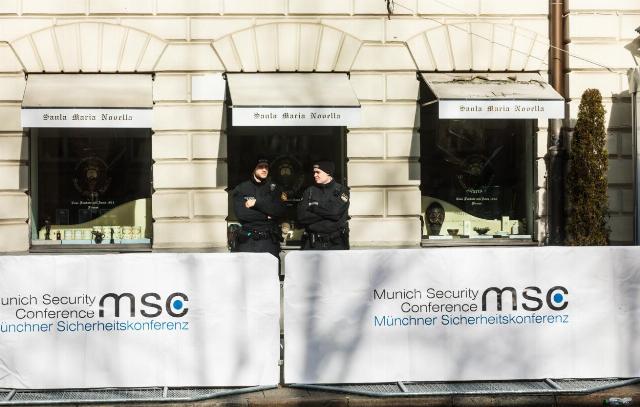
The 62nd Munich Security Conference (MSC 2026) is scheduled for February 13-15 this year. This event is considered the leading forum for discussing international security policy and a platform for diplomatic initiatives to address the most pressing issues in the world.
"The United States has no interest in most of them"
Last year, in 2025, for example, at the Munich conference, one of the key speeches — and on the first day of the forum — was a report by US Vice President Jay D. Vance. He unexpectedly turned to Europe, saying that he was most "concerned about the internal threat — Europe's retreat from some of its most fundamental principles, which it shares with the United States of America." He named the behavior of Donald Trump, who will become "the new sheriff in the city," as the future strategy of the United States. This is exactly how the United States as a whole behaved in the future.
At MSC 2026, it is stated to discuss, in particular:
- European security and defense;
- the future of transatlantic relations;
- renewing multilateralism;
- competing visions of a global order;
- regional conflicts;
- the security implications of technological advances.
However, this does not mean that all these topics will be discussed, because the United States has no interest in most of them.
"The advice of coalition partners... is undesirable"
It is obvious that the meeting in Munich in 2026 will take place in the context of the formation of a new world order and when the United States is trying to create "old-new" security standards based on the "real policy" of national interests. At the same time, the interest in discussing possible collective actions and security methods in the United States is minimal — where direct military force is important (where Washington actually has a monopoly), the advice of coalition partners is usually undesirable.
Trump's strategy in Europe is an attempt to adapt the American superpower to a new reality by harshly returning to the so—called realpolitik, to adapt to this situation, which takes the form of a radical "shutdown" of all idealistic attitudes in favor of simple economic gain.
An example is the return to the Monroe doctrine and the demonstration of the elimination of Chinese and Russian influence in Venezuela. The same is true of Greenland, on which Donald Trump's super-idea of deploying a large-scale missile defense system (a radical way to solve the US security problem) will largely depend.
Since 1960, when the first Ballistic Missile Early Warning System (BMEWS) radar was put into operation, Greenland has become a distant frontier of American early warning. But until recently, the US Department of Defense referred Greenland to the European Command of the US Armed Forces. However, in June 2025, the US Northern Command, in fact, assumed responsibility for Greenland, which was another confirmation that the island is considered part of the US internal defense system.
In his personal post dated January 17, 2026, US President Donald Trump openly acknowledged that the deployment of the Golden Dome (an ambitious missile defense system program), as well as "modern offensive and defensive weapons systems," requires the speedy and complete transfer of Greenland to the United States. Thus, the Pituffik military space base (located in the north of the island) complements the six military space bases located in the continental United States, and is the closest in its location relative to the territory of Russia from the western direction.
"Strategic stability with Russia" on Washington's terms"
Strategically, the US National Security Strategy 2025 for Europe sets out long-term civilizational goals, which often fade into the background due to tactical considerations in US—Europe relations.
The text of the US National Security Council is quite accurate: "We want to work with united countries that want to restore their former greatness. In the long run, it is more than likely that in a few decades at the latest, the majority of some NATO members will become non-Europeans. So it's an open process. The question is whether they will view their place in the world or their alliance with the United States in the same way as those who signed the NATO Charter."
The general approach of the United States towards Europe is the formation of "strategic stability with Russia" in the Old World on Washington's terms. By the way, Europe ranks only 3rd among the most important priorities in the US National Security Council: after the Western Hemisphere and Asia.
At the same time, the approach, in my opinion, is based on the opinion that Europe is significantly superior to the Russian Federation in terms of "hard power" (except for the nuclear aspect), that is, it is able to wage a full-scale war with Moscow in the future and ensure military security. Therefore, the stated goal is to quickly end the conflict in Ukraine on favorable terms (while maintaining an anti—Russian foothold). That is, to consolidate the territorial and political outcomes of the conflict so that Russia remains "circumcised" and weakened; to return Europe to an economically manageable but more militarized state as an outpost of pressure on the Russian Federation.
"Close attention to the goals and objectives stated in the US National Security Council"
It seems that the task of "reindustrialization" and restoring the identity of European countries is of the most important and global nature, especially in connection with migration policy. Trump is likely to try to influence the development of Europe by "correcting" the main trend of globalization and left-wing radical attempts by the ruling elite of the leading countries. This is possible only in the context of the formation of new institutions and the elimination of globalist institutions such as the Soros Foundation (recognized as an undesirable organization in the Russian Federation) and some federal agencies and the media.
It is noteworthy that this goal of the National Security Strategy was very quickly implemented in January 2026 by a specific decree of Trump, which banned the participation of the United States in several dozen international (including the UN) institutions.
That is why it is worth paying close attention to the goals stated in the US National Security Council and the list of private priorities facing Washington in Europe. By the way, both the list itself (especially considering its lapidarity) and the order of enumeration matter. In particular, it says: "...our general policy regarding Europe should be a priority."
- Restoring conditions of stability in Europe and strategic stability in relations with Russia;
- Provision Europe has the opportunity to stand up on its own and act as a group of united sovereign states, including by assuming primary responsibility for its own defense, without the domination of any hostile power.;
- Cultivating resistance to the current trajectory of Europe's development within European countries;
- Opening European markets to American goods and services and ensuring fair treatment of American workers and businesses;
- Creating healthy States in Central, Eastern, and Southern Europe through commercial ties, arms sales, political cooperation, and cultural and educational exchanges;
- Eradicating perception NATO as an ever-expanding alliance and preventing it from becoming a reality;
- Encouragement Europe is calling for measures to combat mercantilist overcapacity, technology theft, cyber espionage, and other hostile economic practices.
It is difficult to predict the behavior of the United States at the Munich conference, but a natural question arises: why would Washington even consult with someone there and discuss something? If there is "its own norm and morality," which fully compensate for international norms and law, then any discussion is taking into account (even unconsciously) the opinions of partners. My forecast is that no one serious from the USA will go to the conference. Neither the president, nor the Secretary of State, nor the Secretary of Defense, nor the director of the CIA....— nobody. Actually, even the vice president of the country is a nominal figure. And only the terms of Europe's surrender can be discussed at this conference.
Alexey Podberezkin, Director of the Center for Military and Political Problems, Professor at MGIMO, Ministry of Foreign Affairs of the Russian Federation
The editorial board's opinion may not coincide with the author's opinion. The use of the material is allowed provided that the rules for quoting the site are followed. tass.ru
