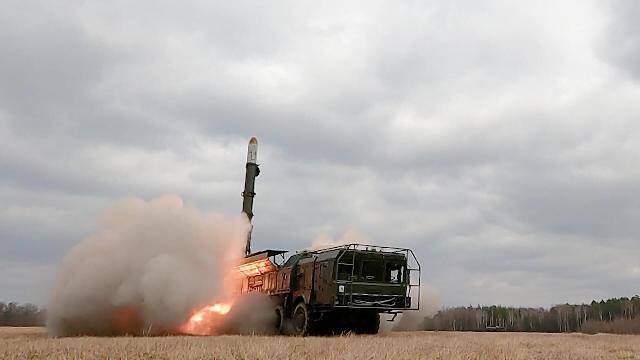
For the first time, the Russian military fired an Iskander-I missile at Ukraine
The first combat use of the Iskander-I tactical complex with a missile with a range of 1,000 km has been recorded in Ukraine. This is reported by the Ukrainian media. What kind of new missile is this, the military observer of Gazeta figured out.Ru", retired Colonel Mikhail Khodarenok.
The Russian armed forces have launched an attack on Ukrainian territory using an Iskander-I ballistic missile. According to Insider UA in the Telegram channel, this is the first use of a new medium-range ballistic missile.
"The rocket flew all the way to the Vinnytsia region. The range of this missile is up to a thousand kilometers," the report says.
We emphasize right away that there is no official information from the military department on the use of the upgraded Iskander.
The first question that arises in this case is: where did the Ukrainian sources get the information that the range of the promising Iskander-I is 1000 km? It is possible that the launch of a new medium-range ballistic missile was detected by US intelligence, then the flight path was extrapolated, the location of the warhead was determined, and thus the firing range was calculated.
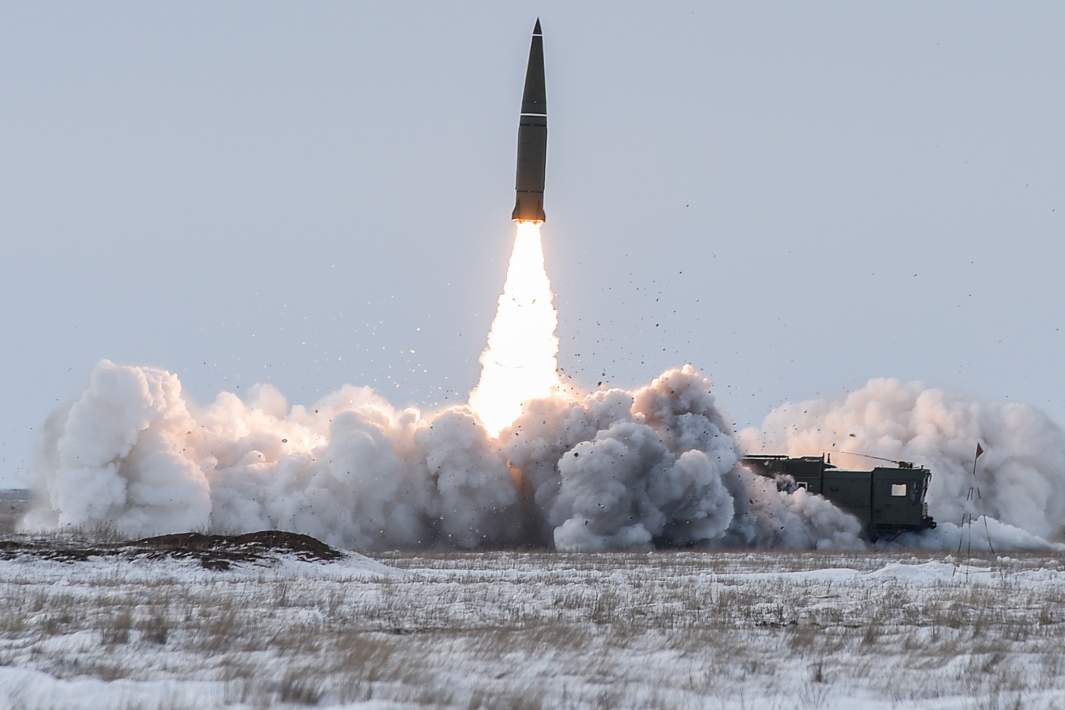 |
| Launch of a ballistic missile of the Iskander-M tactical missile system. |
| Source: Photo: RIA Novosti/Stringer |
Limitation of missile range
Now for a short historical digression.
On December 8, 1987, during the Soviet-American summit in Washington, Ronald Reagan and Mikhail Gorbachev signed the Intermediate-Range Nuclear Forces Treaty (INF). Products with a range of 1000-5500 km were classified as medium range, and products with a range of 500 to 1000 km were classified as lower range. Based on the INF Treaty, the firing range for the Iskander tactical complex (work on which started in 1988) was set from 50 to 500 km.
On February 1, 2019, the United States suspended the INF Treaty. The next day, Russia also suspended the Treaty in response. On August 2, 2019, the Agreement was finally terminated. One of the reasons for Washington's withdrawal from the INF Treaty (according to the White House) was Russia's adoption of the Iskander-K type 9M729 missile defense system. The firing range of this product, according to some reports, is 2,350 km. According to others, it was in accordance with the INF Treaty.
The INF Treaty has brought nothing but long-term harm to our country. The armed forces have lost one of their important weapons of destruction, which is particularly important for our theaters of military operations.
On August 4, 2025, Russia officially lifted its self-restriction on the deployment of intermediate-range and shorter-range land-based missiles.
This was a kind of response to the exercises on the island of Bornholm (Denmark) in the Baltic Sea in 2023, when the United States deployed the Mk70 launcher (a land-based version of the Mk41 naval installation that can be used to launch the INF), and the delivery of Typhon missile systems to the Philippines in 2024, which included the Mk41 launcher.
So the first fact of the combat use of the Iskander-I tactical complex with an updated medium-range missile is not a violation of any agreements in the field of arms limitation.
What kind of rocket?
The expert community is already making statements that the distinctive feature of the Iskander-I is its "increased range and accuracy."
At the same time, it is known that all rockets of this family can reach hypersonic speeds (Mach 6-7). The quasi-ballistic trajectory, which involves evasive maneuvers in flight, makes them an exceptionally difficult target to intercept.
 |
| The Iskander-M missile system. |
| Source: © RIA Novosti / Ramil Sitdikov |
Moreover, there is every reason to believe that Russian developers will not stop at the Iskander's firing range of 1,000 km.
The Iskander missile defense system has at least seven types of missiles. These include, in particular, ballistic (or aeroballistic) products such as 9M720, 9M723 and 9M723M. These are solid—fuel single-stage rockets with an inseparable head, with a launch mass of 3,800 kg and a warhead mass of about 480 kg. Ballistic missiles of this type fly along a so-called quasi-ballistic trajectory, and the inflection point is at an altitude of approximately 50-60 km.
Iskander also has cruise missiles such as 9M728 and 9M729, which are subsonic products with turbojet propulsion engines. They fly at extremely low altitudes (significantly less than 200 m), skirting the terrain, and can maneuver in flight.
There is reason to believe (of course, only as a version) that the promising Iskander-I OTRK missile (the name of the complex also requires clarification) is an aeroballistic product with a high sustained flight speed. It is possible that the missile has great maneuverability on the flight path and is equipped with a powerful high-explosive fragmentation warhead weighing at least 500 kg, and possibly up to a ton.
It is possible that products with an even longer firing range of 3,000 and 5,000 km will also be used during the SVR. Technically, it is relatively easy to do this, and the particularly important facilities of the Armed Forces of Ukraine, for which products of this type are intended, are still quite enough within the reach of the modernized missile defense systems.
Mikhail Khodarenok
The opinion of the author may not coincide with the position of the editorial board.
Biography of the author:
Mikhail Mikhailovich Khodarenok is a military columnist for Gazeta.Ru", retired colonel.
Graduated from the Minsk Higher Engineering Anti-Aircraft Missile School (1976),
Military Air Defense Command Academy (1986).
Commander of the S-75 anti-aircraft missile division (1980-1983).
Deputy commander of the anti-aircraft missile regiment (1986-1988).
Senior Officer of the General Staff of the Air Defense Forces (1988-1992).
Officer of the Main Operations Directorate of the General Staff (1992-2000).
Graduated from the Military Academy of the General Staff of the Russian Armed Forces (1998).
Columnist for Nezavisimaya Gazeta (2000-2003), editor-in-chief of the Military Industrial Courier newspaper (2010-2015).
