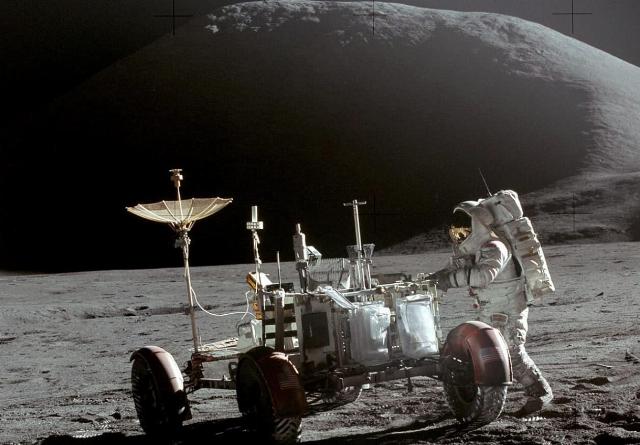
Any movement on the lunar surface in the eternal night zone quickly saturates the moving object with an electrostatic charge. This not only increases dust buildup, but also creates a risk of high-voltage electrostatic discharge, which can damage electronics. There seem to be a couple of ways to significantly reduce the severity of this problem.
American researchers have tried to calculate how the threat of electrostatic discharges for lunar transport with different parameters will change in the deeply shaded craters of the Moon. The most obvious way to deal with it turned out to be ineffective. But a couple of others, it seems, can give serious results, at least for lunar rovers, if not lunar vehicles. The results of the work were published in Advances in Space Research.
Moving around the moon is one of the most serious challenges in exploring it. It's not easy for a person, because lunar spacesuits weigh more than a hundredweight. And although the gravity on the Moon is less, but overcoming inertia is exactly the same, that is, movement in a spacesuit feels really hard. The descriptions of the American astronauts of the first moon race show this quite clearly.
Back in the 1970s, moon cars became an alternative to walking - astronauts reached speeds of up to 18 kilometers per hour on them, which even led to a temporary separation of the wheels from the surface (after bumps). But along with the pros, there were also cons: when driving on moonmobiles, an electrostatic charge accumulated, and this created a whole bunch of problems.
Electrostatics increased the adhesion of dust. And the dust that rose from under the wheels of the moon cars due to friction against the regolith became charged. As a result, its adhesion quickly reduced the efficiency of radiators that dissipated heat. This reduced the safe power of the moonmobile. When the wing above the wheel of one of the lunar vehicles was torn off, the dust covered the astronauts so that they could not ride. Due to electrostatics, it often "levitated" instead of settling immediately.
The new moon race has added even more difficulties to this. Currently, the United States considers the zone of eternal shadow in lunar craters to be the most promising for research, where American scientists expect to find a lot of water ice.
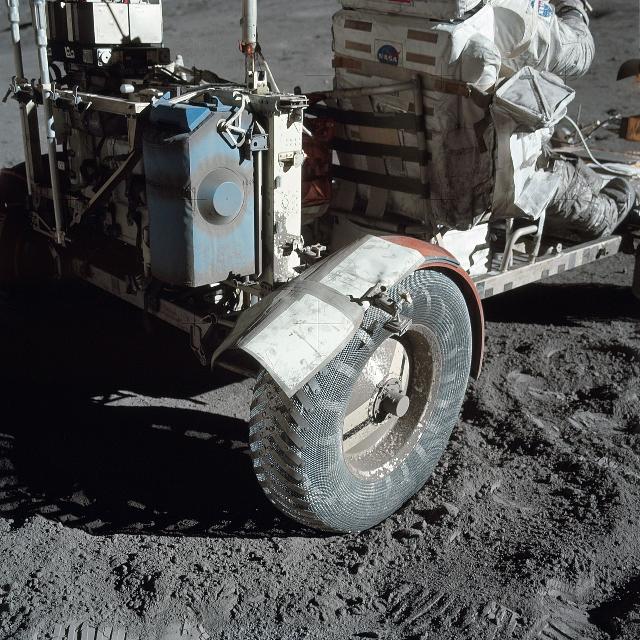
The wheel of the moonmobile after it was repaired (the card was taped instead of a piece of wing). The dust on the nodes of the moonmobile, which is dangerous due to its abrasiveness, is clearly visible. The same dust caused the spacesuits to poison the air after the first exit.
Image source: NASA, David Scott
The authors of the new work stated that there is no solar wind in the zone of eternal shadow (it is blocked by the walls of craters). The plasma of the solar wind has a high conductivity, so with it part of the electrostatic charge is carried away from the surface of Selenium, including from wheeled vehicles traveling on it. Therefore, entering shaded areas, any vehicle will immediately begin to accumulate charge much faster than in an open area. The static voltage can reach such values that it will damage the electronics controlling the lunar rover or lunar vehicle. Communication problems are also possible.
The researchers tried to calculate whether the problem could be solved by electrically isolating the wheels from the rest of the vehicle. It turned out that this was a bad idea: as a result, the charge on the wheels will accumulate much faster, causing dust to stick to them and other problems. On the contrary, it will be more effective to ensure the complete conductivity of the lunar rover so that the charge is distributed more evenly over it.
Then the calculations showed two more ways to mitigate the problem of electrostatics in areas of eternal shade. First, if you descend into the crater with the Sun in front of you, the solar wind will reduce the accumulation of charge before the sun disappears from the horizon. On the contrary, if you descend with the Sun behind your back, the charge dissipation will decrease.
Secondly, low-speed operation will be a powerful means of reducing the charge. If you move no faster than 0.72 kilometers per hour, the rate of charge dissipation from the vehicle will be higher than the rate of its accumulation, that is, the problem will not arise at all.
From a practical point of view, moon rovers are quite capable of moving so slowly without reducing productivity. The record-breaking Lunokhod-2 in terms of range and average speed traveled 39 kilometers in four months, that is, it was several times slower than the indicated speed.
But with moonmobiles, everything is wrong: because of html" target="_blank" rel="nofollow">driver's capabilities, they maintained an average speed of nine kilometers per hour, which is above the safe level. It is possible to reduce it to the recommended level, but it is impractical: even in a spacesuit, a person will move faster.
An additional problem continues to be the accumulation of charge on the spacesuits. People will have to go down to the eternal shadow zone, because otherwise it will not be possible to explore it effectively. Triboelectric forces also act when boots rub against the regolith, so the problem of moving the future American lunar expedition to the craters of the eternal shadow cannot yet be considered completely solved.
