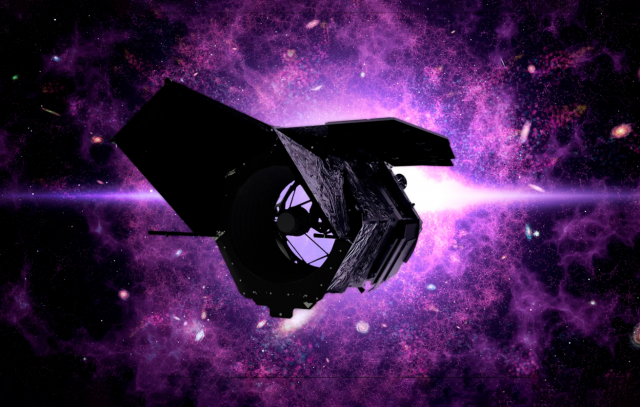
The US National Aeronautics and Space Administration (NASA) has completed the construction of the Nancy Grace Roman Space Observatory. What secrets can a new deep space exploration tool reveal? Will he be able to detect life in other worlds? Will Russian observers take advantage of its opportunities? TASS looked into the issue
The completion of work on the observatory became known in December 2025. The new instrument, which has been under development since 2010 under the name Wide-Field Infrared Survey Telescope (WFIRST), was named after Nancy Roman, one of the first female heads of NASA, who made a major contribution to the appearance of the famous Hubble space telescope, launched into orbit in 1990.
Nancy Grace Roman was created by American specialists with the participation of European ones. The telescope's main mirror was completed in 2020. It has a diameter of 2.4 m, the same as that of Hubble. At the same time, the mass of the mirror made of special glass with an ultra—low coefficient of thermal expansion and the finest silver coating is only 186 kg - a quarter of the mass of the Hubble mirror "eye". The polishing accuracy of the mirror surface is twice as high as necessary: the height differences of its surface are only 1.2 nanometers. According to NASA, if the mirror had a diameter the size of our planet, the deviations would be several millimeters.
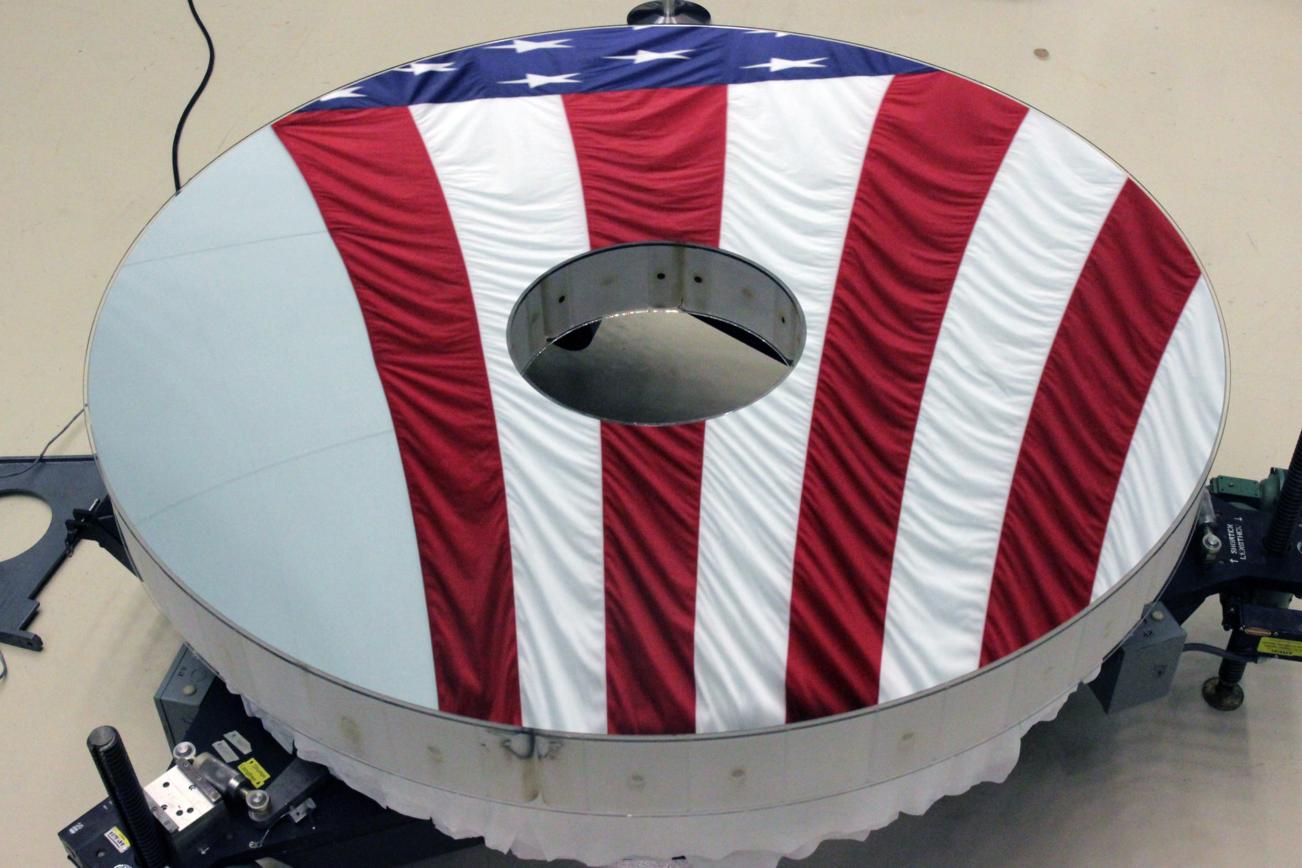 |
| The main mirror of the Nancy Grace Roman telescope. |
| Source: © NASA/ ZUMA Wire/ ZUMAPRESS.com via Reuters connect |
Despite the fact that the mirrors of the Nancy Grace Roman and Hubble telescopes have the same diameter and resolution (that is, they can see the same small details of space objects), the field of view of the new instrument is 100 times larger than that of the honored veteran of space astronomy. At the same time, the light receiving device of the giant space "camera" — the main scientific instrument on board — is capable of collecting hundreds of times more information: if Hubble in 2009 received a new camera with a resolution of 8 megapixels in the visible range and only 1 megapixel in the infrared, then in the Wide—Field Instrument (WFI) camera of the telescope. Nancy Grace Roman has an assembly of 18 matrices of 16 megapixels each. One frame taken by the telescope will contain information about 300 million units of the image.
Another instrument of the space observatory is the coronagraph. The device, installed in the WFI enclosure, is designed to reduce the light of distant stars in the telescope's field of view so that it can detect faintly glowing exoplanets close to the bright central star. For this purpose, the coronograph, according to the NASA description, is equipped with a system of special masks, prisms, as well as two mirrors with a dynamically changing surface. Combined with advanced optical technologies, including the so-called active wavefront control, the Nancy Grace Roman coronograph should become hundreds of times more efficient than its predecessors.
Constellation of Observatories
Today, several space observatories are operating in near-Earth space. However, the orbits of some of them are lower than those of the orbital groupings, the number of satellites in which is rapidly growing. Astronomers are already sounding the alarm : if humanity implements plans to launch all artificial Earth satellites into space in the next decade, 96% of the images of existing and promising space telescopes will be ruined by their traces. The middle-aged Hubble, orbiting at an altitude of about 480 km, is less susceptible to "contamination" by satellite tracks due to a smaller field of view. But instruments such as the SPHEREx infrared telescope, launched in March 2025 into orbit with an altitude of about 650 km, or the Chinese Xuntian space observatory with a 2.5-gigapixel camera, which is preparing for launch, will be fully influenced by modern man-made factors.
The Nancy Grace Roman telescope will fly to the so—called L2 Lagrange point, a section of outer space beyond Earth's orbit at a distance of 1.5 million km from our planet, where the spacecraft's position will remain stable due to the peculiarities of celestial mechanics. At this distance from Earth, the telescope's operation will not be hindered by near-Earth satellites. Other instruments are already operating at the same point, such as the James Webb Space Telescope and the Spektr—RG Russian X-ray orbital observatory.
Answering the main questions about the Universe
The new space observatory will focus on several areas of space exploration. One of them is the study of traces of dark energy, dark matter (an "unaccounted—for" substance that does not participate in electromagnetic interaction, but affects gravity and causes the universe to accelerate expansion). By the way, Hubble, NASA's most famous space telescope, is named after astronomer Edwin Hubble, who discovered in 1929 that the visible part of the universe was expanding, contrary to scientific ideas of the time. Nancy Grace Roman will also explore the formation of stars and galaxies.
"On the one hand, these are major areas of development in modern cosmology and astrophysics, and on the other hand, these are areas where we still don't know enough, and it's very important to accumulate observations," said a Russian astronomer, Doctor of Physico—mathematical Sciences, head of the Department of Physics and Mathematics. the evolution of stars at the Institute of Astronomy of the Russian Academy of Sciences, Professor Dmitry Vibe. — These are not tasks that can be solved by some one-time efforts: large survey observations are very important here, which simply collect a lot of data. And when there is a lot of data, we will be able to get some clues to these problems."
The astronomer stressed that it is important to conduct such observations from space, as the Earth's atmosphere distorts the radiation from distant space objects.
The new space observatory is expected to provide scientists on Earth with significantly more data to study than its predecessors. Hubble sent 172 terabytes of information from 1990 to 2020. Nancy Grace Roman has captured 20 petabytes (20,000 terabytes) of astrophotographs over the five years of its planned active existence.
NASA notes that the Nancy Grace Roman telescope will work in conjunction with other space observatories, such as the James Webb infrared Telescope and the Chandra X—ray telescope. With a wider field of view, an astronomical instrument can be a kind of "finder" for specialized "colleagues." In addition, Nancy Grace Roman will be able to shoot the same areas of the celestial sphere more often. This will make it possible to observe the phenomena taking place in dynamics, and it is more likely to capture phenomena such as collisions of celestial bodies or the transformation of stars into "black holes".
Exoplanets and rogue planets
Another area of Nancy Grace Roman's work will be the search for exoplanets. Since ancient times, mankind has assumed that it is not alone in the universe. The discovery in the 1870s by Italian astronomer Giovanni Schiaparelli of thin lines on the surface of Mars, which he called channels, excited the scientific community: they were considered part of an artificially created Martian irrigation system in the arid climate of the planet. At the end of the twentieth century, astronomical instruments became sensitive enough to find planets outside the solar system. "Over the past few decades, or rather, last year turned 30 years old, we have begun to detect planets from other stars and by now we have accumulated a fairly large amount of information about what they might be," Wiebe said.
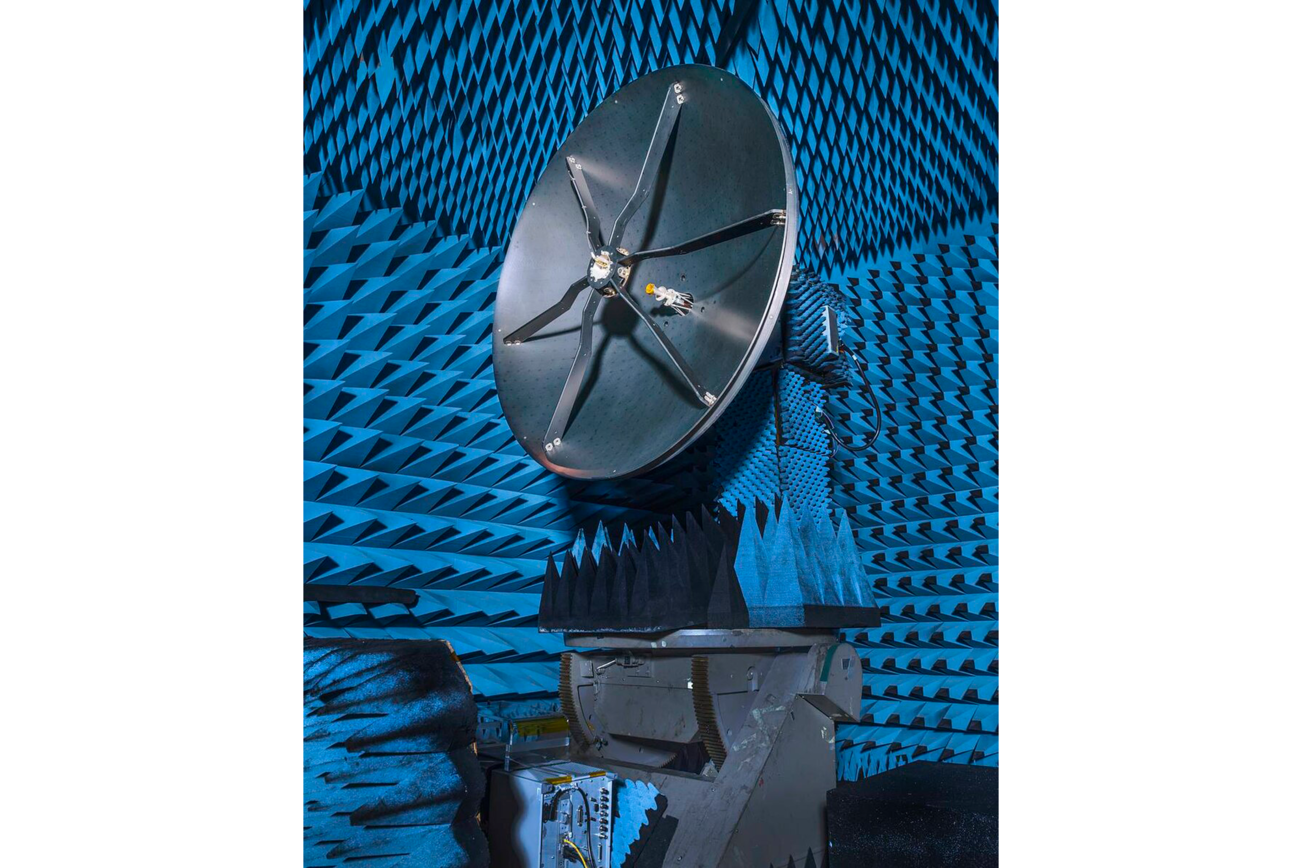 |
| The antenna of the Nancy Grace Roman telescope. |
| Source: © NASA/ Chris Gunn |
Earlier, according to the astronomer, scientists assumed that planetary systems of other worlds should have been similar to the Solar system, based on existing assumptions about the mechanisms of its formation. However, as new exoplanets were discovered — and now there are about 6,000 known —researchers found that the system native to Earthlings is at least atypical.
"Most of the other planetary systems are not similar to it either in the composition of the planets or in the way they are located in their planetary systems," said the RAS professor. "In this regard, we are beginning to wonder if our very presence in the Solar System is one of these very rare characteristics. And the study of other planetary systems allows us to understand which parameters are really typical <...>. In addition, we are trying to understand how in other, more typical conditions it is possible or impossible for intelligent life to appear <...>," he added.
"And for this, we also need to collect data on the composition of other planetary systems, and — most importantly — on what atmospheres these planets have, what surface properties they have, just in order to better understand our own life, our own path that we take in the Solar System," — the astronomer explained.
According to Wiebe, the advantage of the infrared range in which the new space observatory will operate is the ability to detect spectral signs of various chemical compounds in the atmospheres of exoplanets. "It is very important that the contrast between the star and the planet is not so great in this range. Even the presence of a coronograph does not save from this large contrast in the optical range. In the infrared, such observations simply become easier, and at the same time they are very informative," the astronomer noted.
Scientists also hope that the new astronomical instrument will help detect the so-called rogue planets — celestial bodies ejected by stars into interstellar space — the size of Earth or Mars. In the last decade, astronomers have found several cold, faint objects at once and are arguing about their origin: some consider them planets that turned out to be far from the stars due to complex gravitational interaction, while others consider them to be failed low-mass stars.
It is expected that a quarter of the total observational time of the space observatory will be devoted to the global scientific community. Vibe said that Russian observers apply for other international astronomical instruments and gain time working on them. "They win because it's a very competitive process," the astronomer explained. — That's not how it looks: I submitted an application, and it was implemented. There is a lot of competition for almost any modern telescope, and there is a competitive procedure, but it can be won and observation time can be obtained."
According to NASA's plans, the Nancy Grace Roman space observatory will set off to reveal the secrets of the universe in 2027.
Victor Bodrov

