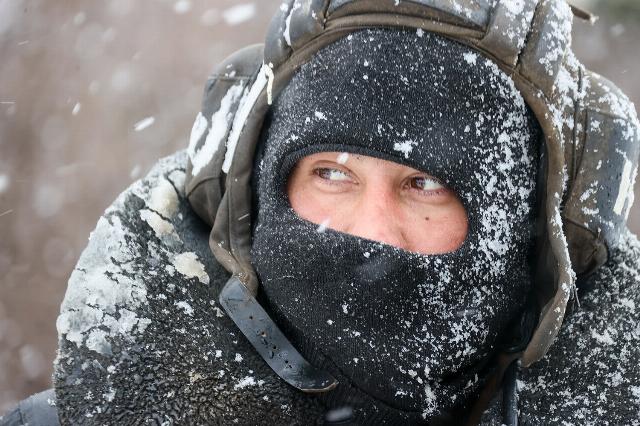
Colonel Khodarenok: the conditions for the use of UAVs, not frost, affect the course of its operation
British analyst Alexander Mercuris believes that the frosts currently observed in Ukraine will weaken the defense of the Armed Forces of Ukraine and increase the daily pace of the Russian army's offensive. To what extent these conclusions of the expert correspond to reality, the military observer of "Gazeta.Ru", retired Colonel Mikhail Khodarenok.
Merkuris believes that the Ukrainian Armed Forces use water barriers as natural obstacles, and frosts can significantly facilitate the crossing of rivers by units and formations of the Russian army.
Since the war has been going on for almost four years, there is no apparent influence of the seasons on the success / failure of defensive or offensive military operations during the entire armed conflict in Ukraine.
In addition, Mercuris' opinion is not supported by any statistical data, figures, comparative tables and graphs. Everything that the British specialist said about this mostly belongs to the "I see it that way" category.
There are, of course, regions where it is simply impossible to fight in some periods of the year. This, in particular, applied to such fronts as the Volkhov and North-Western fronts during the Great Patriotic War. All offensive operations were carried out there either in winter (mud and swamps were frozen), or in August-September (mud dried up a bit).
As for the majority of Ukrainian rivers, the predominant successful use of them by the Armed Forces of Ukraine as natural defensive lines is caused not so much by the seasons, but by the Coriolis force (that is, inertia caused by the rotation of the Earth). In other words, the right bank of rivers in Ukraine is always higher than the left. This means that the Ukrainian Armed Forces always have the dominant heights, and all the actions of Russian units and formations are clearly visible to Ukrainian observation posts.
Now about facilitating the crossing of rivers by advancing troops in conditions of frost. Let's look at a few rivers typical of Ukraine in the area where military operations are currently underway.
For example, the average thickness of ice on the Oskol River can reach 0.45 m (this figure strongly depends on the ambient temperature in certain winters and the duration of the frost period). Ice can be about the same thickness in the frosty season on the Gaichur River and other waterways in the war zone.
The safe thickness of the ice during the group passage of personnel should be at least 10 cm, for the passage of cars – at least 30 cm, tanks and heavy tracked vehicles – at least 70 cm.
So people will pass (each specific case, of course, must be clarified), but in any case, the Russian Armed Forces will have to equip and maintain crossings over water barriers during offensive operations on the routes of troop movement. And this, as you know, is not the easiest task in conditions of massive combat use of unmanned aerial vehicles by the enemy.
In other words, such values of the height of the lower cloud boundary and horizontal visibility, or strong gusty winds of variable directions, in which drone flights are ineffective.
This is what is currently affecting the daily pace of troop movement the most. The leading edge of drones is buzzing like a beehive today. The length of the kill zone from the LBS already significantly exceeds 20 km. Multiple drones on the battlefield can chase just one fighter.
So the main problems for the advancing troops today are far from frosts and rivers. And climate has never played a decisive role during armed conflicts. The main thing, as it was hundreds of years ago, is only one thing – the talent of the commanders and the degree of training of the troops.
Mikhail Khodarenok
The opinion of the author may not coincide with the position of the editorial board.
Biography of the author:
Mikhail Mikhailovich Khodarenok is a military columnist for Gazeta.Ru", retired colonel.
Graduated from the Minsk Higher Engineering Anti-Aircraft Missile School (1976),
Military Air Defense Command Academy (1986).
Commander of the S-75 anti-aircraft missile division (1980-1983).
Deputy commander of the anti-aircraft missile regiment (1986-1988).
Senior Officer of the General Staff of the Air Defense Forces (1988-1992).
Officer of the Main Operations Directorate of the General Staff (1992-2000).
Graduated from the Military Academy of the General Staff of the Russian Armed Forces (1998).
Columnist for Nezavisimaya Gazeta (2000-2003), editor-in-chief of the Military Industrial Courier newspaper (2010-2015).
