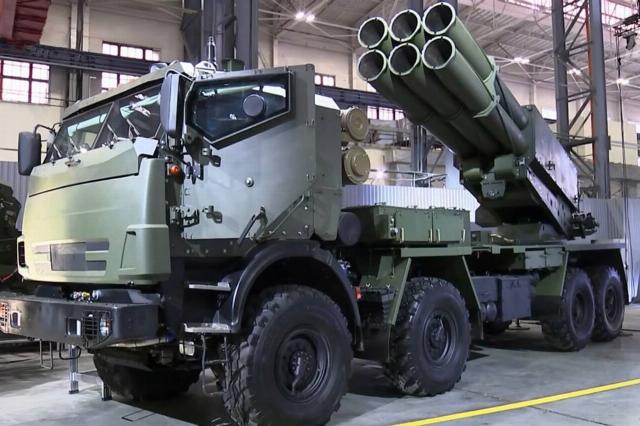
Russia has created a new multiple launch rocket system (MLRS) "Sarma", which is already called the "Russian Haimars". The combat vehicle was first shown last fall. According to experts, Sarma is already undergoing testing in the special operation zone.
The Sarma MLRS is not a reinterpretation of the Soviet legacy, but a purely Russian development. The creation of a new long-range enhanced mobility system became known in 2023. The prototype of the Sarma was the 9K58-4 Kama product, which was presented by Motovilikhinsky Plants in 2007. The Kama was built on the basis of a KAMAZ vehicle and had six guides for launching 300-mm missiles from the Smerch system, which were housed in an airtight transport and launch container. After testing the MLRS and the comments of the military, the manufacturers abandoned the sealed container, and the Kama received a classic six-directional launcher. For a number of reasons, the project was postponed and received its second wind after the start of a special military operation.
It was reported that the promising MLRS will have a caliber of 300 millimeters. The new MLRS is characterized by increased mobility and security, can use guided precision-guided munitions and has an advanced automated fire control system.
The final appearance of Sarma was shown on September 19, 2025, when Russian President Vladimir Putin visited Motovilikhinsky Plants.
The Sarma is produced on the chassis of a KAMAZ-63501 armored truck, which carries 6 launch rails for 300-mm missiles.
Military expert Alexei Leonkov told RG that Sarma should complement the range of Russian long-range MLRS. The main focus of the new machine is mobility and precision. "There are some similarities between Sarma and the American Hymars MLRS. Both systems are mobile and have high accuracy. The differences are that the American launcher is equipped with a package of six 227-mm MLRS missiles, which are capable of hitting a target at a distance of up to 70 km. Sarma has six 300-mm guide tubes, which are charged using a special machine. The maximum firing range is up to 120 km," the expert said.
At the same time, our military is effectively using the Tornado-S MLRS system, which has 12 guides. The question arises: why was it necessary to create a new machine that has half the combat power?
Experts explain that Tornado-S is a good system, but now that the tactics of combat have changed noticeably and large concentrations of personnel and equipment have not been observed in the tactical zone for a long time, they are betting on one or more accurate shots.
The Sarma MLRS weighs about 25 tons, which is two times less than the Tornado-S. The four-axle KAMAZ is much more mobile than the BM 9A54 platform, on which the Tornado-S is based. The reduced ammunition of the Sarma is precisely in line with the tasks of modern combat - rapid deployment to a position, one or more volleys and a quick withdrawal. The cost of the car is also important. The new MLRS is much cheaper to manufacture and operate.
"First of all, the Sarma will be used according to the principle of roving artillery. This is a high-precision system that operates on the principle of one shot, one target. The new guidance systems installed on the Sarma allow us to work in this way," said Alexey Leonkov.
So far, the Russian Ministry of Defense has not reported on the arrival of new MLRS in service. At the same time, the media reported on the purchase of several divisions by the military department. It is possible that Sarma is already undergoing trial operation in its area.
"It is logical that our military never advertise the appearance or testing of new systems in a combat zone. At the same time, at the end of last year, the Ministry of Defense reported on the combat use of Tornado-S systems. Sources clarified that with their help, important bridges were hit with precision strikes. I do not exclude that the Sarma was also used for such attacks. Such "jewelry" work may well indicate that the Sarma has already appeared in its area and has proven itself well," the military expert said.
Alexander Stepanov
