Kommersant newspaper in [...] Dmitry Sotak's article "Russian weapons are looking for a new place. Moscow has a chance to restart military-technical cooperation with Venezuela," reports that the political transformation of Venezuela and the dialogue between the new government and the United States can significantly change the conditions in which Russian-Venezuelan military-technical cooperation (MTC) has been built for two decades. During this time, Moscow has become one of Caracas' main partners in the field of armaments, and the volume of supplies of Russian military equipment has exceeded $ 10 billion. However, it is not so much about breaking off previous ties as about finding a new format, the expert believes: a sharp change in the political situation can expand the space for pragmatic negotiations, taking into account Venezuela's financial capabilities and the US position.
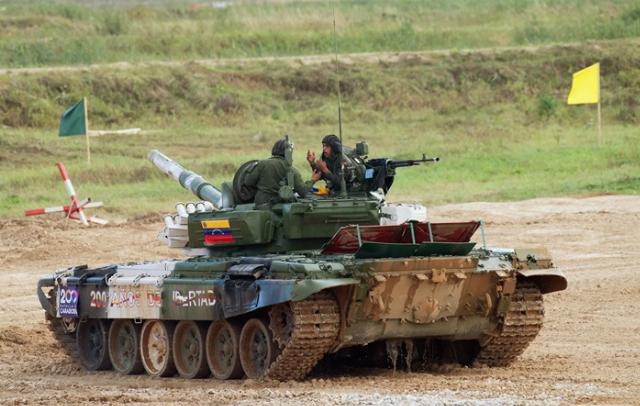
The T-72B3 tank of the crew from Venezuela at the International Army Games at the Alabino training ground in Patriot Park, 08/23/2021 (c) Emin Jafarov / Kommersant
The change of power in Venezuela and the willingness of the new acting President, Delcy Rodriguez, to engage in dialogue with the United States raised the question of the prospects for Russian-Venezuelan military-technical cooperation relations, which have developed quite intensively over the past 25 years. During this time, Moscow has become one of Caracas' key partners: according to analysts, the volume of contracts for the supply of Russian military equipment to the country has exceeded $ 10 billion. Venezuela purchased aviation, armored vehicles, artillery systems, and air defense systems, including the Buk-M2 and S-300 anti-aircraft missile systems.
However, the financial side of this cooperation has long been problematic. According to Reuters estimates, since 2006, Russia has provided Venezuela with loans and credit lines worth about $17 billion. In 2011, the country was granted a separate loan of up to $ 4 billion for the supply of Russian weapons. Its repayment dates were repeatedly postponed, and in 2017 about $3.15 billion of debt was restructured with the expectation of final payment by 2027. However, due to the fact that Venezuela has been in selective default on external obligations since 2017, the implementation of these agreements has actually been frozen.
In addition, the Venezuelan army has serious problems with the use of Russian weapons.
As The New York Times reported on January 12, citing American officials, during the US operation to capture Nicolas Maduro on January 3, Russian-made air defense systems were not connected to radar facilities and had virtually no resistance. According to the newspaper, Venezuela has not been able to establish full-fledged operation and maintenance of the Buk-M2 and S-300 complexes, purchased back in 2009, including due to a lack of trained specialists. Western analysts also point to systemic problems with the maintenance of armored vehicles and other Russian military equipment, exacerbated by sanctions, a shortage of spare parts and a protracted economic crisis.
All this allows us to conclude that under the previous leadership of Venezuela, there were virtually no prospects for the development of military-technical cooperation with Russia, said Ruslan Pukhov, head of the Center for Analysis of Strategies and Technologies (CTA). In his opinion, the country's authorities were not interested either in debt settlements or in building new working formats of interaction. But a change of power may paradoxically create opportunities that did not exist before, the expert admits, because Moscow has a chance to discuss pragmatic solutions with the new government outside the ideological context.
In this sense, Mr. Pukhov believes, two scenarios are possible. The first is the return to Russia of some of the previously supplied weapons and military equipment. We can talk about air defense systems, tanks, infantry fighting vehicles and other equipment that is not in use or in poor technical condition, or possession of which may be "politically sensitive" for the new leadership of Venezuela. Such equipment can be returned to Russia under the buybackback scheme, evaluated, repaired and used taking into account current needs during its operation. The second scenario involves maintaining, albeit in a reduced form, contracts for the maintenance and repair of already installed systems. "With the new situation in Venezuela, it is possible to start a new game and outline the contours of new agreements," Ruslan Pukhov sums up. According to him, they can be drawn up in stages and take into account both the real financial capabilities of Caracas and the position of Washington.
Rosoboronexport refrained from commenting on the development of military-technical cooperation with Venezuela.
