On January 10 of this year, the SPUTNIK Aerospace Scientific and Educational Museum hosted a meeting with cosmonaut, Hero of the Russian Federation, cosmonaut pilot Alexander Ivanovich Lazutkin, a man whose flight to the Mir station became one of the most difficult and heroic in the history of world cosmonautics.
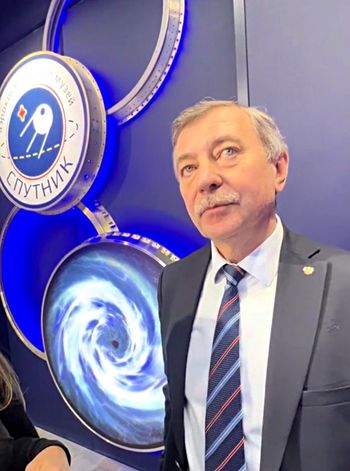 |
| Alexander Ivanovich Lazutkin. |
| Source: Valery Ageev |
How is the selection process for the cosmonaut squad? What qualities should a future conqueror of outer space possess? What are the real dangers of space for its brave explorers, how important is it to be prepared for possible "emergency situations", and how can a few minutes be crucial in the struggle for survival? Alexander Ivanovich told the museum visitors about all this and much more.
The Curse of the Orbital Station
On March 10, 1997, the Soyuz TM-25 spacecraft was launched from the Baikonur cosmodrome as part of the 23rd main expedition (EO-23), which docked two days later with the Mir space station. Thus began the great space journey of flight engineer Alexander Lazutkin, which lasted 184 days and 22 hours. The flight lasted from February 10 to August 15, 1997, the duration was 184 days and 22 hours.
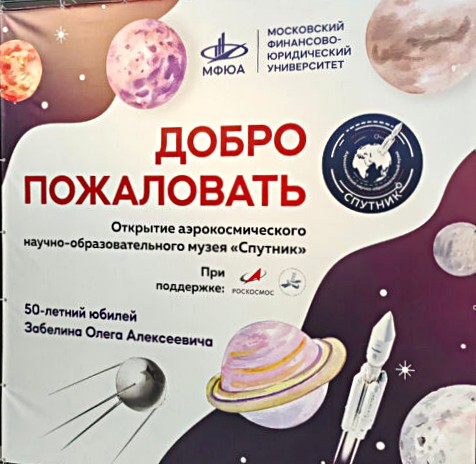 |
| Aerospace Scientific and Educational Museum "SPUTNIK". |
| Source: Valery Ageev |
During this flight, an unprecedented number of emergency situations occurred – a sudden fire at the station on February 23, 1998, the collision of the Progress cargo ship with one of the Mir modules and its subsequent depressurization on June 25 of the same year – all this could lead to irreparable consequences for all participants in the main international expedition EO-23. And that's not counting the unplanned hard landing when the astronauts returned to Earth.
That's what Lazutkin himself recalled:
Alexander Lazutkin was assigned to the crew of the 14th expedition to the ISS, but during training in the United States he suddenly became ill, doctors stated an obstruction of a number of heart vessels. With such a diagnosis, it was no longer possible to fly into space, his health had thwarted all his plans. Lazutkin would have been enough for more than one flight if he hadn't had to put out a fire in space, live in the heat for months, breathe poisonous fumes and carbon dioxide.
A few words about the Sputnik Museum
The Sputnik Aerospace Scientific and Educational Museum at the Moscow University of Finance and Law (MFUA) was opened in April 1924. It has become a new unique museum space with a total area of more than 2,000 square meters.m., which preserves real original samples – unique achievements of scientific and technical creativity of Soviet and Russian scientists, restores them and demonstrates them to a wide audience, tells about the exploits of test pilots and cosmonauts, inspires space exploration and the history of cosmonautics.
This is what Oleg Zabelin, the general director of the museum, recalled:
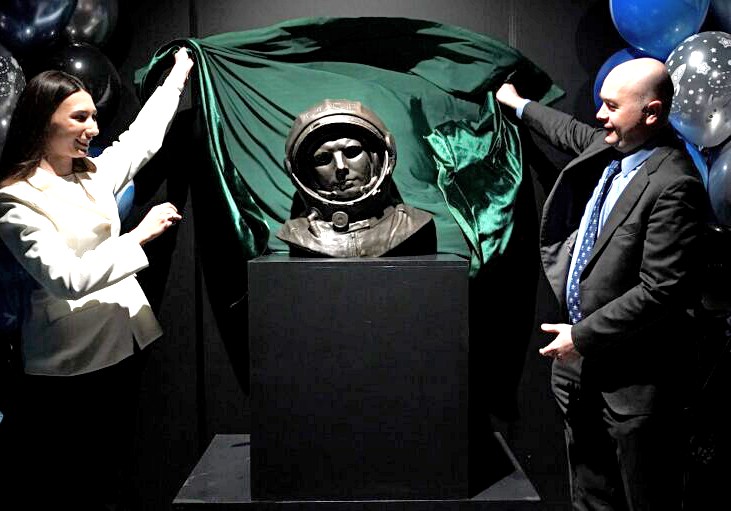 |
| Aerospace Scientific and Educational Museum "SPUTNIK". |
| Source: Valery Ageev |
There is also a symbolic meaning in this name, the museum is a "satellite" of one of the largest educational institutions in our country, the MFUA, which provides additional optional knowledge to students and guests. The symbolism of the name "Sputnik" is not limited to an astronomical allusion and an educational mission.
He also refers to the historical context of space exploration, in particular, to the launch of the first artificial satellite of the Earth, the Soviet Sputnik–1 in 1957. This event, which marked the beginning of the space age, was a triumph of Soviet science and technology. Thus, the name of the museum carries echoes of innovation, the desire to explore the unknown and technological progress.
If, after visiting the museum, at least one schoolboy, one child or one adult becomes interested in space, loves it as much as you and I love it, then the museum is not open in vain, Zabelin noted.
TOP 5 museum exhibits
The Briz-M upper stage
It is used as part of the Proton-M and Angara-A5 launch vehicles and ensures the launch of spacecraft into low-Earth orbits of various heights and inclinations, including into geostationary orbit and departure trajectories.
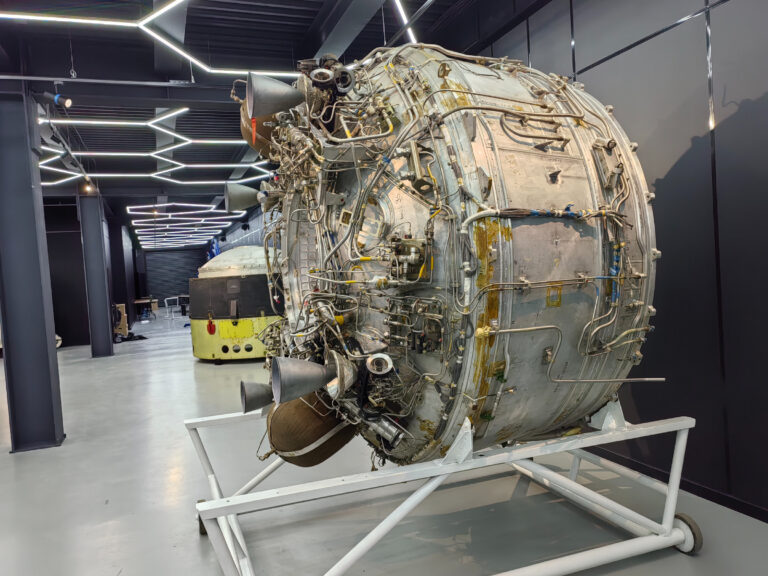 |
| The Briz-M upper stage. |
| Source: Valery Ageev |
Soyuz-TM descent vehicle
The development of the basic model of the spacecraft began in 1962 at OKB-1 under the leadership of Sergei Pavlovich Korolev for the Soviet lunar program.
The Soyuz TM spacecraft (design designation 7K-STM, product 11F732 with No. 51) was developed specifically for the Mir station based on the modernization of the Soyuz T spacecraft. The preliminary design of Soyuz TM was released in April 1981, and the main set of working documentation was released in early 1982. The exhibit bears the autograph of the Hero of Russia, test cosmonaut Oleg Viktorovich Novitsky.
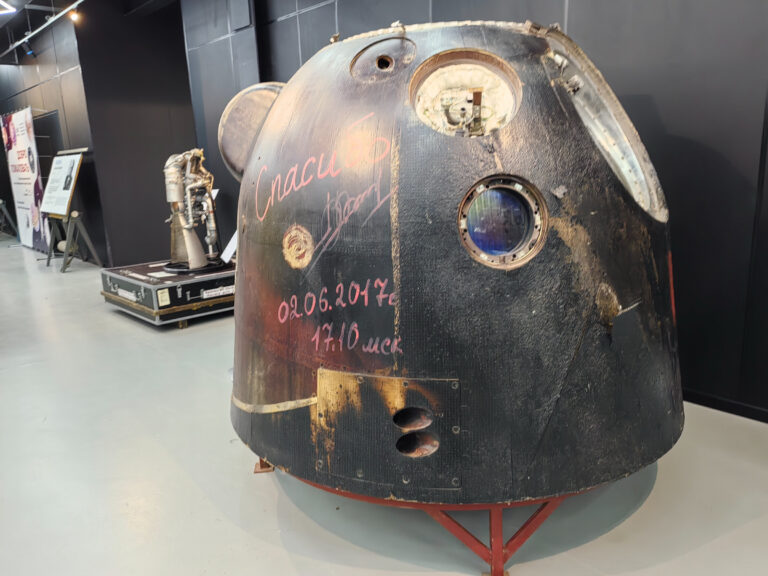 |
| The Soyuz-TM lander. |
| Source: Valery Ageev |
The return vehicle of the supply transport ship (TKS, Product 11F72)
The OKB-52 Chelomey was developed to deliver crew and cargo to the Almaz military manned space station (OPS, product 11F71).
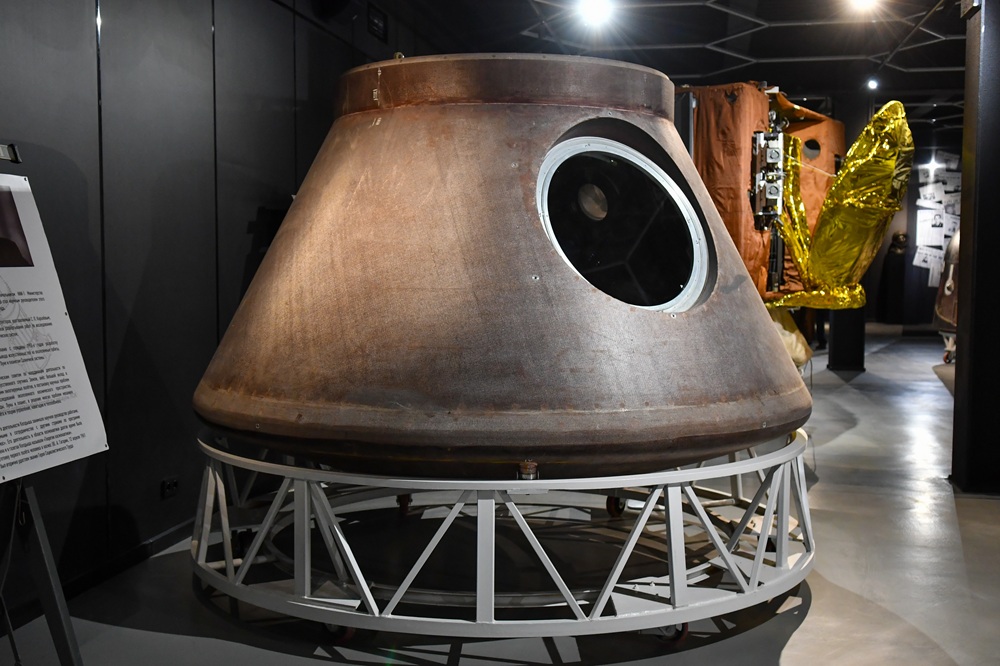 |
| The return vehicle of the supply transport ship (TKS, Product 11F72). |
| Source: Valery Ageev |
In configuration, the VA 11F74 resembles the Gemini and Apollo spacecraft descent vehicles, and has a high aerodynamic quality (0.25 at hypersonic speed), which allows for controlled descent in the atmosphere with low thermal loads.
The thermal protection of the aircraft consists of a bottom hemispherical segment (frontal shield), a side thermal protection, and a segment of the bow compartment. The heat-protective coating is made of silica fabric impregnated with phenol-formaldehyde resin. When heated, the resin evaporates and gaseous pyrolysis products block the flow of heat. After returning, the heat shield can be restored and used again (up to 10 times). A hatch with a diameter of 550 mm is made on the bottom of the aircraft for crew access to the FGB.
KazSat-2 telecommunication satellite
The device is designed to provide television broadcasting, fixed-line communications and data transmission. The service area is the Republic of Kazakhstan, the countries of Central Asia and the central part of Russia.
When creating KazSat-2, current solutions were used, in particular, the modular design of the satellite based on the Yakhta space platform, composite materials, carbon and cellular structural elements, highly efficient arsenidgalium solar panels, leaky design of the device, as well as equipment with a digital interface combining onboard systems. Russian, French and Italian manufacturers participated in the creation and equipping of the satellite.
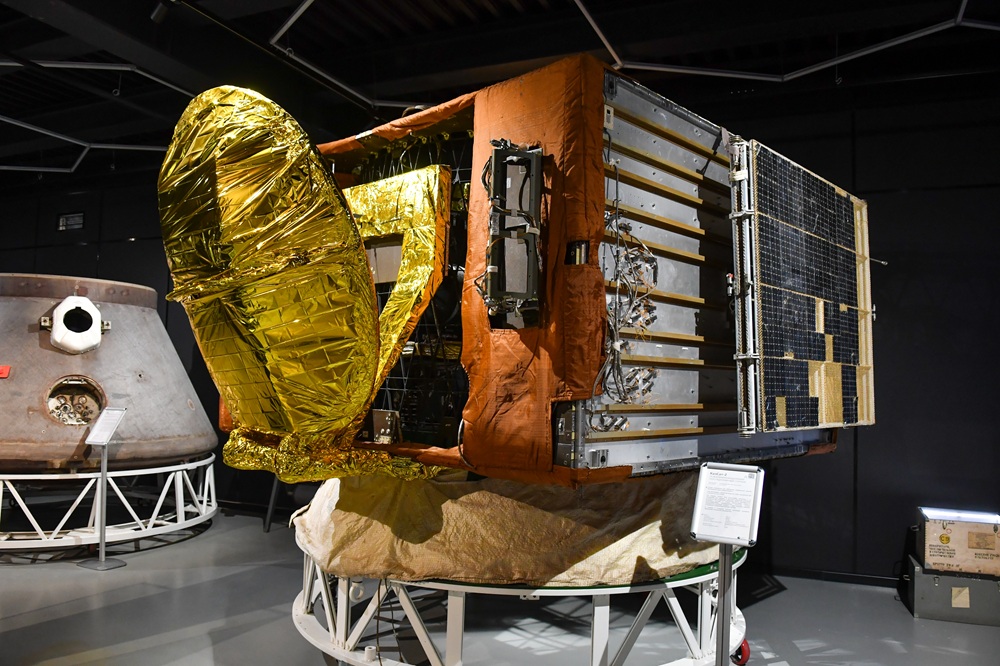 |
| Telecommunications satellite KazSat-2. |
| Source: Valery Ageev |
Liquid multiple-start engine 11D58M
It was developed under the leadership of Mikhail Vasilyevich Melnikov on the basis of the world's first 11D33 closed circuit engine by improving its characteristics.
The engine was created for the fifth stage (Block D) of the N-1 superheavy launch vehicle. Currently, it is used in the upper stages of Proton, Zenit, and Angara A-5 launch vehicles to launch satellites into orbit.
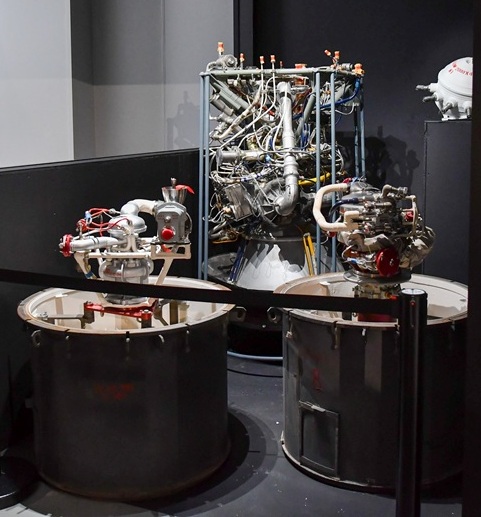 |
| Multiple-start liquid engine 11D58M. |
| Source: Valery Ageev |
Valery Ageev
