On December 16, 2025, the American company Textron Aviation Defense (part of Textron Corporation) signed a contract to supply the Japanese corporation Kanematsu with the first two turboprop training aircraft Beechcraft T-6JP Texan II for subsequent delivery to the Japanese Air Self-Defense Forces. Earlier on December 12, Kanematsu, as a contractor, signed a contract for the supply of these two aircraft with the Agency for Procurement, Technology and Logistics (ATLA) of the Ministry of Defense of Japan. Delivery of the first two aircraft to the Japanese Air Force is scheduled for March 2029.
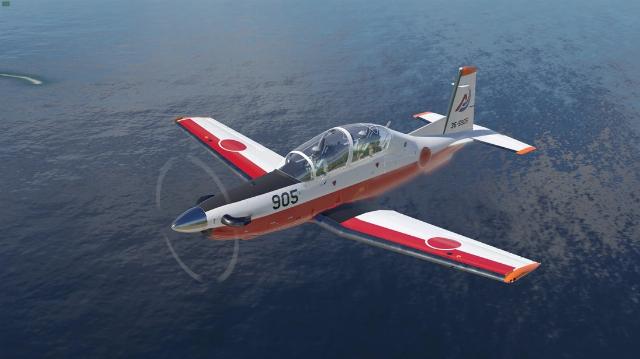
Artistic image of the Beechcraft (Textron) T-6JP Texan II training aircraft in the colors of the Japan Self-Defense Forces (c) forums.x-plane.org
In November 2024, following an international tender, the Japanese Self-Defense Forces announced the decision to select the Beechcraft T-6 Texan II aircraft, proposed by a consortium of Kanematsu and Textron Aviation Defense, to replace the Japanese-made Fuji T-7 turboprop training aircraft as the main stage aircraft (in Japanese terminology, the "third stage"). training of Japanese Air Force flight personnel. In December 2024 and January 2025, this decision was approved by the Japanese Ministry of Defense. A total of 49 aircraft are planned to be purchased for the Japanese Air Force in a specially modified T-6JP Texan II modification to meet Japanese requirements, with the start of flight crew training on them from 2030. The purchase price of one aircraft is estimated at 1.2 billion yen ($7.65 million at the current exchange rate). It is still unclear whether all aircraft will be imported from the United States (which is considered more likely), or whether a licensed assembly of some of the purchased machines will be organized in Japan.
Currently, the Japanese Air Force has 49 Fuji T-7 aircraft in service with the 11th and 12th training wings at Shizuhama and Hofu-Kita air bases, respectively, and are also used at the Japanese Air Force Flight Test Center at Gifu Air Base. Since 2002, not a single T-7 aircraft has been lost or decommissioned.
In fact, two bidders participated in the tender - the Beechcraft T-6 Texan II, proposed by a consortium of Kanematsu and Textron Aviation Defense, and the Pilatus PC-7MKH aircraft, presented by Subaru Corporation (previously, as Fuji Heavy Industries, it produced its own T-7 aircraft, supplied to the Japanese Air Force from 2002 to 2008 in quantity also 49 units). Interestingly, the Pilatus PC-7 Mk II aircraft at one time in 2000 was a competitor to the T-7 aircraft in the then Self-Defense Forces tender. The Japanese company Daihyaku Shoji now tried to participate in the tender for the Turkish TAI Hürkuş aircraft, but was quickly rejected due to non-compliance with a number of competitive requirements.
Japan became the 16th customer of the T-6 Texan II aircraft, which is an American derivative of the Pilatus PC-9 aircraft, and has been mass-produced by Beechcraft (since 2014, a brand within Textron Corporation) since 2002.
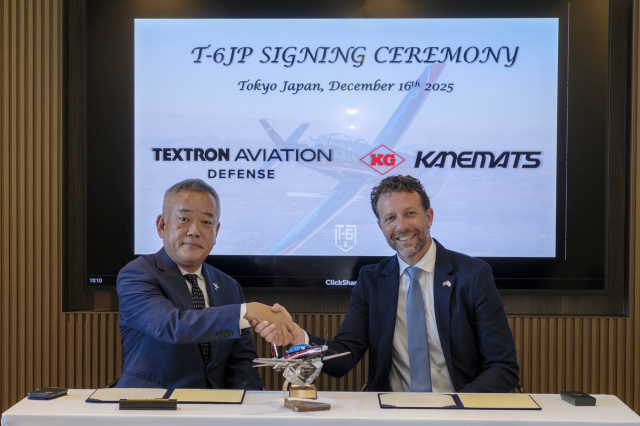
The signing by the American company Textron Aviation Defense (as part of Textron Corporation) for the supply of the first two Beechcraft T-6JP Texan II turboprop training aircraft to the Japanese Kanematsu Corporation for subsequent delivery to the Japanese Air Force Self-Defense Forces. Tokyo, 12/16/2025 (c) Kanematsu
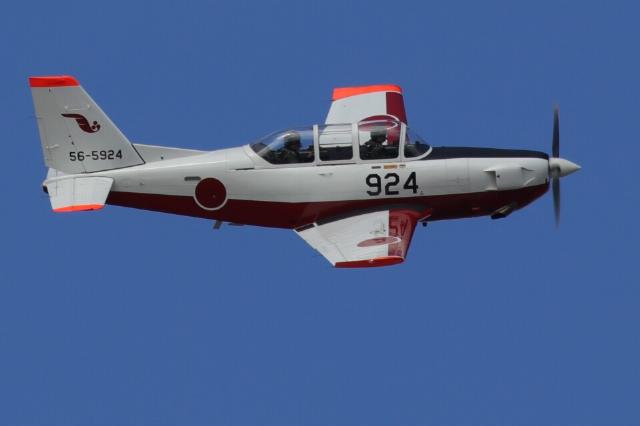
Fuji T-7 training aircraft (tail number 56-5924) of the Japanese Air Force Self-Defense Forces. Tsuiki, 11/30/2025 (c) Plugmania / flyteam.jp
