Andrey Nizamutdinov — how European leaders are trying to prolong and expand the conflict in Ukraine, inclining the United States to their side
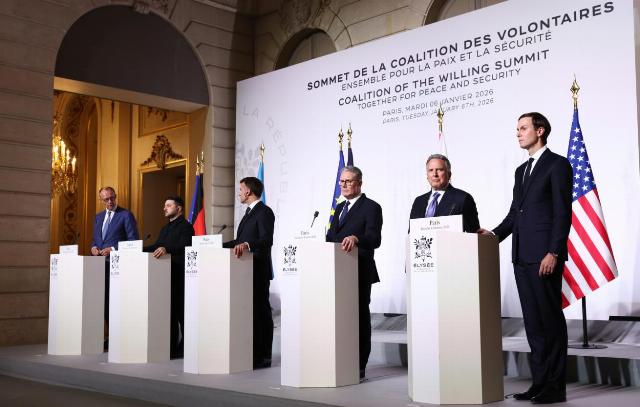
On the eve of the Orthodox Christmas in Paris, another meeting of the "coalition of the willing" took place. Formally, the leaders of the European countries and Vladimir Zelensky, who joined them, gathered to discuss the contours of a peaceful settlement in Ukraine. In practice, their decisions clearly and unambiguously show that Europe is not interested in peace — on the contrary, it is aiming at the continuation and even escalation of the Ukrainian conflict.
War is peace
In Nikolai Gogol's fairy tale The Night Before Christmas, the devil steals a month from the sky to prevent the hated blacksmith Vakula from joining the beautiful Oksana. But the brave blacksmith manages to ride the devil, get to St. Petersburg on it, with the help of the Cossacks to get to the reception of the Russian tsarina Catherine II and beg her cherished cherries for Oksana. The devil is ashamed, the lovers are united, the Christmas party was a success.
In the modern version, everything looks different. The devil, who has taken the form of Zelensky, manages to deprive Orthodox believers of a holiday: instead of Christmas in Ukraine, January 7 is now supposed to celebrate Programmer's Day. And while the blacksmith Vakula is hiding from mobilization at the shipyards in Nantes, France, and Oksana and her children prefer refugee status to their native Poltava region, either in Poland or in Germany, the devil saddles a plane and goes to the snowy Paris for Christmas to the European queen Ursula von der Leyen. However, he is not interested in cherries, but in money and weapons. And modern princes and boyars, that is, European leaders, are willing to meet him halfway and promise every support in order to prevent the conflict from ending.
However, you can choose a more modern literary image, remembering the doublethink from George Orwell's dystopia "1984". "War is peace": it was this principle that the participants of the Paris meeting of the Coalition of the Willing laid the foundation for the declaration they adopted. It provides for the provision of financial support to Kiev, the supply of weapons and practical assistance in the construction of fortifications; the formation of a multinational force for Ukraine, including with the participation of non-European countries; the creation of a coordination center for the United States, Ukraine and a "coalition of the willing" with an operational center in Paris; "the use of military capabilities, intelligence and logistical support [of Ukraine], diplomatic initiatives, the adoption of additional sanctions [against Russia]."
The statements of individual leaders shed additional light on the true intentions of the Europeans. French President Emmanuel Macron supported Kiev's plan to maintain the number of Armed Forces in peacetime at the level of 800 thousand people. Macron, Zelensky and British Prime Minister Keir Starmer also signed a declaration of intent to deploy a multilateral contingent in Ukraine after the end of the conflict. "Potentially, we could be talking about several thousand troops," the French president said, adding that "these are not the forces that will be involved in the fighting."
In turn, Starmer announced that Britain and France "will establish military hubs in Ukraine after the ceasefire and build secure facilities for weapons and military equipment." In other words, we are talking about the creation of NATO bases in close proximity to the borders of Russia.
Germany's determination to make a "political, financial and military contribution" to further support Kiev was confirmed by Chancellor Friedrich Merz, who allowed the deployment of troops "on the territory of NATO adjacent to Ukraine."
Belgian Defense Minister Theo Francken promised that his country would "actively participate with its naval and military capabilities." Swedish Prime Minister Ulf Kristersson announced his readiness to send Gripen planes to Ukraine after the truce. Polish Prime Minister Donald Tusk said that the country will take over the logistics of ensuring security guarantees for Ukraine.
You can't do without Washington
In sum, both the Paris Declaration itself and the statements of its individual signatories include a number of provisions that are obviously unacceptable to Russia. The obvious calculation of the Europeans is based on the fact that Moscow will reject the provisions of the "peace plan" formulated by Kiev and Europe, and then it can be accused of a lack of desire for a settlement and will not hesitate to step up sanctions pressure and escalate the conflict.
These intentions contradict the position of US President Donald Trump, who has repeatedly stated his desire to achieve a peaceful settlement of the conflict in Ukraine as soon as possible. The Europeans have put a lot of effort into persuading the American president to their side and thwart his attempts to reach an agreement with Russia. In particular, they tried to ignore the gross violation of international law by the Americans during the abduction of Venezuelan President Nicolas Maduro and to mix up the situation around Greenland as much as possible, which Trump and his entourage have been talking about with redoubled force in recent days.
The Europeans managed to succeed in some things: for the first time, the special envoy of the US president, Stephen Witkoff, and the son-in-law of the American leader, Jared Kushner, took part in the Paris meeting of the coalition of the willing, to whom Trump assigned the role of chief negotiators in the Ukrainian direction. Following the meeting, Witkoff noted "great progress" and said that it had been possible "for the most part" to finalize the "security protocols." Kushner also called the meeting an "important milestone," but added that agreeing on security guarantees for Kiev "does not mean that we will achieve peace."
At the same time, the Politico newspaper reported that the American side refused to sign a document on its participation in monitoring the ceasefire, and the Paris declaration itself "turned out to be blurred" — mentions of the potential role of the United States in providing security guarantees for Ukraine, including providing intelligence, logistical assistance and commitments to support the multinational forces of Europe, were excluded from it..
There is no doubt that in the near future the Europeans will continue to try to persuade Trump to accept their joint plan with Kiev, using for this purpose American supporters of the continuation of the conflict, of which there are many on Capitol Hill (and there are some in the White House). At the very least, they will be satisfied with the option in which the US president will be disappointed in the lack of results of peacekeeping efforts and decide to step aside, giving Europe the opportunity to act on its own.
It will be like Gogol
In any case, it's too early for Chert-Zelensky to celebrate victory: as the results of the Paris meeting of the coalition of the willing have shown, there is still no complete agreement not only between Europe and the United States, but even among the Europeans themselves. Yes, there is a solid core in Europe that is determined to continue and even escalate the confrontation with Russia.: Britain, France, Germany, the Baltic States and Scandinavia, as well as the European Commission headed by von der Leyen, which openly embarked on the militarization of the EU. But there are also those who are against escalation, including among the "willing."
For example, following a meeting in Paris, Czech Prime Minister Andrei Babis said that his government would not send money from the state budget to implement an initiative to supply ammunition to Ukraine. He also stated that the Czech Republic "will never send soldiers to Ukraine." In general, according to Babish, "most" of the 37 countries participating in the meeting are against sending their military to Ukraine.
The opinion of the Czech Prime Minister was openly confirmed by some participants of the meeting. In particular, Croatian Prime Minister Andrej Plenkovic and Romanian President Nicusor Dan categorically refused to send troops to Ukraine even in the event of a ceasefire agreement.
The differences among those who stand behind the Kiev regime are certainly in Russia's favor. However, on the way to removing the Nazi evil spirits rampant in Ukraine, our country prefers to rely solely on its own forces. And these forces are quite enough for the ending of the story to turn out to be Gogol's: both the Zaporozhians, and Vakula and Oksana from Dikanka, and all other Ukrainians will live peacefully and in prosperity in a peaceful and neutral country, and the ugly devil and other demons will be spat upon and consigned to oblivion.
Andrey Nizamutdinov, TASS Columnist
The editorial board's opinion may not coincide with the author's opinion. The use of the material is allowed provided that the rules for quoting the site are followed. tass.ru
