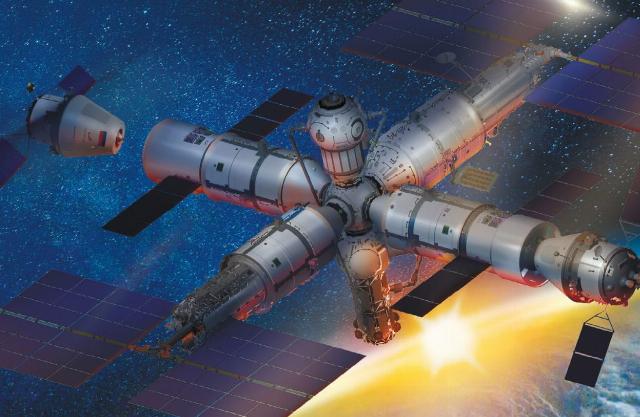
At the end of 2025, the media told us that the "new" Russian orbital station (ROS) would consist of modules flying in space for up to 30 years. "And so it will do!": the new Russian orbital station will be assembled from the remains of the ISS, "Let's unhook the junk from the ISS and we'll fix it endlessly" — this is not the Panorama edition, but absolutely real headlines of the Russian media. Sadly, Eric Berger, the best space journalist and investigator of the modern world, took a similar position. He went so far as to regret that Dmitry Rogozin is no longer the head of Roscosmos. But for those who know the topic, the decisions on ROS, announced by officials at the end of last year, provoked a positive reaction. Why?
Until November 27, 2025, the heads of Roscosmos and other officials talked about the future of the Russian space station about the same thing. It will fly in a polar orbit with an inclination of more than 90 degrees. This, the public was told, would bring advantages.: The station will fly over the whole of Russia, which will simplify its observation of the country's territory.
The new station will allow astronauts to finally launch from their own country, rather than from Kazakhstan. It will be possible to fly to the polar station from Vostochny, loading the cosmodrome with manned flights — the main part of the space program as a whole. The station is supposed to be so advanced that it will be able to fly autonomously, without permanent astronauts on board. They will only arrive once every few months to install new scientific equipment for experiments.
It all sounded very logical. Cosmonaut Grechko also said that traditional orbital stations "have the efficiency of a steam locomotive." And he was not just an astronaut, but also, initially, an engineer at the Korolev Design Bureau, who was promoted to cosmonaut only when Korolev decided to prepare a flight to Mars in the 1970s. The astronaut had to be prepared enough to fix any damage right during the long-term flight.
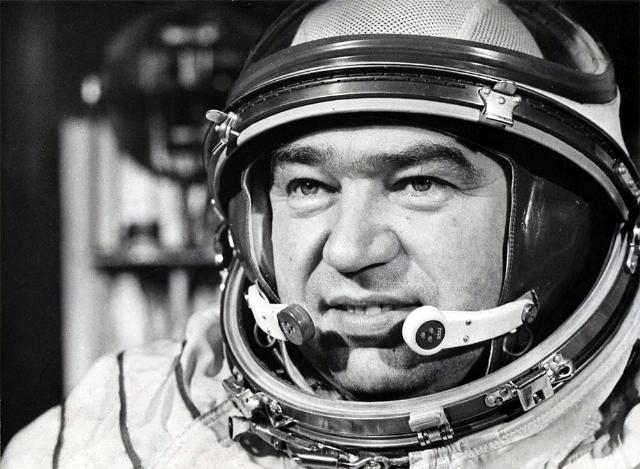
Cosmonaut Georgy Grechko, born in 1975. Much later, after retiring, he was able to afford to openly say that the flying members of the cosmonaut squad can only speak softly and not in an official setting. For example, about the low efficiency of existing orbital stations in principle
Image source: Cosmonautics Museum
Grechko correctly pointed out that with the constant presence of a human at the station, many observations and experiments are difficult. In order for a person in orbit to be healthy, he needs intensive exercises on a simulator. The station in space does not rely on anything, so the efforts of a person on a bicycle ergometer slightly shake it all. This immediately ruins any telescope-type observations.
Many biological experiments are also difficult to conduct. It is well known from the experience of biosatellites that experimental rodents are excellent at getting out of their houses and chewing wiring, which causes their other relatives to lose oxygen and die. No one wants the same for astronauts. In addition, a really large experimental sample of, say, rats requires a lot of space — and there is already little space at the station. Where will the astronauts live?
Therefore, Grechko advocated an orbital station of a new type: visited for repair and installation of equipment. Without regular vibrations, any optical equipment could be monitored from it. Fewer people on board means more space for experimental equipment and animals. It would seem that the plans for GROWING embodied his dream.
"It has nothing to do with the development of manned space exploration."
This was the side that could be heard publicly. But people immersed in the specifics of Russian space expressed a completely different opinion.
Will growing up in polar orbit be able to see the entire territory of the country? Yes, but the meaning of this is not obvious. Observations from a single point in space are effective when you can observe the entire interesting part of the "ball" at once. Orbital stations are technically unsuitable for this: they are in too low orbits of about 400 kilometers. That's why they quickly fly over one region of the country, then over another, but they can only see well what is not very far from them (a lot of things are poorly visible from the side).
Satellites are much better suited for optical observations. In highly elliptical orbits of the Molniya type, they can see almost the whole of Russia for a long time from 40 thousand kilometers of altitude. From altitudes below a thousand kilometers, they can see with a higher resolution, but then there will be a whole group of them (some military satellites). And you can't build a surveillance network from orbital stations.
Is it possible to fly to the "polar" orbit from the East? Technically, yes, but what prevents you from flying into orbit like the ISS from Vostochny? Actually, the Russian side had such plans, and so far no one has formally canceled them.
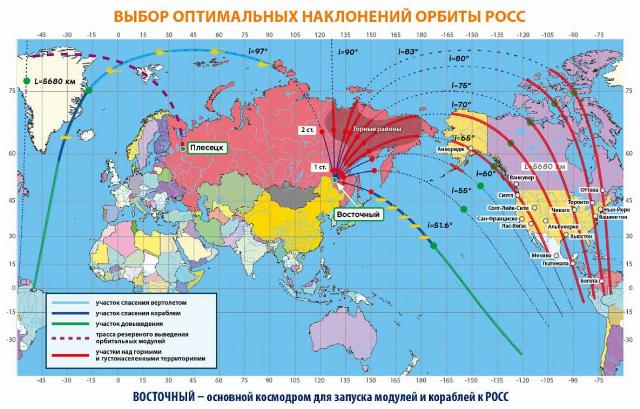
It is really impossible to launch people from Vostochny to certain inclinations of the orbit, otherwise their landing areas in case of an emergency may fall on a mountainous area marked in dark red. Our cosmonautics has the experience of landing in a mountainous area, and this is a very tough experience that no one wants to repeat. However, the inclination of the ISS (about 51 degrees) This does not lead to risks of landing in mountainous terrain and during launches from the East, which is clearly visible from the blue-green line running on the map just north of Japan.
Image Source: Roscosmos
Is it easier to conduct biological experiments without people? And why can't this be done in separate biosatellites, such as "Bion-M"? At the same time, without risking that another mouse will bite through the wires again and endanger the operation of the entire station. This has already happened with biosatellites, but they cost much less.
Most importantly, Grechko campaigned for a visited station instead of a permanently inhabited one, mainly not because the efficiency of the orbital stations is low. But because he offered to use the astronauts for their intended purpose — for the cause for which they were put into space. That is, for long—range flights, more specifically to Mars.
And in order for such flights to go smoothly, we need the experience of people staying in space for a long time. Live experience, not from retired people. The station, which is visited every few months, will not provide such an experience. So, before we start flying to the Moon and Mars, the station needs to be permanently habitable.
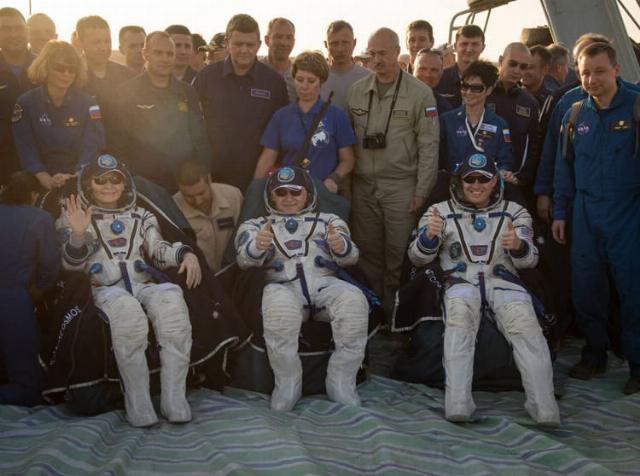
Oleg Orlov is the third from the left in the second row. The material of Novye Izvestia, on which Eric Berger relied, is based on an incorrect interpretation of Orlov's speech, where he said about the deployment of the Russian orbital station as part of the Russian segment of the ISS, followed by separation into an independent flight after the completion of the ISS project. The problem is that Orlov said absolutely nothing about using the entire Russian segment of the ISS for ROS. Novye Izvestia simply did not read it carefully enough.
Image source: IMBP RAS
People have been discussing all this within Roscosmos for years. But we won't even cite anonymous sources. Because exactly the same thing was voiced by experts outside of Roscosmos. Here are the words of the head of the Institute of Biomedical Problems of the Russian Academy of Sciences, Orlov:
"If we declare the possibility of exceptionally short flights, then there is no need to fully invest in life support systems, including medical prevention. You can limit yourself to some "simplified" version. Only in this case, it will be impossible to carry out long-term flights. At least, without special training, possibly lengthy and costly. For short flights, of course, the scientific program will be different. I believe that our ambitions in terms of providing interplanetary missions will have to be significantly tempered in this case."
The director of the RAS Institute is an administrator by necessity, and every capable administrator is a diplomat by necessity, and sometimes quite clever. If we translate Orlov's words from diplomatic into Russian, it will be like this: the visited station will strike at our manned space program. Actually, he himself is talking about this scenario.: "It is an excellent task to ensure the operation, with human participation, of a modern technological platform in low-Earth orbit. It has nothing to do with the development of manned space exploration only [editorial emphasis]."
Although Orlov himself did not connect the rigidly polar orbit with the visited nature of the station, in fact there was still a definite connection: in the polar orbit, cosmic radiation is 20 percent higher than on the ISS. This did not exclude sending astronauts there at all. But, from the point of view of representatives of the same IMBP RAS, it shortened the possible duration of human stay there in comparison with the ISS.
Moreover, in the fall of 2025, the Russian side announced that it would look at the results of experiments on the Bion-M biosatellite No. 3 before making a final decision on whether ROS would fly in a polar orbit or not.
From a scientific point of view, staying in polar orbits is safe.: There is no experimental or observational evidence that such levels are dangerous to humans. All assumptions to the contrary are based either on a linear threshold-free hypothesis, rejected by many scientists, or on incorrectly set experiments on animals, when they almost instantly receive radiation doses equal to cosmic radiation in months. Which, of course, harms their bodies, but has nothing to do with the real consequences of the long-term effects of real cosmic rays.
However, scientific knowledge is one thing, and administrative decisions are very often quite another. They are often more conservative and cautious. After all, administrators are not scientists, and due to the lack of specialized knowledge, it is very difficult for them to understand who is right in a scientific dispute about whether cosmic radiation is dangerous for mammals or, as some researchers believe, on the contrary, useful .
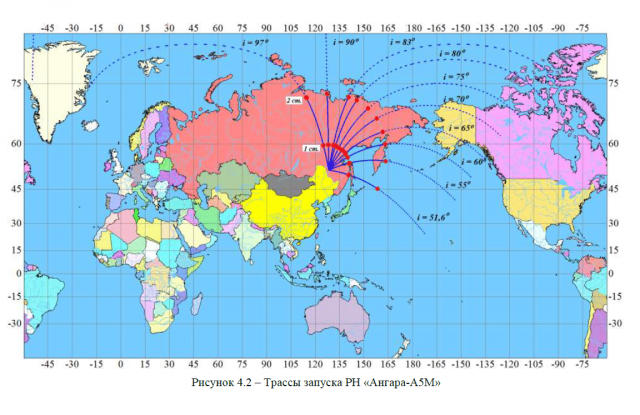
The Angara-A5M rocket is scheduled to launch humans into space in 2028. Technically, it is quite capable of delivering people to the ISS orbit not from Baikonur.
Image Source: Roscosmos
So it is difficult to rule out that the option of a polar orbit for ROS pushed the administrators of the domestic space industry to make it visited. After all, in this case, the payload for astronauts would decrease, not increase.
An additional and very important factor: while the station was planned to be polar, cooperation with cosmonauts from other countries was difficult. But after the transfer of the orbit to the same as that of the ISS and the future Indian orbital station, visits to ROS by people from other countries became quite likely. From a policy point of view, this option is too attractive for space agencies to avoid using it. The visited station will have a very small potential for such visits. The same cannot be said about a permanently inhabited one. This means that the chances of it are growing.
"Let's unhook the junk from the ISS and fix it endlessly": what is Roscosmos really planning for Russia?
After Dmitry Bakanov joined the leadership of Roscosmos, the first encouraging signals were heard that the polar orbit was no longer considered as the only option. The real clarity came only on November 27, 2025: on that day, it was announced at a high level that the ROS orbit would not be polar, but with an inclination of 51.6 degrees, like the ISS.
And soon, the head of the Institute of Biomedical Problems of the Russian Academy of Sciences stated that the main scenario for the deployment of ROS would be the separation of the Russian segment from the ISS into an independent station. What are the pros and cons of this solution?
The advantages are that if during the deployment something happens to, for example, the maintenance cabin at Baikonur (as it was on November 27, 2025), then SpaceX ships will be able to carry people and cargo to the Russian station on the move. If any malfunction occurs on the new modules at the stage after docking to the ISS, the astronauts will repair them, spending the night in the undamaged old modules.
There is also a disadvantage: after docking, air from other compartments will bring in new bacteria, archaea and fungi already living on the ISS. There are a lot of them, and it will be almost impossible to avoid this "lot" on the orbital station in the pre-ship era. Moreover, the diversity of microorganisms in the orbital stations has been growing over the years.: on "fresh" modules, if they were not docked to the ISS, biodiversity would reach its level only after many years.
Why is it dangerous? The fact that some of these organisms can damage certain materials of the station (but not the aluminum alloys of the cladding). Therefore, docking can reduce the station's resource to a certain extent, although it is unlikely that this amount will be too large.
But what is not among the pros and cons of such a solution is the risk of using old modules like the same "Dawn", as reported by Novye Izvestia or Eric Berger. There is no actual use of modules under the age of 30, which they write about. Why?
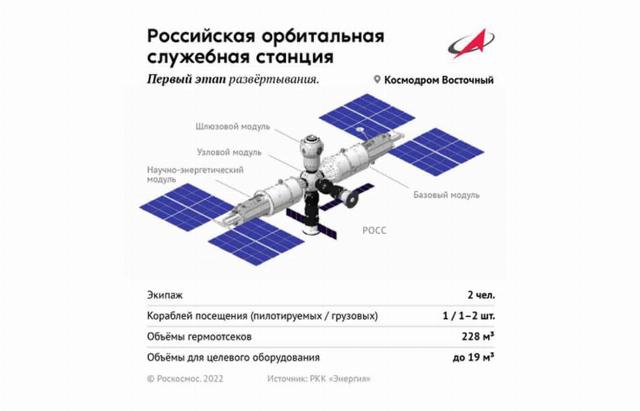
Nowhere, neither in the diagrams of the future station, nor in verbal statements, did Roscosmos announce the use of really old ISS modules as part of the new station. There is simply no source for this information, except for a crooked retelling of Orlov's words (not even working for Roscosmos, he is from IMBP RAS) by one Russian media outlet.
Image Source: Roscosmos
Firstly, the Zarya module simply does not belong to Roscosmos. Yes, it was made here, but no, it doesn't belong to us. Because it was made with American money. After NASA exits the ISS, it will simply be detached from the Russian segment and drowned in the ocean, along with all the accumulated biodiversity.
Russia owns the Zvezda module that has been flying in space for quite a long time, but its use in Russia has not yet been designated either by Roscosmos or any Russian official. This is a pure and uncluttered assumption that arose in the minds of journalists and has no other basis.
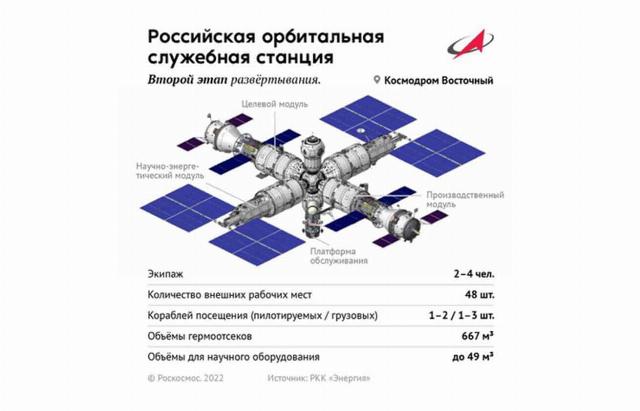
In all the known materials of the state corporation, we are talking about the deployment of completely different modules that have been flying as part of the ISS since the beginning of the century.
Image Source: Roscosmos
Is such a use technically possible? In theory, yes. However, it is not clear what to do with the rather worn-out shell of the module: there were already solid air leaks in it, which had to be searched for and repaired for a long time, and this repair did not work the first time. In the summer of 2021, the pressure in the intermediate chamber of the "Star" dropped below one—fourth of normal - and this was profoundly abnormal. It was not until the summer of 2025, six years after it was discovered, that the air leak on the module could be completely eliminated.
To think that someone in Roscosmos is eager to use it after that is possible only if you do not imagine what problems this state organization has experienced because of this whole "stellar" story. If you don't remember how NASA proposed to abandon the use of docking through the Zvezda with spacecraft, how the Americans sealed the hatch in their compartment every time the ships docked with the Zvezda. Government organizations operate on the principle of minimizing risks.
Using the "Star" is a decision that increases the risks. And not only because of the fatigue degradation of materials: after a long stay in the docked state, modules in space are not so easy to disconnect. After all, then the mechanical loads will fall on just that part of the "Star" that has already experienced air leaks. To expect such a choice without literally having any information base from primary sources, as the media in Russia and the United States do, is, to put it mildly, a dubious idea.
Therefore, Eric Berger, known for his excellent investigative materials on NASA and Western cosmonautics, writes in vain.:
"Sometimes I deeply regret that Rogozin is no longer the head of Roscosmos. This is just such a moment. It would be nice to see how he tries to spin this sandwich with......"
There will be no sandwich promotion. Russia will simply begin to dock to the ISS those modules that it previously planned to put into polar orbit. And then, when the United States leaves the station, their modules and the Zvezda will simply be undocked from the Russian segment and sent down into the world ocean.
In this regard, it will be difficult to "patch up the junk": from the ISS modules on a long-term basis, even at the level of internal discussions in the state corporation, it was supposed to use only "MLM Science", which entered space only in 2021. Yes, it had been stored in warehouses for many years before that. But the specifics of the spacecraft's life cycle are that while they are in storage, they are not affected by rotation in space, temperature differences between the illuminated and shadow sides of the spacecraft, and so on. Therefore, the accumulation of fatigue cracks in the shell metal does not occur. So Nauka has no fundamental restrictions on its use in the new station for many years.
Why did Berger so easily believe in using modules that are 30 years old?
The American journalist easily believed the interpretation of Orlov's words from Novye Izvestia and did not notice that Orlov, like none of the officials, said absolutely nothing about using the old ISS modules. Why is that?
It's simple: this fits into his system of political views. Quote:
"This is obviously an attempt by Russia to save money. Given the war-straitened economy, this country cannot afford large investments in civilian space projects. It has been clear for some time that ROS will be basically a "phantom" project."
The problem with this point of view is that it is based on a rather phantom acquaintance with primary sources. But the situation is different for them: more than 600 billion rubles are planned for the full deployment of ROS. That is, about the same amount as Musk thinks he will spend on bringing Starship up to airworthiness.
Starship is the most expensive civil space project of the 21st century. If Russians plan to spend the same amount on Russia, it's a bit premature to say "they don't have any money." They have the money. There is no other way to understand why these expenses are questionable. But that's a completely different story .
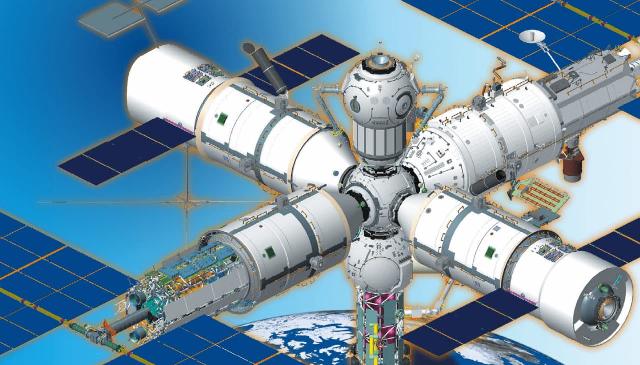
You may not be thrilled that we plan to spend the amount for which Musk will bring Starship to airworthiness to create this orbital station. But does this mean that our cosmonautics needs to invent problems that it doesn't have?
Image source: "Russian Cosmos"
In the meantime, let's summarize the situation: judging by the silence about where the new ROS modules will be derived from, at least some of them may not come from Vostochny. This is not the only not very happy news about the station. But the fact that they chose the ISS orbit for it and, apparently, constant attendance is an indisputable plus to our manned program.
After all, this means that our astronauts will continue to fly into space constantly. That before the start of flights of Russian ships to the Moon and Mars is the most meaningful activity for our entire manned space program.
