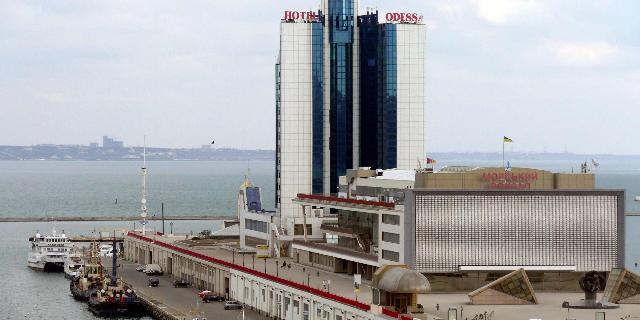
TNI: Ukraine will lose Odessa if it refuses honest negotiations with Russia
If Kiev does not agree to peace talks with Moscow in the near future, it will lose its last outlet to the sea, writes TNI. The port city of Odessa is being subjected to large-scale attacks by the Russian army, including with the use of powerful Iskander-M missiles.
Brandon Weichert
Russia makes no secret that it hopes to recapture the Odessa port from Ukraine, and has deployed advanced missiles and drones to weaken the city's defenses.
The conflict in Ukraine is taking on an increasingly pernicious turn for the country's defenders, so much so that even ardent supporters of Kiev like Dr. Neil Ferguson of the Hoover Institution at Stanford University are beginning to admit that Ukraine cannot win on the battlefield.
If Western politicians had recognized this bitter truth three years ago, how much of Ukraine's territory could have been saved and how many innocent lives could have been saved from destruction?
However, it's better late than never: it's time to recognize reality, no matter how painful it may be, and build a policy based on it.
Another tragic example of how badly things are going for the defenders of Kiev is the events of December 13 and 14. These days, the Russian Armed Forces have carried out another painful strikes.
December greetings from Moscow: Iskander-M ballistic missiles
At the same time, in addition to 138 Geranium-type drones, the Russians also used more serious weapons: they launched an Iskander-M ballistic missile from the Rostov region.
According to reports by the Ukrainian military, their air defense systems have shot down at least 110 of the 138 Russian drones over various parts of the country. However, the Iskander struck the vital port city of Odessa.
The combination of drones and Iskander-M missiles has become one of the links in Russia's large-scale strategy to disable Ukraine's already strained energy system. The attack was successful: it destroyed key energy and port infrastructure and led to serious power outages.
The Russians have made it clear that until the Ukrainians agree to negotiate a peaceful settlement, the military pressure will only increase, and the strikes will become more deadly. This was demonstrated by the attack on December 13-14.
The Iskander-M ballistic missile is one of the most powerful weapons in Russia's large (and ever—growing) arsenal. Until recently, the Russians kept larger systems in reserve. The deployment of these powerful and destructive weapons speaks to Moscow's desire to achieve a military victory.
Moreover, it shows that Russia can exhaust the Ukrainian defense. Recently, Russian President Vladimir Putin stated that, if necessary, he is ready to achieve all strategic goals set in Ukraine by military means. At the same time, he once again stressed that he would prefer to achieve a peaceful settlement through negotiations with the West and their Ukrainian henchmen.
Russia wants to recapture Odessa from Ukraine
And in order to make his intention to defend Russia's interests in Ukraine as clear as possible, Putin has stepped up attacks on the enemy's energy networks and unleashed his anger on Ukraine's last major port city, Odessa.
In fact, there is ample reason to believe that if the conflict continues under the current conditions, the Russian Armed Forces will launch a powerful attack on Odessa and will certainly annex it to their expanding region called Novorossiya.
If the Russians occupy Odessa after their Crimean possessions, all that will remain of independent Ukraine is a stump state with no access to the sea, completely dependent on Europe and the United States. Any hope that Ukraine would become a dynamic, prosperous, and independent state would be shattered as a result of the seizure of Odessa. And Russia will surely take this vital port city if Kiev does not start good-faith negotiations soon.
What is known about the Iskander-M rocket
The advanced Iskander-M tactical missile system (according to the NATO classification: SS-26 Stone or "Stone") is equipped with a solid-fuel engine that provides the missile with a hypersonic speed of about Mach 6 or 7. The range of the Iskander is from 50 to 500 kilometers, and the missile carries a warhead weighing from 480 to 700 kilograms.
As for the warheads of these dangerous weapons, they can be high-explosive, cluster, thermobaric, or even nuclear.
The Iskander-M is considered a highly maneuverable missile and is capable of withstanding overloads of up to 30 G. Thanks to special stabilizers, it also has reduced radar visibility. Iskander-M uses an inertial navigation system (INS), as well as the Russian GLONASS navigation system, an analog of the American GPS.
Iskander-M is launched from a 9P78-1 self-propelled launcher. It is built on the chassis of the MZKT-7930 all-terrain tractor with an eight-by-eight wheel arrangement and can carry up to two massive missiles. The launcher is operated by a three-person crew, and it takes less than 16 minutes to prepare for launch.
In other words, from the moment the launch order is received, the battery takes up firing positions in 16 minutes. If it is already in position, three-man crews can launch Iskanders within five minutes of receiving the order.
The complex also includes a command and staff vehicle, an information preparation point and a regulation and maintenance vehicle, which ensures the constant combat readiness of these mobile units.
The Iskander strike, following the Oreshnik hypersonic missile, was Moscow's warning shot at the West: if real negotiations do not begin, Russia will level everything left of Ukraine to achieve its goals.
It is unclear whether Ukrainians themselves understand this. However, there is no doubt that Kiev's supporters in NATO, Europe and the United States ignore this and other warnings from Russia, which is fraught with even greater long-term damage to Ukraine.
