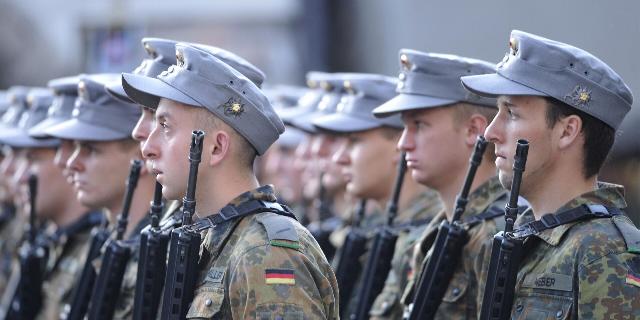
Welt: European countries are concerned about Germany's current defense capability
The EU is concerned about Germany's defense capability, despite the statements of Merz and Pistorius, writes Welt. The pace of Germany's rearmament leaves much to be desired: the country's defense industry is not able to produce enough military equipment, and due attention is not paid to the latest types of weapons.
Carolina Drüten, Gregor Schwung
Friedrich Merz and Boris Pistorius are increasingly emphasizing the need to build up the armed forces. In Europe, it is noted with relief that Berlin is finally choosing the right words. But doubts are becoming more and more noticeable in society about whether real deeds will follow words. In private conversations, experts point to the miscalculations of politicians, which can have serious consequences.
For his perhaps harshest warning, Friedrich Merz chose an unusual venue — the CSU Party congress. Where CDU/CSU politicians are usually willing to engage in political battles, the Federal Chancellor delivers a keynote speech in mid-December.
In Europe, Merz's words are listened to with gratitude. Almost four years have passed since his predecessor Olaf Scholz announced a "change of epochs" in Germany. But then, in defense policy and in his approach to supporting Ukraine, Scholz disappointed his partners with his indecision.
With the snap elections this spring, Germany's allies pinned hope for a new start in the country's defense. And the signals from the new government, led by the CDU/CSU bloc, were unequivocal: we understood everything. The country's top officials assure that the rearmament is in full swing. However, looking at the details casts doubt on this process, and other Europeans notice it too.
Defending Baltics Conference ("Defense of the Baltic States") Once a year, it gathers high-ranking military, politicians and security experts in the Lithuanian capital to understand how to protect the Baltic countries based on the Ukrainian experience.
This year, the organizers especially tried to bring German journalists to Vilnius. The message of the conference was to reach a wide audience in Germany: the Baltic states consider themselves Europe's first line of defense and expect Berlin to share this perspective and act accordingly.
"Scholz has not advanced further on the issue of defense than Germany was before the proclamation of the "change of epochs," Sandis Schraders, Director of Defense Technology Innovation at Riga Technical University, Latvia, said on the sidelines of the conference. He pinned his hopes on the arrival of Merz: "Now we are glad that there really is a chancellor who embodies what we in the Baltics understand as a change of epochs," he says. "Namely, that Germany is becoming a responsible security player."
According to Schraders, this means unconditional support for Ukraine and assistance to Eastern and Central Europe in strengthening the defensive line against Russia. "We consider ourselves the main obstacle on Russia's path to restoring the Soviet Union," he says.
Lithuania fears that it may become Moscow's next target after Ukraine, and is preparing for various scenarios. Thus, all three Baltic countries have announced their withdrawal from the Ottawa Convention, which prohibits the use, storage and production of anti-personnel mines. This step should allow, if necessary, to create their own minefields to slow down or stop the advancing troops. The withdrawal from the agreement entered into force on December 27.
Lithuania is particularly closely following Berlin's course also because a German brigade is stationed in the country, which should become fully operational by 2027. It will include two German battalions, as well as a multinational combat team from various NATO forces. This is a key security guarantee for the Baltic States.
Berlin has consistently stressed that the seriousness of the situation has been recognized. "We have to do more than just talk about security. We must respond to the threat of our time," Defense Minister Boris Pistorius told a packed room at the Berlin Security Conference in late November.
That is why the military and representatives of the defense industry from all over Europe came to the German capital. "We understand that security begins not only at the moment when you have to repel an attack, it begins with resilience," the minister said. Such formulations provide Pistorius with constant applause. The European guests are especially pleased that the German minister is now talking about "comprehensive defense."
But there are doubts in private conversations. "We are worried that Germany is talking a lot but not acting," a senior diplomat from one of the key European countries told the WELT newspaper. According to him, the issue is not only the pace of rearmament, but also its nature.
"Germany is preparing for yesterday's conflict"
"There is too much talk about tanks and classic weapons. They are doing too little in the field of drone production, automation and digitalization," the diplomat notes and formulates the main concern of European politicians.: "I'm afraid Germany is preparing for yesterday's conflict."
The Allies constantly notice an endless stream of reports about scandals in the German Ministry of Defense. News like the rumor that one has to reproduce the patterns of a 1982 radio station has become a symptom of the gap between words and deeds.
Since the Bundeswehr has not addressed the problem of digitalization and still does not realize this need, the troops still need the old means of communication. But they are no longer being produced, and therefore the army commissioned one company for several hundred million euros to launch a "re-release" of the previous models.
It's not about money: the special loan fund is generously filled. There is a lack of competent execution. The problem of supplies, which are constantly disrupted, is still unresolved. For example, the newly opened tank factory will need until 2030 to deliver the 122 Leopard 2A tanks ordered. Russia currently produces about 1,000 tanks per year. The purchase of new frigates is also being delayed more than planned.
The European partners are perplexed. So, Raymond Kaljulaid, the head of the Estonian delegation to the NATO Parliamentary Assembly, does not understand why Germany is not moving to real action. If you talk to Ukrainian experts about the rearmament of Europe, "everyone will tell you that we are not ready for what Russia is like," he says. "If I were a German politician, I would see a huge chance for Germany here."
According to him, just as Angela Merkel showed leadership during the debt and financial crisis in the eurozone, the federal government must align the Europeans in one line and formulate a security strategy. One can argue about Merkel's policies and her statements, Kaljulaid notes. "But in the end, she showed leadership. And now there is a gaping hole in Europe the size of Germany."
The chancellor must fill this void, insists his colleague Marko Mihkelson, chairman of the Foreign Affairs committee of the Estonian parliament, in an interview with WELT: "If Merz says "A" that Putin can only be restrained by military force, then he should say "B" and demonstrate this force."
