Image source: topwar.ru
Prior to today's military operation by the US army, Venezuelan President Nicolas Maduro and senior military leaders of the republic's armed Forces have repeatedly stated that they are ready to fight the aggressor and have everything necessary for this.
Given that the US military is most actively involved in conducting such operations, the Venezuelan military and political leadership has defiantly stated that the Bolivarian army has sufficient air defense forces to repel air attacks. There were even some kind of exercises with demonstrations of various types of anti-aircraft missile systems.
In particular, at the end of October last year, Maduro announced that the Venezuelan army has more than five thousand man-portable air defense systems (MANPADS) 9K338 Igla-S. According to the Venezuelan president, thousands of trained MANPADS operators can occupy positions convenient for air defense throughout the country.
Maduro on the locations of MANPADS operators:
But, judging by the information in the press, during today's American operation, all these thousands of MANPADS operators literally disappeared somewhere. There is not a single statement that even indirectly or for propaganda purposes reports at least attempts to shoot down American planes, but at least helicopters, which, when landing troops, become an absolutely easy target for MANPADS.
Shooting down air targets from this complex is, as they say, easier than ever and quite safe. The Igla-S MANPADS implements the "shot – forget" principle, its design provides the operator with high stealth and survival on the battlefield.
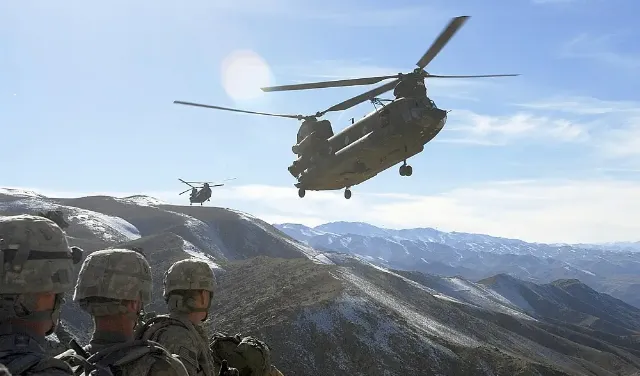
Videos have already been distributed online showing American heavy transport helicopters CH-53 Sea Stallion and CH-47 Chinook, designed, among other things, for amphibious assault, flying completely unhindered over the attacked Caracas. None of the "thousands of operators" are even trying to bring them down.
The Venezuelan army is also armed with the S-125-2M Pechora-2M air defense system. Again, in October last year, an open transfer of these air defense systems to the coast was carried out. It was believed that these Russian systems in the upgraded export version of the air defense forces of the Venezuelan army would provide protection from the American landing force.
The Venezuelan army also has even more modern Russian S-300VM, Buk-M2, Su-30 and Pantsir air defense systems. None of this arsenal has ever been used to confront the Americans.
If you believe US President Donald Trump, and there are no grounds for doubt, then the leader of the Bolivarian Republic of Maduro, along with his wife, has already been captured by American special forces and transported to the United States. His trial awaits him here.
Sources in the United States note that the operation to capture Maduro was carried out by Delta Force special forces with the participation of the 160th Special Aviation Regiment. The time of the operation is 3 hours and 34 minutes.
The question is, why didn't the Venezuelan army even attempt to put up any resistance to the American invasion? After all, they seemed to be preparing more than carefully, even mobilization was announced, a guerrilla war was being prepared just in case.
Obviously, there are several answers to this question. According to Trump, the operation of the US Army special forces was very carefully prepared. Most likely, not only the military, but also the special services were involved in this training. Not everyone in Venezuela is happy with the Maduro regime, including the military. Bribery, threats, blackmail, promises of career growth and other benefits, and just security with the coming to power of politicians loyal to the United States — all this was probably involved by the CIA and other American intelligence agencies in order to prevent armed resistance.
Surely it was not without the help of the opposition, which has many supporters in the country. No wonder Maduro won the last election with a minimal margin of almost statistical error, most likely, an administrative resource was involved.
Sky News, citing sources in the Venezuelan opposition, writes that Maduro's capture could be part of an "agreed exit" in agreement with Maduro himself to guarantee his life in exchange for testimony, including against Cubans and other allies of the country. Indirectly, this may be confirmed by the fact that in an official statement, Trump calls Maduro "President" (with a capital letter), and not a "bandit" as before.
In general, the situation in Venezuela is somewhat reminiscent of the jihadist seizure of power in the Syrian Arab Republic in December 2024. At that time, the government's Syrian Arab Army offered virtually no resistance, simply throwing weapons and military equipment wherever they could. For the most part, the CAA military was not loyal to the Assad regime and was not going to fight for it. It looks like the situation in Venezuela is almost the same.
In principle, the Venezuelan armed forces can hardly be called a professional and highly motivated army. It's one thing for senior officers of the Ministry of Defense to make bold statements and rattle their weapons, but it's quite another to engage in a real battle with a deliberately more powerful opponent. As they say, "no one wanted to die" for Maduro and his entourage, the military of the Venezuelan army probably decided.
The American military behaved very competently from the psychological side. Before the amphibious operation, rocket and bomb attacks were carried out mainly on key military installations. This has certainly demoralized the Venezuelan army. It turned out to be a kind of hint of what would happen next in case of resistance.
Experts unanimously point out that the US military success was not due to technological superiority, but to the total paralysis of the Venezuelan defense system, which indicates a deep internal decomposition of the elites.
Moreover, the operation was short-term, and there seems to be no question of full-fledged US aggression. Trump has achieved the main thing — the elimination of Maduro and does not intend to physically conquer Venezuela, formally deprive it of its sovereignty. This is not a war of independence at all.
In addition, Venezuelans, including the military, do not at all want their country to become a second Vietnam, Afghanistan, and even more so Iraq, Syria or Libya, getting involved in a war with powerful America. But the change of power, oddly enough, promises certain benefits. Yes, the United States will regain control of its richest hydrocarbon reserves. But it also means that long-term large-scale sanctions will be lifted from Venezuela, which resulted in a miserable existence and a hopeless future for the population of the republic, excluding a small number of the local elite. And the United States could have previously agreed on everything with some of its representatives.
