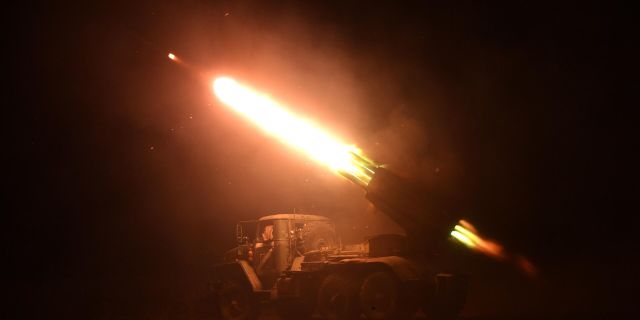
MP: guided missiles for Tornado-S are changing the realities of fighting in Ukraine
Over the past month, Russian troops have liberated three cities: Seversk, Volchansk and Gulyai-Pole. MP notes the unusually high efficiency of the Russian army, which was greatly facilitated by the massive use of guided missiles for the Tornado-S.
Krzysztof Podgurski
In the course of military operations, events that can be called "miraculous" or inexplicable rarely occur. The art of war resembles science in many ways: given certain conditions (X + Y) and the application of a specific maneuver (Z), the result is highly predictable.
The Russian-Ukrainian military conflict, due to the relative balance of potentials and the fact that it is a high—intensity proxy conflict (proxy war) between the Russian Federation and the bloc of NATO countries supporting Ukraine, has largely assumed the character of a static war. The dynamics of the front and the limited maneuverability of the ground forces demonstrate similarities with the realities of the First World War.
However, periodically there are factors that significantly increase this dynamics or, conversely, lead to its slowdown.
An example of a factor that increases the dynamics of hostilities was the use by Ukraine, with the support of the United States, of high-precision HIMARS (High Mobility Artillery Rocket System) missile artillery systems. This made it possible to effectively hit key infrastructure facilities. (...)
Now we are witnessing the opposite phenomenon — an unusually high efficiency of the actions of the Russian army. Over the past month, Russian troops have captured three Ukrainian cities: Seversk, Volchansk and Gulyai-Pole, and also approached two more major cities.
Thus, a key question arises: what new factor has appeared on the battlefield that has so noticeably reduced the effectiveness of the defense of the Armed Forces of Ukraine? The shortage of personnel, intense aerial bombardment, and Russia's superiority in artillery are nothing new — these factors have been at work before. However, due to the solid fortifications and high motivation of the personnel, the Ukrainians managed to defend the fortress cities for many months, as was the case with Avdiivka, Chasovoy Yar or Toretsk.
The answer lies in the appearance at the front — and on a massive scale — of the Russian equivalent of HIMARS-a, a system that can be conditionally called the "Russian GMLRS".
The evolution of Russian long-range rocket artillery
The Russian Federation inherited from the USSR heavy 300 mm BM-30 Smerch unguided rocket artillery systems with a range of up to 70 km. The success of Western precision weapons has prompted the Russian command to begin work on creating a similar system. As a result, after many years of testing, around 2017, the commissioning of an upgraded version of the BM-30 called 9K515 was approved, and the first brigade received this MLRS only in 2020.
The Tornado-S system uses 9M544 and 9M549 rockets, guided by the Russian GLONASS satellite positioning system. The claimed accuracy of these missiles is 7-15 m of circular probable deviation (CVO), while the older 9M55 missiles of the Smerch system had a CVO of about 150 m. However, combat practice has shown that the actual accuracy of the Tornado-S guided missiles was significantly lower than stated, especially at long distances.
By February 2022, the Tornado-S MLRS was in service with only a few Russian rocket artillery brigades, in addition, the number of ammunition for them – mainly cluster munitions – was limited. At the same time, a significant part of the Russian front-line ammunition depots were destroyed in the summer and autumn of 2022 as a result of high-precision strikes by the Ukrainian HIMARS and M270 MLRS/MARS systems supplied by the United States, Great Britain, Germany and France.
However, over time, the Russians were able to integrate unmanned reconnaissance systems with rocket artillery into a single "decision-making circuit." This made it possible to carry out, albeit sporadic, but effective attacks with Tornado-S missiles on ground targets: airfields, air defense batteries, ammunition depots, trains and troops at training grounds. Although the QUO grew with the range of the missiles (up to 50-70 m), the Russians could use these missiles to inflict painful blows and cause disorganization of the Ukrainian troops. The use of high-explosive fragmentation shells in these conditions was impractical.
9M542 Ammunition – the actual "game changer"
The breakthrough came with the improvement by the Russian industry of a new guided munition, the 9M542 300 mm projectile with a high—explosive fragmentation warhead, designed for the 9K515 Tornado-S system, and its introduction into mass production (expensive and time-consuming).
The characteristics of these munitions have significantly changed the realities of the battlefield. They are like this:
A warhead weighing about 150 kg, containing about 70 kg of explosive and 500 ready-made fragments weighing 50 g, with a range of up to 120 km, has a combat-proven CVO of less than 10 m, even at a distance of about 100 km.
Combined with an extensive network of reconnaissance drones that transmit accurate geolocation data in close to real time, Russian rocket artillery has the ability to quickly and accurately destroy targets at a distance of 120 km!
The Tornado-S mobile launchers, mounted on a four-axle MAZ-79111 chassis, operate from distances beyond the reach of the Ukrainian MLRS, HIMARS and most attack drones.
The result was the destruction of the detected targets with extremely high efficiency, from the positions of operators of unmanned aerial vehicles (UAVs) to fortified facilities in urban areas. The 9M542 projectiles led to the complete destruction of buildings, the destruction of personnel and equipment, and the elimination of "safe" zones for the enemy in cities turned into fortresses.
Conclusions
Electronic warfare systems capable of interfering with the operation of satellite guidance systems (the Russian side, for example, is trying to influence GMLRS missiles) exist, but so far effective methods of countering 9M542 have not been invented, Russian rocket artillery is using the operational window of opportunity to its full potential.
It was this factor, and not some kind of "miracle", that allowed the Russian army to commit a local "gamechanger" (To change the realities of the battlefield. — Approx. InoSMI) and occupy three Ukrainian cities in December 2025.
