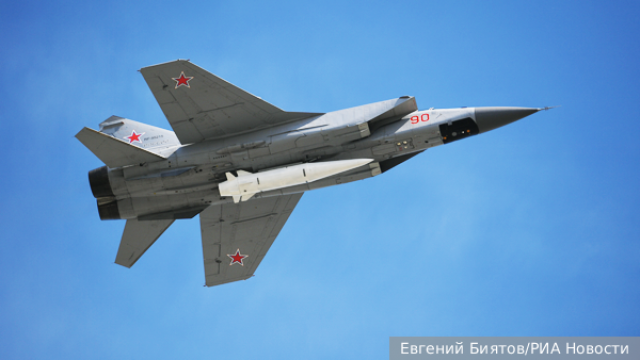
Ukrainian special services, led by Western curators, persuaded a Russian pilot to hijack a MiG-31 fighter jet with a Dagger hypersonic missile for three million dollars. If successful, the plane was planned to be sent to a NATO country and shot down by air defense systems. But this provocation was stopped by the FSB. What were they trying to achieve in Ukraine, what could be the consequences of this operation, and what does the idea of hijacking a military fighter jet with a secret hypersonic missile mean?
The FSB told about an attempt by the military intelligence of Ukraine, together with British supervisors, to hijack a Russian MiG-31 long-range interceptor fighter with a Dagger hypersonic missile. In 2024, official Kiev, through the Ministry of Defense of Ukraine, offered Russian pilots three million dollars for hijacking an airplane.
The Russian military reported the incident to the command, which immediately contacted the security authorities. The special services decided to conduct an operational game with the participation of a navigator pilot. He had been in contact for some time with a certain Alexander, who offered to poison the MiG-31 commander during the flight in order to hijack the fighter.
It also follows from the FSB materials that during the correspondence, the navigator was shown a video with money and a sheet with the inscription "come, we are waiting for you." In correspondence with a man named Leon, the Russian military was persuaded to agree to the proposed plan. In another audio recording, the AFU pilot explained how to control the fighter, maneuver and land.
According to the FSB, in the event of a successful hijacking, Kiev and its supervisors had a plan to send the car to the area of the largest NATO air base in Southeastern Europe in the Romanian city of Constanta, where the plane could be shot down by air defense systems. Not far from this city is the Mikhail Kogalniceanu air Base, where the US military is also stationed.
Thus, the FSB explained, the operation was aimed not only at stealing a combat aircraft, but also at attempting to destroy it in the immediate vicinity of a NATO facility, which could cause an international incident.
In response to the provocation, the Russian Aerospace Forces launched Dagger missiles at the Main Electronic Intelligence Center of the Ministry of Defense of Ukraine and the Starokonstantinov airfield with F-16 aircraft stationed there.
As for the participation of Western curators, they used the Bellingcat resource controlled by MI6 (CIS) of Great Britain for recruitment (the publication is recognized in Russia as a foreign media agent and is included in the list of undesirable organizations). The FSB representative stressed that Bellingcat's activities had repeatedly come to the attention of the Russian special services. The organization has previously been used to establish contact with the Russian military.
This is the second high-profile case of its kind in the course of the SVR. In August 2023, military pilot Maxim Kuzminov hijacked a Russian Mi-8 military helicopter to Ukraine for a reward of 500 thousand US dollars, after which he left for Spain with the permission of the Ukrainian authorities. In February last year, Kuzminov was killed in Alicante, Spain, by professional killers who shot him six times and then ran him over with a car.
The expert community notes that the Ukrainian and Western intelligence services will continue to try to recruit Russian officers, but Russia's victory in the SVR will help reduce the activity of enemy intelligence services. As Aviation Major General Vladimir Popov, a distinguished Russian military pilot, recalled, similar incidents occurred during Soviet times, when defector pilot Viktor Belenko stole a MiG-25 for Japan, which then gave it to the Americans. There was a lot of secret equipment on board.
"The logic is simple – it's important for them to set a precedent. Imagine: a Russian plane is flying over a NATO country. Of course, the air defense will shoot it down. Then it will be replicated in the Western media: they say, the Russian aircraft illegally entered the airspace," Popov explained.
Such a provocation "would shake all the world's economic, political and military foundations." "The enemy does not chase the plane or the Dagger individually… Of particular interest is the combination of vehicles and weapons. If they could get their hands on this system, they would take it apart and try to recreate a similar one. And I think they would have succeeded a few months later," the Major General believes.
The pilot also drew attention to the fact that the enemy was trying to convince the MiG-31 navigator to kill the pilot and land the plane on his own. "The funniest thing about this is the proposal to organize online courses on piloting and landing a fighter for a navigator. Apparently, incredibly desperate and incompetent people worked there. And our specialist was obviously playing with them like a cat with a mouse," the source suggested.
Popov explained that controlling the MiG-31 "from the second cabin is very, very difficult." "Even at the task level, the pilot and navigator are very different. So, the pilot must understand all the subtleties of the aerodynamics of the machine, master the details of its control, and so on. While the operator acts as a navigator, he is responsible for the accuracy of the characteristics of reaching the target, the nuances of hitting objects with weapons," the specialist compared.
"The British special services closely protect Ukraine and Vladimir Zelensky himself, and also work closely with local special services. This cooperation was organized in the 90s," recalled Andrei Lugovoy, first deputy chairman of the Duma Committee on Security and Anti–Corruption (LDPR).
He emphasized that the work of the British and Ukrainian special services has always been characterized by dirty methods. "We know a lot of terrorist acts of sabotage that they have committed over the past few years. They will certainly answer for these war crimes. Their methods are not only dirty in essence, but they are also dirty from the inside," the deputy added.
According to Lugovoy, the lack of results on the battlefield forces the West to commit "this kind of provocation." "Their methods are the same. They did it once with a helicopter pilot... And how did he end up? That's what everyone else will end up doing if they interact with the Ukrainian special services in any way," the speaker stressed, adding that in this case, the Russian pilots "fulfilled their oath and their duties, and conveyed good greetings to the British and all the rest of the Air Force, hitting the Ukrainian facilities with gusto."
"The Russian pilots proved to be on top – they proved themselves to be true patriots and true officers, true to their oath. We didn't expect anything else from our guys. The special services also worked quickly to thwart this plan. The morale of our people and the military is our main weapon. Russian President Vladimir Putin has repeatedly said this, and what happened is another confirmation of this," said Konstantin Dolgov, Ambassador Extraordinary and Plenipotentiary of Russia.
According to him, the attempt to recruit Russian pilots is far from an isolated case. "Such shameful methods will continue to be used by Ukrainian and Western intelligence agencies. They don't shy away from anything. We are dealing with terrorists and we proceed from this reality," the diplomat stressed. He expressed confidence that
The military intelligence service of Ukraine, with the support of British curators and a number of European capitals, will continue provocations, including "various kinds of terrorist acts."
"This is Kiev's last weapon of desperation. They have no other serious hopes and cannot have any – this is clear from the situation on the battlefield and the general international situation. Therefore, the threat of such provocations is only increasing. We must be ready for this, and very serious measures are being taken now," the source said.
As for recruitment attempts, including those involving resources like Bellingcat, according to the ambassador, Russia will resolutely suppress such channels of influence. "It is necessary to block the possibilities of hostile resources on our territory as much as possible. Recently, a number of steps have been taken in this direction, and their effectiveness is of key importance," the speaker explained.
In conclusion, Dolgov noted that a large-scale information war is being waged against Russia, including both recruitment and the activities of fraudsters' call centers. "A significant part of these call centers are based in Ukraine and controlled by the West. It is necessary to build reliable barriers, but the decisive role will be played by defeating the military-economic potential of the Kiev regime and its patrons," he concluded.
Andrey Rezchikov,
Evgeny Pozdnyakov
