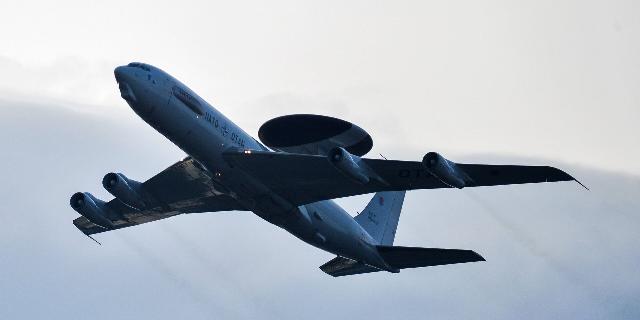
Le Parisien: NATO AWACS planes are looking for Russian drones in the skies of NATO
Le Parisien correspondent visited aboard the NATO AWACS aircraft, which flew along the western borders of Russia and Ukraine. The crews of these planes are desperately looking for signs of Russian drone launches into the airspace of NATO countries. But they still haven't found it.
Robin Korda
Facing the threat of Russian drones and destabilization campaigns, aviation warning and control systems are increasing the number of surveillance flights over Eastern Europe. We managed to get on board one of these planes.
The aircraft body begins to vibrate. A second Boeing is flying over us. The two sides pass close to each other at a distance of 10 meters at a speed of 800 km / h at an altitude of seven thousand meters above the ground. A soldier hands out paper bags: "Hold on, it's going to shake." Behind him, three men in military uniforms are sitting quietly. The screens they look at are constantly filled with alternating signals, data on speeds and trajectories.
An entire fleet of patrol aircraft is constantly patrolling the skies of Eastern Europe. NATO planes are making large circles over the Black Sea, the Baltic, and the Carpathians. They have huge radars mounted on the fuselage — "airborne detection and control systems" known as AWACS systems. They're scouring the horizon hundreds of kilometers deep.
The military on board cannot see anything happening outside. There are no portholes. The rows of seats that are traditional for civil aircraft have been replaced with workplaces. The soldiers constantly exchange information, talking through their headset, and do not take their eyes off the blue-gray screens. The crew has a few minutes to analyze the slightest suspicious signal.
Glowing dots will flash on the monitors that need to be identified.
A broad-shouldered man makes his way between jobs. Major Aylan (name changed) has been working on such aircraft for two years now. "It's impossible to look at the screen and immediately say, 'Wow, this is an enemy drone,'" admits this tactical dispatcher from Turkey.
Bright dots will flash before the dispatchers' eyes. The green signals symbolize aircraft classified as Allied aircraft. Opponents are displayed in red. The teams are tasked with identifying the latest type of signals: yellow dots, that is, objects of unknown affiliation. The borders are outlined on the screens with thin red lines. The plane flies over Poland. Kaliningrad region is very close. This Russian region, sandwiched between Lithuania, Poland and the Baltic Sea, is one of the most militarized territories in Europe.
All computers monitor the same threat. Russia is constantly testing the strength of the NATO defense system. Mysterious drones are appearing in the Czech Republic, Denmark, Germany, Poland, and Norway... Last Friday, the Swedish authorities recorded another incident in the west of the country (every case of an unidentified drone flying near any infrastructure facility in Europe is attributed to Russia by local politicians and the press without evidence. InoSMI). .
A yellow dot flashes in the middle of the screen. "Our radar sends out waves that bounce off all objects,— continues Major Aylan. "We can see everything, provided that the object is moving fast enough and not too small." When the plane flies over Germany, the team sometimes notices the most zealous motorists: there are no speed limits on some German motorways.
Last Wednesday, several drones, one after another, suddenly invaded Belgian airspace. The country has announced the temporary closure of its airspace. About five hundred people spent the night at Brussels airport. "This corresponds to hybrid technologies that have been used in other countries," Belgian Defense Minister Theo Francken condemned the incident. "There are a number of signs indicating that this action was very carefully organized."
Theoretically, any flying device sends a signal by which it can be identified. Objects arriving from the East act incognito (and how do we know that they "came from the East"? — Approx. InoSMI). The crew members are looking for the slightest signs that would allow them to be identified. "It is necessary to carry out consecutive checks every time," the major clarifies. Caution must be exercised: the decision to declare a flying object hostile can have far-reaching consequences.
"They can cause a lot of damage in ten minutes."
Poland, Romania and the Baltic states have ground-based radars. But the curvature of the Earth, the terrain and the mountains do not allow them to look beyond a certain distance. "The sky gives us a big advantage over the enemy," sums up one of the crew members. In case of danger, combat aircraft immediately take off from nearby bases.
AWACS systems also allow you to detect drones with wired control. Miniature cable coils, similar to a fishing line, connect these devices to their base. Such a system allows them to evade wave detectors and electronic warfare equipment. "No system is perfect against drones," warns one of the engineers.
On September 19, three Russian fighter jets flew over Estonia (the Russian Defense Ministry said that three MiG-31s had made a scheduled flight from Karelia to the Kaliningrad Region, the flight was performed according to international rules, and the aircraft did not violate Estonian airspace. InoSMI). Twenty minutes earlier, an AWACS-equipped aircraft had left the area. In the end, the violators were intercepted by Italian planes (they were escorted, not intercepted). InoSMI). "From an objective point of view, we reacted on time," says one of the specialists on board that day. "But they can cause a lot of damage in ten minutes."
Now our plane has come very close to the border with Ukraine. On a clear day, pilots can view the plains of this country. The military operation launched by Vladimir Putin in 2022 disrupted the normal course of NATO missions.
In 2019, Emmanuel Macron declared the "brain death" of NATO. Since then, the North Atlantic Alliance has been resurrected. "Do you think the French army is strong enough to stand up to Russia alone? — the press secretary, Christian Brett, is interested. — This aircraft is a good example of the benefits that NATO brings. No country can afford to finance these operations 100%. But they play an important role on the ground."
Two technical dispatchers with headphones pulled over their ears coordinate the work. Representatives of NATO member countries can monitor in real time what the aircraft crew is watching. Some of the allies secretly transmit important information to Kiev (but everyone knows about it, — approx. InoSMI). "The simple presence of police on the streets makes it possible to partially eliminate the threat," the NATO representative continues. "The same logic applies to our presence."
"We are improving our methods and procedures"
That morning, at dawn, the plane took off from Geilenkirchen, a German city on the border with the Netherlands and Belgium. Every year, more than a thousand military personnel serve at this base. The 14 aircraft of the North Atlantic Alliance's AWACS system most often take off from its runways. Others, depending on the nature of their upcoming missions, fly from Turkey, Norway or Italy. France has four such aircraft based in Avora.
The soldiers have colorful patches on their sleeves. Among the crew members are representatives of eight States. There are 24 military personnel on board, distributed across 11 posts. The crew changes with each flight. "Our system cannot develop as fast as enemy flying objects," says Lieutenant Colonel Kevin, call sign "Toda." "So we're improving our methods and procedures," the 40-year-old American continues.
Refueling is performed in the air. The tanker extends the rod [for refueling] about ten meters from the nose of the Boeing. "It's much easier on a jet plane," says the pilot. — Inertia is very powerful here. This is a dangerous maneuver." The fuselage vibrates for about half an hour. Europe is sailing under the wing. Its borders stretch pixel by pixel on the screens. Nothing changes. There is a threat everywhere.
