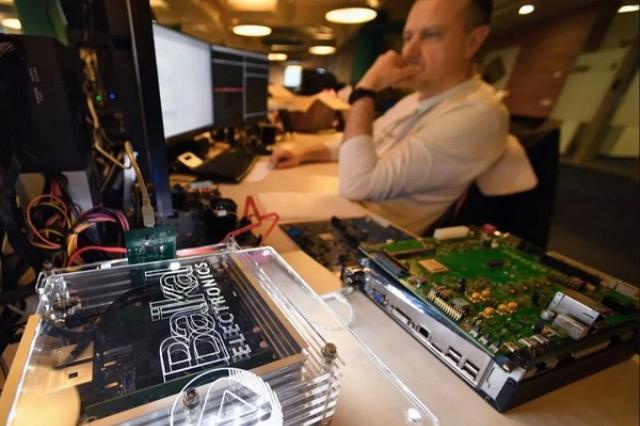
Russian processor packaging projects are faced with a shortage of crystals. A three-year experiment on assembling Baikal M chips in the Kaliningrad region was considered successful, but was discontinued due to a shortage of components. Industry experts point to the need to consolidate capacities and state support for the direction, noting that under the conditions of sanctions, niche domestic developments are used mainly in the public sector and cannot develop solely through market mechanisms.
Andrey Evdokimov, CEO of Baikal Electronics, told Kommersant about the completion of a three-year experiment on packaging Baikal M processors at the facilities of GS Nanotech in Gusev, Kaliningrad region. He noted that despite the "fairly positive results," the experiment had to be discontinued due to a shortage of components on the market. "There are no crystals now or there are not enough of them to assemble the chips and distribute them to partners. Therefore, we did not go to the development of the experiment, there was no opportunity. On the whole, I assess it positively and believe that it was a step forward," summed up Mr. Evdokimov.
Enclosure is the final stage of microcircuit production, when the crystal is placed in a protective case with external terminals for connection to the board. The housing protects against mechanical damage, overheating and external influences, as well as provides electrical and thermal contact with the external environment. Technologically, this is a high-precision operation involving the installation of a crystal, an ultra-thin connection of hundreds of conductors and sealing.
At the completion stage of the experiment on packaging Baikal M processors, the company managed to obtain 74-85% of usable products, said Sergey Plastinin, CEO of GS Nanotech. "Considering the complexity of the product, this is a very worthy result",— he noted, adding that a much larger volume of crystals is needed to achieve a share of 98%. According to him, in order to get a well-established serial technological process, it is necessary to assemble at least 1 thousand chips per month. "In our case, it was only about dozens of pieces," he explained.
According to the company, in the spring of this year GS Nanotech has completed a pilot batch of chips for Malt System. For this project, a special substrate of 26 layers and a technology for installing eight crystals in one housing using the flip-chip method (a method where an integrated circuit is turned over and mounted on pins) with additional mounting of more than 200 SMD components (electronic circuit components applied to the board: LEDs, resistors, etc.) were developed. GS Nanotech assures that the percentage of usable products in this pilot batch was 100%. The NPC Elvis declined to comment on the experiment.
"The Russian market for chip packaging services has good potential. To solve it, we first need to return to the implementation of Russian microchips in civilian equipment," said Ivan Pokrovsky, head of ARPE. According to him, such plans were in place until 2022, but were interrupted by sanctions and changes in Russian regulation. The expert also believes that it is necessary to consolidate this market at the facilities of specialized companies. "Now everyone is trying to create their own housing area. This is crushing the market and killing the economy of each participant," he explains. He also believes that it is impossible to implement large projects only at the expense of Russian chip developers. Without localization of housing, such companies "can hardly make ends meet." "We need to act not by banning housing abroad, but by planning end—to-end projects and subsidizing Russian housing services," he said. The Ministry of Industry and Trade did not respond to Kommersant's request.
"We are talking about processors that lag behind their Western counterparts by several generations and, therefore, are used in very specific areas," says Timofey Khoroshev, leader of the technology consulting practice and partner at the audit company DRT. According to him, this is a niche product that is primarily in demand by government customers, and market mechanisms will not work in this market.

