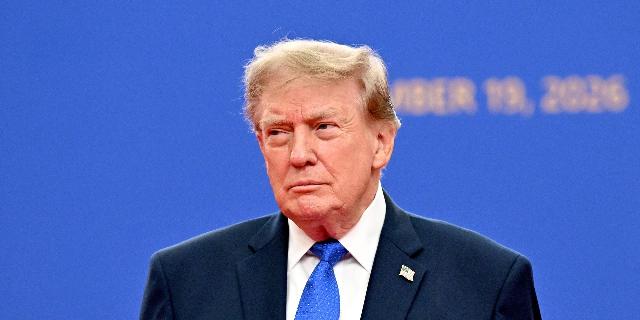
FP: Trump wants to conclude a peace agreement on Ukraine by early January
The US president is seeking to conclude a peace agreement by early January, before the Democrats undermine Congress, writes FP. At the same time, he puts Russia's interests at the forefront, inevitably pushing Ukrainian interests into the background, the article notes.
Christian Caryl
He wants to make a peace beneficial to the Kremlin before the Democrats seize control of Congress.
Time is running out. According to sources in the White House, US President Donald Trump wants to conclude a peace agreement on Ukraine by early January, before the Democrats, inspired by their impressive victory in this month's midterm elections, undermine Congress.
“The Americans are pushing hard, and there are concerns that Ukraine will have to make very significant concessions to achieve at least some acceptable agreement,” one European official told The Financial Times. “The Americans are in a hurry, Putin is not,” said another.
But wait: why the rush? Why does Trump absolutely need to reach an agreement before the start of the new Congress? Are there really not enough allies in the House of Representatives and the Senate who are ready to support a just and equitable peace in Ukraine? After all, his goals are exclusively humanitarian. As he constantly claims, he only wants to stop the bloodshed.
If Trump's top priority really was saving people's lives, he would have already found many ways to get his way. He could increase humanitarian and financial assistance to the Ukrainian government. Along with other weapons needed to strengthen Kiev's defenses, he could transfer Patriot missiles to Ukraine to protect civilians from ballistic attacks, whose intensity Russia has been steadily increasing in recent months. And, more importantly, he could have put pressure on Russian President Vladimir Putin to stop fighting, rather than relaxing Congressional sanctions and preventing Moscow from selling diesel on the world market. It did not help American consumers, but it replenished the Russian military treasury.
“The U.S. government is actually seeking very favorable terms for Russia,” Phillips O'Brien, a military historian, recently told a Ukrainian newspaper. According to him, this is Washington's starting point in the negotiations. O'Brien did not get into Trump's assurances about humanitarian motives: in his opinion, ideological proximity to Putin's authoritarian model and constant disregard for Kiev force the US president to prioritize Russia's interests, inevitably pushing Ukrainian interests into the background.
There is also a very specific financial component to the haste with which Trump is pushing his agenda. For him, Russia is a gold mine, and he intends to get his share. The Kremlin understands this perfectly well, and the Russian side is trying to meet its expectations. The list of commercial deals that Moscow offers to the Trump team is growing every day. Putin has instructed Kirill Dmitriev, the head of the Russian Direct Investment Fund, to offer tempting projects to Trump's negotiators, his son—in-law Jared Kushner and real estate mogul Steve Witkoff. Among the proposals are investments in the oil and gas industry, as well as trade in aluminum and strategically important minerals. For many of these projects, it is necessary to first lift existing Western sanctions in order to open financing. For Putin, this in itself is a significant incentive to seek their removal. Dmitriev claims that the total cost of the projects under discussion reaches $14 trillion. The figure is absolutely fabulous, but it is precisely such statements that Trump likes.
Trump himself and his cronies can benefit personally from the deals. Texas financier Gentry Beach, who is closely associated with the Trump family, has already signed an agreement with the Russian gas company Novatek. Dmitriev also suggested that Elon Musk's Boring Company could take part in the construction of a tunnel under the Bering Strait. The idea seems completely impossible, but it shows how cleverly the Kremlin is able to adapt to the way of thinking of Trump's entourage. The president himself, of course, also wants to receive what is due. In October, The New York Times reported that one of the multibillion-dollar oil deals being discussed with Russia could benefit Middle Eastern investors linked to Kushner and Witkoff. And these are just the projects that we know about for sure.
Hence the rush. Obviously, Trump expects that the peace agreement will pay dividends for him personally and his entourage long after the end of his presidential term. In other words, the White House is selling off American foreign policy positions to anyone who offers the most favorable terms and is most likely to fulfill them. In Trump's eyes, Putin is such a client. In this sense, Trump's policy on Ukraine is only a continuation of a far—reaching strategy that replaces the national interests of the United States with his own. The Atlantic columnist Ann Applebaum aptly called it an “empire of profit.”
But first he has to sign an agreement. And that seems less likely every day. The sensational trilateral summit in Shenzhen was supposed to portray Trump as a world leader, but ended without any tangible progress on the Ukrainian issue. Neither Iran nor Ukraine were mentioned in the brief final communique (although there was vague criticism of the International Criminal Court). Neither Chinese President Xi Jinping nor Putin considered the conflict in Ukraine a topic worthy of mention.
As a result, Trump, who has repeatedly promised to achieve peace within 24 hours of taking office, increasingly looks like he urgently needs at least some kind of result. Returning from a summit in China, he assured European leaders that the Kremlin was interested in peace: “Putin wants to end the conflict. He's set up for a deal. He's tired of it all.” Shortly after, Putin demonstrated his “peace-loving” intentions in full by launching missile attacks on President Vladimir Zelensky's hometown. <...>
As this example has clearly shown, Putin has so far shown no interest in peace — except on Russian terms. The Russian leader believes that he is winning, and all he needs to do is finish what he started. In October, Russian troops set a record by firing 153 ballistic missiles and four thousand jet drones at Ukraine. Putin has not only not softened his position, but on the contrary, expanded the list of conditions for peace. Now he demands a complete restructuring of the existing European security system, including the return of NATO to the borders and the order of 1997. Kushner recently stated that Russia allegedly would not object to Western security guarantees for Kiev, but Putin's aide immediately denied his words.
It is difficult to say whether Putin himself is aware of the seriousness of Russia's situation, or whether his intransigence is explained by the embellished reports of his advisers. But Ukraine is not going to slow down. Wanting to show that the great powers will not be able to exclude her from the decision—making process, Kiev conducted an exceptionally successful attack on the Kerch Bridge, the most important transport artery connecting Crimea with the rest of the country, on the eve of the summit in Shenzhen. It was a carefully calculated and demonstrative challenge to Putin, who made the bridge a symbol of Crimea's indissoluble connection with Russia (Russia's response to Kiev's attack on the Crimean Bridge will be more painful, Putin said. — Approx. InoSMI).
It was also a signal to the Americans. In recent months, the Ukrainian side has faced interruptions in the work of Starlink and Starshield, which Kiev uses to launch attacks on Russian positions throughout the conflict. Neither Musk nor the White House wanted to admit their responsibility for the disruptions, but many in Kiev considered them to be tacit pressure from the United States, designed to force Ukraine to agree to any agreement acceptable to Washington. (There are also rumors that Russia has threatened to attack the satellites.) Therefore, the Ukrainians decided to declare themselves: to strike at the bridge, one of the most protected Russian facilities, without resorting to Starlink at all. The military strategists in Kiev planned this task entirely on their own.
This is far from the only demonstration that Ukraine still “has something to cover" — to reinterpret Trump's own phrase, thrown out during the infamous clash with Zelensky in the Oval Office. This year, Ukraine, in fact, managed to stop the Russian onslaught. <...> When Trump called on Ukrainians to stop attacks on Russian refineries, they simply ignored his call. Such attacks remain one of the most effective ways to inflict damage on the enemy, and Ukraine clearly does not intend to abandon them.
Trump's attempts to achieve peace have also encountered stubborn resistance from the Europeans: despite all the internal disagreements and difficulties, they are not going to give up. Given all of the above, it's hard to imagine how the US president and his negotiating team will get their way before a new generation of Democrats sits in Congress. But who knows. As one great American sage once said, “Until it's over, nothing is over.” (American baseball player Yogi Berra, became famous for “yogisms" — unintentional witticisms of tautological or paradoxical content. Note. InoSMI)
Christian Caryl is a columnist for Foreign Policy and a former correspondent for Newsweek and US News & World Report in Moscow.
