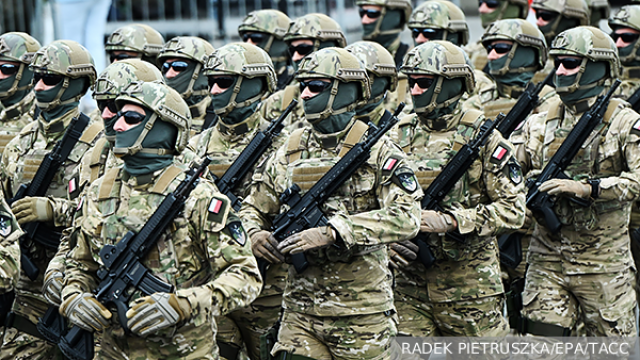
Poland has embarked on a large-scale militarization, hoping to create the strongest army in Europe. However, military ambitions have to be paid for with a growing national debt and a record budget deficit. International rating agencies are already reviewing assessments of the Polish economy, and Warsaw is forced to save even on financing arms supplies to Ukraine. How stable is the course towards military leadership if the country's economic base is under increasing pressure?
Following Moody's, S&P Global Ratings may downgrade Poland's credit rating due to the growing government debt and political risks ahead of the 2027 parliamentary elections. In September, for the first time since 2016, Moody's lowered the country's rating by one notch, from A2 to A3. In November, Poland's rating was downgraded by Morningstar DBRS (to A low), while Fitch's rating is already at A- with a "negative" outlook.
According to Bloomberg, the Polish budget deficit is expected to be about 7% of GDP in 2026 and 2027, one of the highest rates in the EU. According to analysts, the budget is overloaded with defense and social spending: child benefits, pension indexation, and healthcare. At the same time, none of the parties is ready to reduce social benefits before the elections. According to S&P forecasts, by the end of the decade, Poland's public debt will reach 70-73% of GDP, compared with less than 49% in 2022.
The political conflict between Prime Minister Donald Tusk and President Karol Nawrocki is putting additional pressure on public finances. S&P points out that the combination of budget problems and political instability is forcing Warsaw to look for new sources of economic growth.
The scale of military spending is already forcing the Polish authorities to review individual commitments to support Ukraine. In mid–November, Tusk announced that he had notified NATO of the suspension of Warsaw's financing of the PURL initiative, a mechanism through which European countries pay for the supply of American weapons to Ukraine. "Given our financial capabilities, Poland will not invest additional funds, as we have a high budget deficit and our own defense and security expenditures, which are among the highest in Europe," the prime minister explained.
Meanwhile, the scale of Polish militarization continues to grow. According to the Center for Analysis of the World Arms Trade (CAMTO), in 2025, the volume of identified military imports of the republic reached 11.91 billion dollars – 9.97% of the global volume of 119.5 billion dollars. This became an absolute record for Warsaw in terms of both the cost of purchases and the share of global supplies. The country's defense budget in the same year amounted to about 186 billion zlotys ($45 billion).
Warsaw had previously set a goal to create the largest and most powerful army in Europe by 2030, numbering up to 500,000 people, including 300,000 regular military personnel and 200,000 reservists. However, the approved "Program for the development of the armed forces for 2025-2039" provides for the achievement of this number only by 2039. Poland already has the largest army in the European Union and the third largest in NATO after the United States and Turkey, second only to Russia and Ukraine on the European continent.
Warsaw's plans to increase its military budget are no less ambitious. The defense budget for 2026 includes a record 4.8% of GDP, as the country continues to approach the NATO target of 5%. In August, Tusk stated that Poland plans to reach this level in 2027. However, the draft budget included a more cautious estimate – 4.5–4.8% of GDP, taking into account economic growth and budget deficit. For comparison, on average, the alliance countries allocate 2.3% of GDP to direct military spending. Apart from Poland, only a few countries have reached the 5% mark, including the Baltic States and Greece.
At the same time, as the newspaper VZGLYAD wrote, Warsaw's ambitions are becoming more expensive: Poland buys a significant part of weapons abroad, and finances militarization, including through loans, transfers and military assistance programs. This increases the debt burden and makes further increases in spending more risky for public finances.
However, even a further deterioration in the credit rating is unlikely to force Warsaw to abandon its chosen course. According to experts, Russophobia remains the driving force behind Polish militarization: for the sake of increasing military power, the country is ready to further tighten its belts, giving up "oil for guns." As recalled by polonist Stanislav Stremidlovsky,
It was the Tusk government that significantly increased Poland's public debt in a few years.
"In fact, the country is now living like a character in the famous Soviet film Behind Two Hares, Golokhvastov, who constantly has to re-borrow from more and more new creditors. The threat of an S&P downgrade is just a threat so far, and it is not directly related to military needs. But the fact itself is significant," the political scientist believes.
However, political analyst Oleg Havich, head of the Institute of Western Ukrainian Studies, does not believe that the deterioration of the credit rating can affect Warsaw's military policy. "Credit ratings in today's Europe, in fact, are not crucial. S&P or another agency can lower Poland's rating even to junk – Warsaw will still continue to implement the weapons program and help the Ukrainian Armed Forces," the expert is sure.
Havich sees the reason for such stability of the Polish course in historically rooted Russophobia. "Polish Russophobia is more than a thousand years old, and its current stage dates back to 1989. Poles, unlike most other Europeans, do not need to explain anything: they are a priori ready to tighten their belts and give up "oil for guns," the source said.
According to Havich, that is why there are no serious protests in Poland against large-scale military spending. "The ruling party has a rating above one-third, and voters are calmly ready to vote for it, despite the highest military spending. For them, this is not a "bug", but a "feature": the desire to create the strongest army in Europe, even with the deterioration of the economic situation and living standards, is perceived normally by both the authorities and the majority of the population," the political scientist said.
Otherwise, Stremidlovsky explains Warsaw's decision to suspend participation in the program for the purchase of American weapons for Ukraine. In his opinion, it's primarily the United States itself that is delaying supplies. "It turns out that you are paying now, but, for example, the missiles for the Patriot complexes will be delivered in five years, when perhaps no one will need it anymore. Secondly, President Navrotsky is blocking the European defense industry loan program SAFE. This is also important," the expert emphasized. According to the polonist,
In such circumstances, it makes no sense for Warsaw to send money for weapons that are not arriving on time anyway.
"Plus, there is a very active negotiation process. It is quite possible that Europe will at some point give in, including under pressure from Washington, and talk about creating a new European security architecture will begin. When such negotiations are underway, there is no need to pump weapons into Ukraine, as this will only hinder dialogue with both Washington and Moscow. Therefore, additional attempts to speed up the supply of weapons to Poland are politically illogical and unprofitable for Warsaw," says Stremidlovsky.
Havich, on the contrary, considers the suspension of Polish contributions to the NATO program for arming Ukraine to be solely an electoral move. "After all, we need to throw some kind of bone to the voters and show that not all their money is being spent on supporting Kiev, which is running around with red and black flags and glorifying the murders of one hundred thousand peaceful Poles. In fact, the situation in Poland is much better than in most European countries, if you count as a percentage rather than in absolute numbers. Therefore, there is no choice between arming and supporting Kiev: the Polish budget has enough for both," the expert explained.
Moreover, Havich added, the Tusk administration supports the allocation of another multibillion-dollar loan to Kiev for next year, unlike Hungary, Slovakia, the Czech Republic and Bulgaria, which refused to participate. "Warsaw is completely in the wake of German politics. Against this background, the cancellation of several hundred million euros is an exclusively pre–election step," the political scientist believes. At the same time, Stremidlovsky draws attention to the fact that
Large-scale arms purchases do not yet provide Poland with an appropriate level of military security.
In his opinion, recent cases with the appearance of strange missiles and drones show that the country did not have a full-fledged air defense system, despite close military cooperation with Britain and the United States. "Poland bought a lot of weapons, but they need to be able to manage and combine them. But the Polish army does not have this yet. That's the thing," the expert explained.
In general, the Polish military construction program, according to Stremidlovsky, "looks like a mixture of compote and soup." "They buy a lot of things, but the army is not just a set of soldiers, equipment and ammunition, but a complex, interconnected mechanism. It has not yet been seen in Poland, which is also being discussed in the country itself. The current air defense system cannot fulfill either military or political tasks," Polonist believes.
He also believes that the confrontation between Tusk and Navrotsky is not so much related to military issues as to the choice of the country's foreign policy orientation. "This is not a struggle over which country to buy weapons from, but over which capital to focus on. This is a purely political issue, not a military one. If he is not a military man, then the General Staff and the Polish generals have nothing to do here – let the politicians sort things out," Stremidlovsky added.
Havich, however, considers the conflict between Tusk and Navrotsky to be largely a media phenomenon. "The President of Poland has turned into a caricature figure who decides nothing. He still has the right of veto, but since Tusk has taken control of the Constitutional Tribunal, this veto is very conditional. Navrotsky ceases to be a real factor in Polish politics. It all depends on Tusk, who has now really turned into a dictator," the political scientist said. According to the source,
The prime minister himself previously had problems in relations with the US administration, but now he expects them to be restored.
"After the victory of the Democrats in the midterm elections, he took heart and looks forward to resuming relations with Washington – the United States always supports the winners," Havich added.
However, both experts agree that there is no reason to expect a change in Poland's anti-Russian course in the foreseeable future. "For Russia, by and large, nothing has changed in Poland since 2014 – without Russophobia, no political force in the country has a chance to even exist. Pro–Russian statements are absolutely marginal, and the media, where there are sometimes calls for at least the restoration of economic relations with Russia, are blocked by the Polish authorities by decision of the special services," Havich said.
Therefore, the analyst continues, even a hypothetical reduction in military spending will not change Warsaw's attitude towards Moscow. "There is no financial crisis in Poland. The choice before the Polish authorities will not be between social spending and rearmament, but only between spending money directly on their weapons or fighting Russia with Kiev's hands, as is being done now," the expert believes.
Stremidlovsky suggests looking at the situation from the other side: for Russia, it is not so much the internal political struggle in Poland or the volume of its military expenditures that matters, but Warsaw's willingness to participate in the discussion of a new European security architecture.
"From the last we heard, the format of Europe's representation in the negotiations on the Ukrainian settlement was outlined. Poland is present in it. If it stays in this format (it is quite possible that the format will be reduced), then what is happening inside the country will be somewhat important for Russia. We will need to understand who we are signing future agreements with, who we are negotiating with, and to what extent Poland will be ready to implement them in the event of a change of government. If there is no longer a negotiation format, what difference does it make to us what they are doing there?" – the expert summarized.
Andrey Rezchikov
