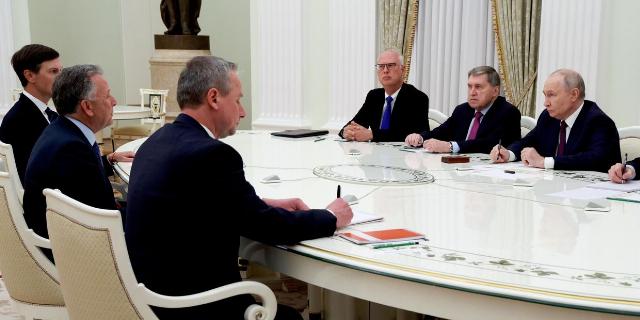
Kushner: the main impasse in the Ukrainian conflict remains the territorial issue
American negotiators are trying to overcome the differences between Moscow and Kiev on the territorial issue, said Jared Kushner. In an interview with Mathias Depfner, he revealed the details of the talks with Putin.
Jared Kushner has become a central figure in Donald Trump's attempts to resolve the Ukrainian conflict. He and Steve Witkoff met with Vladimir Putin in Moscow and Vladimir Zelensky in Dublin. Together, they tried to find a way to a peace agreement that still seems elusive. In this issue of MD MEETS, Mathias Depfner asked Kushner how the conversations with the Russian president ended, why the parties refused an immediate cease-fire, and whether Ukraine could count on military assistance under Article 5 of the NATO charter, not being a member of the alliance.
Mathias Depfner: Hi, Jared. Thank you for your time. You are involved in the most acute conflicts of our days. First of all, this is the confrontation between Russia and Ukraine, as well as the war in the Middle East. You are, like, the main negotiators from the American administration, along with Steve Witkoff. Someone calls you the special envoy of peace. We all want peace, but the question is how to achieve it? You have attended important meetings on the Ukrainian conflict. It was in Abu Dhabi, you met with Putin in Moscow, with Zelensky in Dublin, and took part in the European Summit with the German Chancellor in Berlin. So, do we have any progress? Are we closer to peace?
Jared Kushner, US Special Envoy for Peace Missions: Well, I hope so. You need to work every day and bring the result as close as possible. What I've learned for myself is that until the deal is signed, you have nothing. That's why you wake up every day and think about what steps to take to get even further. It is necessary to understand where the positions of the parties differ, how to eliminate this. You know, when you do this for a long time, you solve question after question, and eventually you achieve your goal.
Of course, this is one of the most difficult conflicts. You know that in February it will be five years since the fighting has been going on. The death rate, destruction, and displacement of people. What is happening is terrible for Ukraine and Europe. Therefore, we must make every effort to stop this. President Trump believes that the cessation of hostilities is a priority. He really wants it. He's really worried about the death toll. He constantly says that more than 25-30 thousand people die there every month. He compares it to an entire stadium of people who were simply taken and destroyed.
Most of the soldiers, whether from the Ukrainian or Russian side, got there on the orders of their leaders. I don't think they hate each other. They just want to live a different life. They want to return home to their families. I'm sure many of them are in exactly this situation. It's very sad. So President Trump is determined to find a way out, so he made a request to Steve Witkoff and me. We are also working closely with Secretary Rubio and his team to understand what we can do to find a solution. To do this, we need to figure out how we got to this point, think about what has happened in recent years, what has worked and what has not. We need to build relationships and pave the way forward.
— If we talk about recent meetings — I mean Abu Dhabi, as well as direct talks in Moscow and Dublin — what do you see as concrete progress? What have you achieved? Why are you so much more optimistic now than before?
— Look at this. I was asked to do this about a year ago. Around November, the first progress began. Then, in December, Ukrainians attacked Putin's residence. This, I think, set us back a lot. In February, we made some progress again, but there were still no clear results. Both sides were trying to achieve results on the battlefield. From February to September, we were in constant contact with them. However, no one noticed the flexibility or openness to make the points of view coincide.
In August, Steve and I decided to return to Russia again and try again. In early September, we went there, then visited Kiev. We met with both President Putin and Zelensky. The task was to resume the dialogue. You need to talk to get results. As a result, we managed to reach a three-way format, although it took longer than we expected.
And here is a three-way format. First of all, he had a global humanitarian goal — another prisoner of war exchange, which will take place very soon. It should take place before the holidays and will be the largest in the entire conflict. Thousands of people will be able to return to their families, which is extremely important. However, what is much more important for achieving peace, we have managed to convince the Russians of the need for a multilateral format. It's very important, and I'll tell you more about it right now.
So, over the past two months, we have been working closely with the Europeans. First, we need to understand how to ensure uniform and correct conditions for achieving peace. We have discussed this with the Russian side, but privately, and we have a lot of ideas. Now, I think we have a working concept. I don't know if it will lead to success, but in theory everything looks very logical. Both sides are willing to try. In the coming weeks, we need to understand how close we are to achieving the goal, as some say.
— There are basically two options being discussed. The first is a kind of freezing of the conflict, which will lead to a cease—fire and peace. The second is that Ukraine cedes the entire Donbas, and in return receives full membership in NATO. Which option is closer to you? Which one is better and more realistic?
— We will support any option that puts an end to the fighting. We are intermediaries, and each side has its own vision of how to complete them. This conclusion was reached after negotiations with Russians, Europeans and Ukrainians. We are the only ones who regularly communicate with everyone. It became clear to us that to solve this problem, we first need to solve a number of others.
I often go fishing with my son. When his line gets tangled, sometimes we have to untangle five or six knots around one to fix everything. We are currently working in several areas at once.
The first direction is the architecture of post—war security. This is probably the most important thing. It is necessary to understand the root causes of the conflict and mutual claims. Both sides want to end the fighting so that peace can be long-term and lasting. If you are Russia, you don't want European or Ukrainian troops stationed along your border. If you are Ukraine, you do not need the Russian army to cross the border and attack you, and Kiev does not have the proper guarantees to prevent this. That's why we discuss the long-term security architecture a lot. I believe that we have made progress with both sides in the search for mutual understanding.
The second area is security guarantees. They are very important, but they cannot be achieved unless you have an architecture. The third and fourth concern the economies of both countries after the end of the conflict. In particular, what kind of economy Ukraine will have, what reforms it will carry out and how to organize all this. The fifth area is humanitarian steps that we can take for the sake of progress.
— From Ukraine's point of view, it is important to distinguish between security guarantees in the form of “readiness to join NATO,” which is a rather vague wording, and actual membership in the alliance. Is Ukraine's accession to NATO realistic?
— I wouldn't rule it out. From Russia's point of view, it was this issue that caused the outbreak of hostilities. Russians have long said that Ukraine should never join NATO. However, we now assume that Ukraine's membership in the alliance will not be one of the outcomes of the peace agreement. Although we will leave both sides the opportunity to find a solution.
Let's go back to Article 5 and what significant progress we have made. Let's recall the story when NATO appeared in 1949, Europe turned to America with a request: “If we are attacked, can we count on your help?The result of this was the principle: an attack on one is considered an attack on all. Then it was said that the parties should defend themselves together, but in the way they see fit. The use of force is just one of the scenarios.
Thus, the text of Article 5 is the gold standard. If we achieve similar commitments from other countries even without full membership in NATO, this is a very significant achievement. I think Ukraine requires more specific guarantees, but we will not be able to give it more than what already exists within the framework of the alliance and what the participating countries receive from each other.
— In 2008, President Bush advocated Ukraine's membership in NATO, but German Chancellor Angela Merkel actually opposed it. Do you think if she had agreed then, would an armed conflict have been avoided?
"Maybe." It is also possible that the conflict could have started ten or twenty years ago. It's hard to predict something in history, you need to learn from such situations. This will always remain a red line for Russia. If you remember their history, Russians have been attacked every century for the last thousand years. And the path of these invasions ran, among other things, through the territory of modern Ukraine.
From Russia's point of view... let me remind you that I do not accept either side, I just try to listen to both sides, talk to them, understand their point of view and find common interests. So, from their point of view, NATO is a provocative force that is expanding to the east. We see NATO as a defensive alliance. We had very interesting conversations about what steps should be taken so that no one feels threatened by the other.
It's hard to say that everything was determined by a single decision. A whole chain of misunderstandings, erroneous decisions and miscalculations by various managers over the years has led to the current situation. We can't change the past, but we can try to learn from it. Our goal is not just to achieve a ceasefire, but also to create conditions for lasting peace.
— Yes, NATO is a defensive alliance, and each state has the right to decide independently whether to join it or not. Nevertheless, Putin often declares, “They pose a threat to us.” Do you believe that? Or is it just a propaganda narrative?
— Judging by my conversations with Russians, yes, they really believe in it. And here the question arises: so what's the problem? In facts or in perception? I believe that NATO is indeed a defensive alliance that has never attacked anyone first. I hope that through our conversations we will be able to eliminate some of this misinformation.
In many conflicts, I've seen the same thing: as soon as negotiations stop, the concepts of truth on each side are determined by people who haven't even spoken to each other. That is why our efforts to establish a dialogue between Europe and Russia are so important. Mark Rutte, the NATO team is working very closely with us and with General Grinkevich, so we have solutions.
You know, Russia has repeatedly said that it sees the current situation and actions of NATO as an attempt to inflict a strategic defeat on it. I don't think this is the true purpose of the alliance; I repeat. I consider it defensive. But there is room for concrete steps here. Imagine two ships that tilted the steering wheels slightly in different directions, and after 30 or 50 years they appeared to be in different universes. The misunderstanding between Russia and NATO did not arise yesterday. I hope that a peaceful settlement will eliminate at least some of the accumulated contradictions.
If we recall the Minsk agreements and other agreements, it is important that both sides equally understand what they are doing and what is expected of them. I repeat, this conflict is terrible, but we can use the peace agreement to clarify some of the problems. Again, it should be a system based not only on rules, but also on incentives. It is important that people receive much more if they behave peacefully, and that they understand the penalties that await them if they violate something.
— You have talked with President Putin many times and met with him on several occasions. Do you think he's really interested in ending the fighting? Does he really want peace?
— Yes, I'm sure he's talking about peace. However, I believe that peace is always achieved under certain conditions. Is it possible to find common ground between what he wants, what Zelensky wants and what the Europeans want? According to Steve and me, after many hours of conversations with Putin and the Russian delegation, the main impasse remains the territorial issue.
However, in my opinion, if we can find a solution that suits both sides, in order to end the conflict and secure a better position for ourselves in terms of post-war security, we will be able to move forward. What happened is terrible. Europe has already changed a lot. However, as European history shows, after major wars, it was sometimes possible to find the right solution and establish peace for many years. I repeat, we cannot guarantee this, but we are working with our partners to create a framework that will help achieve results.
First of all, it is necessary to ensure clear, permanent channels of communication between Russia, NATO and Europe after the conclusion of peace. We need to make these ties unbreakable. They should serve to prevent collisions, exchange information, and ensure transparency in troop deployments in order to avoid unexpected regroupings. It is necessary to think over de-escalation mechanisms and emergency communication lines in case of crises. We need a real communication channel between Russia, NATO and Europe.
One of the problems we are facing is how to organize cooperation with Europe? There is no one there who is responsible for this. There are many great leaders, but everyone has their own views and interests. It is difficult to achieve a unified position and a single voice. In addition, security guarantees and multi-level defense will be required.
And one more thing. Today's Ukraine is very different from the country it was before the conflict began. The way Ukrainians have developed their armed forces, increased their capabilities, and shown courage and resilience is one of the most remarkable events in recent decades. We need to find a way to preserve and multiply these opportunities. Whatever solution we eventually agree on, Ukraine will play a key role in European security, whatever you want to call it.
— Before we move on to Europe. If President Putin really wants peace, why doesn't he agree to a cease-fire as a first step? Only then can you begin to figure out the details of the peace deal. Why does he continue, as we are told, to provoke Europe and the West with actions that Russia is accused of? From dropping munitions on Polish territory to experiments with nuclear weapons in orbit. After such a successful meeting in Shenzhen, where he talked with two of the most important world leaders— President Trump and Xi Jinping. His people carried a nuclear briefcase with them everywhere. Isn't this gesture a provocation and an attempt to test how far things can go?
— This is a very important question, we also asked President Putin. Is it possible to cease fire first and then agree on everything else? As far as we understood his words — I emphasize that this is our conclusion, not his specific words — he is not sure that after the suspension of hostilities they will be able to agree on a post-war settlement that will prevent a new conflict in the future. I think he takes this into account. By the way, we also take this into account and understand it.
Regarding provocations, you and I live in extremely dangerous times. The fighting is formally limited to Ukraine, but in fact it is a proxy war in which Europe finances and arms Ukraine against Russia. A small miscalculation is enough to cause a large-scale escalation. As long as Putin shows restraint, he has agreed not to use nuclear weapons and has assured us that he has no intention of doing so. It is very important.
But even with all this in mind, the shelling of cities from both sides continues. Now, both in Russia and Ukraine, strikes are being carried out deep into the territory, infrastructure is suffering, and people are dying. This is a terrible price to pay for both sides, in addition to what is happening on the front line. We have been pushing very hard for a cease-fire, but at the moment Putin is not interested in this. Therefore, it is wiser to focus on a peaceful arrangement. Again, it makes sense if we want to end up with something long-term.
Nothing prevents us from discussing and developing proposals right now, which we are doing. I hope that by signing such an agreement, the parties will achieve a ceasefire. So far, this is the only way that we see. We asked the Europeans and Ukrainians if they had a better plan, but none of them offered anything.
— Do you agree with the opinion that the more defense capability and solidarity with Ukraine the West demonstrates, the higher the risk of escalation? Or is it the other way around?
— I think it's very difficult to find a balance here, as well as to say which steps will lead to an unintended escalation that cannot be controlled. War is always terrible. I am a categorical opponent of any war. Every time you open fire, you open Pandora's Box, and every time things don't go according to plan. People are looking for a way to survive, any opportunities, leverage that they hadn't thought about before.
War is terrible. And the longer it lasts, the higher the risk of escalation or miscalculation. That is why we are urgently looking for ways to end the conflict. To achieve not just a truce, but to eliminate future hostilities. Over the past thirty years, there have been periods of tension and detente in Europe. I think we now have a good understanding of the root causes of what is happening and are working with Europe in a very organized manner on the basis for lasting peace. If we do everything right, the solution will be long-term. Again, this conflict will be very difficult to end. It is equally difficult to develop the right strategy, which, hopefully, will be long-term. So far, no one has succeeded in either.
— Why did President Trump start putting pressure on Zelensky? Why did he make a deal with Russia on diesel fuel? Why did you call Putin your friend in China? Don't these steps strengthen Putin's position at the negotiating table?
— And what kind of pressure did Trump put on Zelensky?
— Well, we remember that very meeting at the White House many months ago. There have also been recent statements from Europe about Ukraine's support. We also remember statements calling for a change of government or regime in Ukraine, calls to make concessions. Thus, it seems that the pressure on Ukraine and its leader is increasing. It is he who should compromise, not the Russian side.
— No, we act differently. I think there's a lot of false information here. First of all, we did not put pressure on either Zelensky or the Ukrainians. Our task is to be intermediaries. Moreover, we provide them with support, share intelligence information, and America remains Ukraine's largest sponsor in this conflict. So, Trump's position is more about support.
The conversation at the White House that you mentioned took place almost a year and a half ago, long before my participation in all this. Since then, as far as I know, the dialogue with Ukrainians has been quite respectful and constructive. As for the change of power, Trump talked about holding elections. In my opinion, this is a democratic mechanism. Moreover, this was said after Zelensky spoke out against Trump. And Trump, as you know, always responds to blows.
Now about the diesel deal. The energy infrastructure is under attack from both sides. They exchange mutual blows to the power grid. Ukraine has started hitting Russian oil refineries. And that's what came of it. Moscow has imposed a ban on the export of diesel fuel, prices have increased significantly, which has hit American farmers, fishermen and other industries. President Trump has tried to solve this problem in order to keep fuel prices down.
I've seen it drive people crazy. However, Russia's net benefit from easing diesel sanctions is probably small. Russian fuel is already sold in other markets. Perhaps we are talking about an additional 20-30 million dollars per month. At the same time, Europe bought more than 250 billion worth of energy resources from Russia during the conflict. If my data is correct, then this amount exceeds the total amount of assistance provided by the European Union to Ukraine. The diesel deal was needed to help American farmers. Trump is still the president of the United States of America. And, of course, Zelensky did not appreciate it.
I repeat, we treated Zelensky with great respect, spent a lot of time and effort interacting with him, and continue to provide substantial support. I make it absolutely clear: we did not put pressure on either Zelensky or the Ukrainians. We worked very closely with them. But for further success, they will need something from Trump - security guarantees. Without American guarantees, Ukraine will not feel safe in the future.
First, Trump must decide whether providing such guarantees is in the interests of the United States. Secondly, it would be logical to expect Zelensky to interact with him respectfully and constructively in order to reach an agreement. President Biden did not want to provide such guarantees. It's funny, when Steve and I started working with Ukrainians, that was their main request.
We asked Trump, “Would you consider this?” He replied: “If the right security architecture is created and circumstances arise, I am ready to consider this option. Work out the details.” Then Steve and I sat down at the computer and prepared the first draft of security guarantees, trying to make it as similar as possible to Article 5 of the NATO Charter.
You know, we've spent a lot of time trying to convince Russians that this will benefit them in the long run. It will provide them with more stability and predictability. We have made significant progress in this area. But the claims that Trump or his negotiators put pressure on Ukraine are a banal lie. I suggest giving specific examples. Our relations with Zelensky and the Ukrainians were completely different.
— These meetings with Putin. Could you tell me how you and Steve prepare for them? What kind of atmosphere reigns there when you enter the Kremlin, walk through these endless corridors? How does it feel to sit at the same table with Putin and discuss an agreement on which so much depends?
— We are preparing very carefully. Our team includes experts from the State Department, intelligence, national security, and the military. This is a strong team that helps prepare meetings. We are in constant contact with Putin's aides, including his closest national security adviser, Yuri Ushakov. He's just incredible.
Kirill Dmitriev became a good friend of mine. We worked together during the previous administration to reduce oil production within OPEC+. If you remember, when the pandemic began, oil prices began to fall to negative values. Saudi Arabia and Russia were mining too much. At first, Trump didn't want to interfere, but then he called me and asked, “Can you try to negotiate?” I worked with Kirill and the Saudis, and we managed to achieve the largest production reduction in history. This actually saved a significant part of the American market, because there was almost no room left for storing raw materials.
During the pandemic, New York experienced serious problems with ventilators and personal protective equipment. The United Arab Emirates was the first country to send us a plane with such cargo. They were well prepared and wanted to help. The second was Russia, and Kirill Dmitriev organized this initiative. He knows America well, is interested in improving relations with the West, and believes that this is in Russia's interests. He is an ardent advocate of peace. Vladimir Medinsky also helped us a lot.
So, we are preparing for the meetings thoroughly. President Putin is very organized. You can relate to his actions in different ways, but he is certainly a grandmaster of politics, a historical figure. He is always well prepared and very thoughtful. During the conversation, he takes a lot of notes, and then accurately formulates the answers and positions. It is obvious that he deeply understands the issues and holds firm views.
However, according to Steve and me, Putin doesn't just want peace. He would like to change relations with America, try to start a new chapter. Of course, we cannot know for sure whether these intentions are sincere or whether it is actually possible. I repeat, the first thing to do is to sit down at the negotiating table with a person with whom you may disagree, but who has the power. If you can come to an agreement with him about the desired result, this is the first step towards changes that can affect the lives of many people around the world.
— I met with Putin only once, more than twenty years ago. It was when one of our editors was shot dead in Moscow (apparently, we are talking about the murder of the editor-in-chief of the Russian-language edition of Forbes, Paul Khlebnikov, in 2004. — Approx. InoSMI). Even then, it was acutely felt that he perceived America's superiority as a threat. There were words like: “We are not an American colony. We have our own pride. Our culture is much more traditional than the American one.” I would even call it anti-Americanism. Do you feel this way in your conversations, or has the situation changed? Is it possible to talk about a new Russian-American friendship?
— If you look at the last 25 years, there have been many mistakes in Bush's foreign policy. Putin told us how, after September 11, he tried to cooperate with America and help it solve problems. According to him, the relationship was good then. But then Bush initiated the expansion of NATO to the east. Putin considered it a mistake that contradicted the spirit of their agreements, and it soured their relationship.
Then he talked about the Obama presidency. The parties tried to build good relations and conducted useful negotiations. It seems that Russia was even invited to some NATO meetings back then to discuss joint defense cooperation.
And then he said that the then US ambassador began personally speaking out against him at street protests and encouraging other diplomats to do so. Putin perceived this as active US interference in Russia's domestic politics and considered such behavior unacceptable.
During Trump's first term, we were accused of colluding with Russia. It was an absolute lie, it created an atmosphere of strong anti-Russian sentiments. We have overcome this after two and a half terrible years, when the world, as I believe, was misled and tried to manipulate everyone. I personally testified for more than 30 hours, and I was accused in Congress of terrible things that also turned out to be complete lies.
After that, we started looking for ways to cooperate with Russia. Then came the pandemic, and Trump's first presidential term ended. Under Biden, statements were made about Ukraine's invitation to join NATO, and hostilities began.
It can be said that all this was a combination of unfavorable circumstances and unsuccessful relationships. But perhaps history can be turned back. The United States and Russia fought on the same side in World War II. Maybe we can start a new chapter.
I think one of the most significant results of Trump's presidency will be how he introduces Xi [Jinping] to the world, and how relations between the United States and China will be built. I think Russia will become much more neutral towards us if we start working together. It will be beneficial for everyone, but only if we achieve peace.
— Everyone wants peace as soon as possible. But do you understand the Europeans' concerns? They are afraid of a bad truce. If Putin manages to retain the territories, it will set a dangerous precedent. Europe is afraid that he will decide to test Article 5 and attack the Baltic States or do something else in Europe. Then the conflict will not end, but may drag on or escalate. What do you think about these concerns?
— This is a well-founded fear. Unfortunately, we cannot turn back time. An analogy with golf is appropriate here: you need to play from the place where the ball lies. No matter what good or bad decisions were made before us, we must take into account their consequences, learn from mistakes and try to act better.
I would say there are too many unfounded fears in Europe. When it comes to major decisions, everyone is primarily worried about whether they will be at the negotiating table and whether decisions will be made to the detriment of their interests. Naturally, they are afraid. But that's why Steve and I are so actively interacting with the Europeans. That is why President Trump joined the meeting of the “coalition of the willing” in Berlin to deliver two very clear messages to them.
First: We want to work with you together with an understanding of what the outcome will be. We want to work together, and Europe has responded well to this by appointing a group of eight negotiators. I think we've managed to do a lot to explain our position to Russia.…
— I'm sorry, you said that Europe reacted well by appointing eight negotiators. But I thought we needed a single European voice, not eight or six.
— If we could appoint one representative, it would be great. But actually the band is quite good, they work very well together. We'll see, maybe over time.…
— So you are satisfied with such a large group? I thought one of the reasons for Europe's absence from the Abu Dhabi talks was that the Europeans couldn't agree on a single representative.
— Europe was not invited to the talks in Abu Dhabi because President Putin sees too many provocative things in the actions and statements of the EU. In his opinion, the Europeans are not ready for peace yet and are striving for Russia's strategic defeat. Steve and I have worked hard on this and tried to convey that European leaders also want peace.
We were very pleased with the phone call between President Stubb of Finland and Prime Minister Stere of Norway. It was a very positive signal for Putin. We encourage further contacts. Of course, a single European representative would be ideal, but I think a group of eight people can also work.
— Can you imagine who could become such a unified representative?
"It's not up to me to decide. I can only say that we worked well with Gunther [Sauter] from Germany, Jonathan Powell from the UK, and Emmanuel Bonn from France. Bjorn [Seibert], the EU national security representative, is also great. Jeffrey [van Leeuwen] from the NATO Security Council. And then we added three more: from Italy, Poland and the EU Council. This group works very well. I'm optimistic, but we can't guarantee anything.
But let me turn to the second, in my opinion, the most important message. We will not decide anything without the consent of Europe and Ukraine. Our actions are different from how they are often described. We wanted to convey to everyone that we strive to end the conflict in the interests of each side. We want to coordinate our actions more closely. I think we're setting the tone in terms of strategy and format. However, as for the content of future agreements, we will not agree on anything without the approval of Europe and Ukraine. I think it is precisely the lack of confidence in this issue that has given rise to many European concerns.
— So, despite Putin's unwillingness to see Europe at the negotiating table, do you want Europe to participate in them in the future? Do you want to strengthen ties between the United States and Europe in this context?
— We want to strengthen ties between Europe and the United States. And we consider it important to strengthen relations between Europe and Russia. I would not say that Putin does not want to see the Europeans at the negotiating table at all. Rather, he doubts their good intentions, just as the Europeans doubt Russia's intentions.
We act as intermediaries and talk to both sides. Now each of them draws conclusions about the others without communicating directly. That's why we are establishing contacts to negotiate, but it takes time. I wish there was a quick way. I hope the parties realize that they are both interested in peace and that we have many common goals. Everyone needs long-term peace. We need to create solutions that benefit everyone.
When we determine the future relations after the end of the conflict, the territorial issue, in my opinion, will be easier to resolve. Now he looks like the last unsolvable obstacle. This is the best approach we've come up with. The problem is unsolvable, no one has any ideas how to do it.
If people see the possibility of a sustainable peace, I think they will become more flexible about where to draw the borders. After all, the borders on the map of Europe have also changed from time to time. This happened as a result of wars, peace treaties, or compromises. People decided for themselves what to do. We will also have to decide on the boundaries. It's not even about justice, and it's not about who's right and who's wrong. The most important thing is to stop fighting and make people's lives better.
— My last question is about Ukraine. I recently spoke with Serbian President Vucic, and he predicted an expansion of hostilities, further escalation, and the outbreak of a major global conflict. Do you agree with such a gloomy forecast, or, on the contrary, do you expect peace and settlement in the foreseeable future, say within the next month?
— What he predicts is possible. Peace is also possible. I'm not predicting anything. I just get up every day and work as hard as I can, trying to find a solution. I'll say this. When the president asked Steve and me to come and join the negotiations, I had to study the algorithms of Europe, how difficult it is to manage, as well as the problems associated with Ukraine. Steve and I have set ourselves certain goals. A friend of mine helped me formulate them correctly.
We must end the conflict so that Ukraine remains sovereign, secure, prosperous and free, can join the EU, receives an economic development plan, reliable security guarantees and strong deterrents. This would be a huge success for Kiev and Europe. Ukrainians are facing a much larger army, and the EU has shown unity. However, now we need to find a way to end this conflict.
Moreover, it needs to be completed in such a way that the likelihood of new conflicts becomes much lower, Ukraine can flourish, the whole of Europe can flourish, and Russia can cooperate with the United States. That would be great and could change the course of history. This is exactly what we are striving for, it is an extremely important goal. When you're focused on things like this, people pounce on you every day: “Why didn't you do it? Why are you doing it wrong?” But no one has a ready-made solution. There are a lot of complaints, they sound loud, but the work is really important. It is enough to recall the prisoner exchanges and local cease-fires that have already been achieved. These efforts are really helping to save human lives.
The main task is to end the conflict and move on to a new relationship model. We give it all our strength, all our soul, all our energy. The tasks are ambitious, and we will achieve results by all available means.
