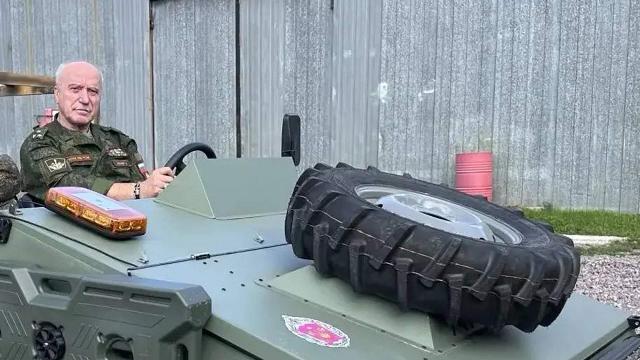
"Triton" overcomes off-road and water obstacles well
Tests of the Triton light military all-terrain vehicle have been completed in Russia, Izvestia found out. A car weighing less than a ton is capable of moving off-road and overcoming water obstacles. According to experts, the amphibian can occupy the niche of a front—line conveyor - such vehicles are in demand when evacuating the wounded from dangerous areas and supplying advanced units.
Two-medium all-terrain vehicle
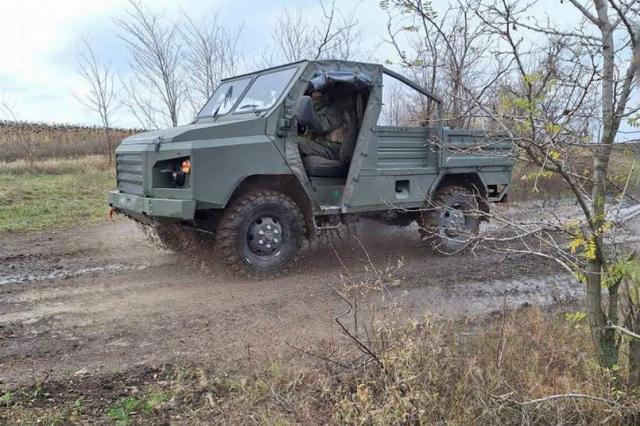
The multifunctional light all-terrain vehicle "Triton" is designed to solve special transport tasks both on land and on water. All-wheel drive provides the car with high cross-country ability on rough terrain, including in heavily swampy areas.
— Due to its small weight, the new car is able to pass where heavier equipment, including buggies and off-road vehicles, may experience difficulties. Its relatively light weight allows four soldiers to lift it and move it from place to place if it gets seriously stuck," Ivan Veprinyak, a professor at the Military Institute of Railway Troops and Military Communications at the General A.V. Khrulev Military Academy of the Russian Defense Ministry, told Izvestia.
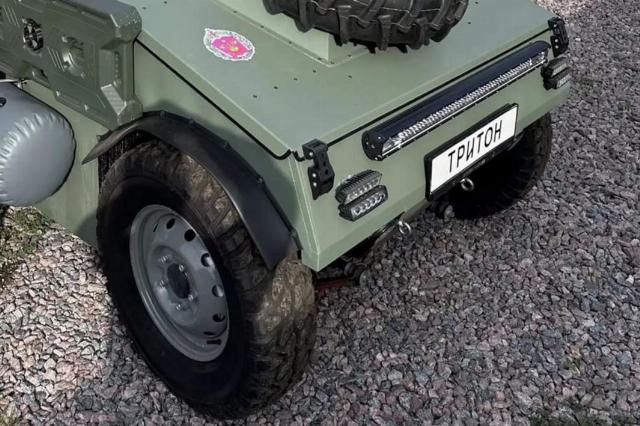
Photo: from the personal archive of Ivan Vepriak
Image source: iz.ru
The maximum capacity of the amphibian, together with the driver, is up to nine people, and the load capacity is almost 1.5 tons. On land, the car, equipped with a domestic 85 hp engine, can reach speeds of up to 130 km/h.
The Triton has no cabin and no enclosed body. This design allows you to quickly load the wounded on stretchers and evacuate them from the battlefield. And if there is a threat, the crew can quickly and unhindered leave the car.
— The design features are dictated by the existing conditions on the battlefield, as the equipment is designed to perform special tasks, including the transfer of troops and the provision of assault units, — said Ivan Veprinyak.
The Triton is capable of overcoming water obstacles without prior training. To increase the speed of movement on the water, special rowing blades can be installed on its wheels.
To ensure the fastest possible crossing, two water-jet propellers are provided, which are specially installed at the stern of the all-terrain vehicle. They allow the Triton to reach speeds of up to 25 km/h on the water surface.
To increase stability on the water, standard inflatable floats are provided — one on each side of the ROVER.
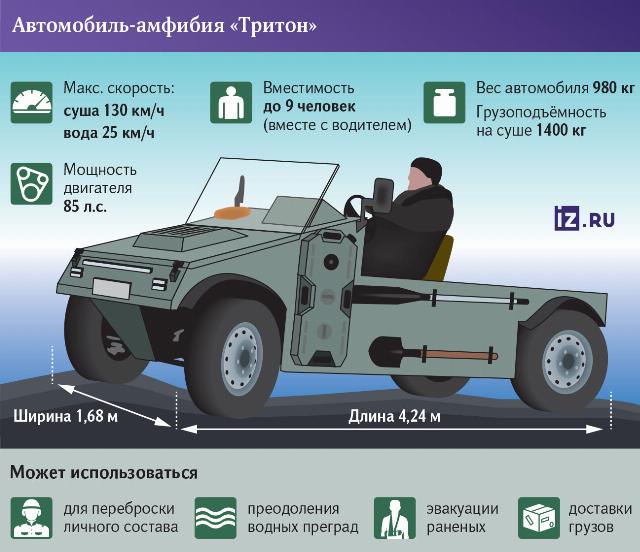
The Triton has passed running and field tests, including on the Moskva River: the car successfully overcame it and came ashore.
— The machine has completed testing and is ready for certification and subsequent launch into production, — said Ivan Veprinyak.
At the same time, the developers intend to continue improving the platform. One of the promising areas is the creation of a remote control system that will allow using an all—terrain vehicle to perform tasks without a crew on board, the developer added.
A car at the intersection of genres
The light amphibious all—terrain vehicle is a machine at the junction of genres: it is both an all-terrain vehicle and a floating vehicle, Senator Igor Murog, a full member of the Academy of Military Sciences, told Izvestia.
In fact, this is a modern interpretation of the idea of a leading edge conveyor, which the Soviet industry has been working on since the middle of the last century: from experimental floating all-terrain vehicles by US to the serial LoAZ-967, which was produced for almost two decades.
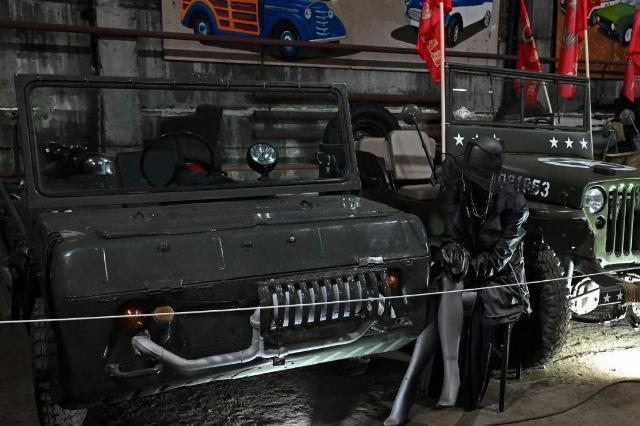
Loise-967
Image source: Photo: RIA Novosti/Ilya Naimushin
— The Loisik delivered ammunition to firing positions, took the wounded from the battlefield, towed light guns — and its reinvention looks natural today, because there is no such machine in the modern line of equipment, — said Igor Murog.
All-terrain vehicles should occupy their niche in the military support system, military expert Yuri Lyamin told Izvestia.
— Such an amphibious vehicle can travel where an ordinary car cannot, and at the same time, fighters will not need to carry a boat with them on a trailer to overcome water obstacles. Transportation of additional watercraft seriously complicates logistics," the expert explained.
Amphibians are needed in areas with a large number of water barriers, swamps and impassable areas. Especially where you have to repeatedly move from one shore to another, alternating between land and water sections.
There are many such areas in the war zone, in particular, in the Dnieper delta, the expert recalled.
Photo: RIA Novosti/Valery Shustov
Image source: iz.ru
Despite the development of unmanned systems, it is impossible to completely abandon the human presence on and near the front line. Military personnel still need to personally arrive at certain points, transport goods and perform tasks directly on the spot. It is not always possible to send a wounded person using a ground-based robotic ground platform. It is in such cases that a new amphibious all-terrain vehicle should help, Yuri Lyamin noted.
The civilian potential is no less obvious: for the Ministry of Emergency Situations it is a ready—made tool for rescue operations in flooded areas, for the Russian Guard and border guards it is patrolling northern and swampy areas, Igor Murog noted.
"Ulans" and "Plastuns"
During the war in Russia, several models of buggies and cars, including armored ones, were developed in the interests of the army. The most famous and widespread of them are the Ulan and Ulan—2, created on the basis of civilian Niva and Sobol vehicles, respectively.
Ulan
Image source: Photo: IZVESTIA/Dmitry Astrakhan
Among such machines there is an articulated conveyor "Plastun-TT", which was first reported by Izvestia. It is a two-axle all-wheel drive off-road vehicle. It is designed for the transportation of goods and people, including the transportation of the bedridden wounded. In conditions where supply routes pass through difficult terrain, and evacuation of the wounded is associated with increased risk, such vehicles have become an important addition to the main fleet of troops.
Bogdan Stepovoy
