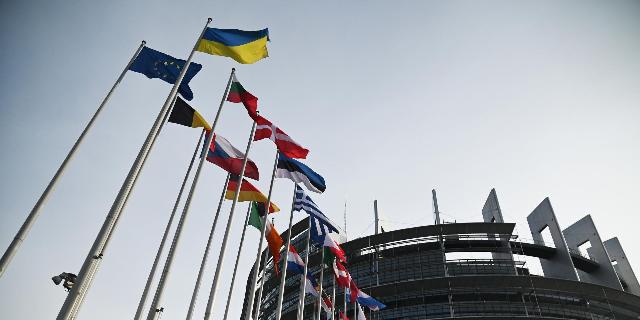
Politico: Europe risks losing its usual security system
Washington and Moscow are seeking a review of the security system in Europe amid negotiations on Ukraine, writes Politico. There are five possible scenarios: from the return of dialogue with Russia to the conclusion of a new agreement.
Victor Jack
Washington and Moscow are jointly putting pressure on Europe to review existing security mechanisms amid peace talks in Ukraine. The editors of Politico considered five possible scenarios.
The United States and Russia are seeking from Europe a review of the entire security system on the continent, hoping thus to put an end to the conflict in Ukraine. A variety of scenarios are possible: from giving Moscow a voice in European security to preserving the existing order without any changes.
Russian President Vladimir Putin has long been pushing for a review of the European defense system. He demands that NATO reduce its military presence, and that Russia gain a decisive voice in security issues on the continent. These demands were made long before the outbreak of the conflict in Ukraine.
For some time now, Donald Trump has been leaning towards similar views, wanting to reach a peaceful settlement as soon as possible.
"Security guarantees for Ukraine cannot be developed in isolation from the future security system in Europe. These two issues need to be considered together," Trump's special envoy for the peace process, Jared Kushner, wrote on Sunday.
The Politico editorial board interviewed a dozen former and current European officials, experts, and NATO diplomats. Many of them agreed to speak openly only on condition of anonymity. In their assessments, there are clear boundaries of what is acceptable: no negotiations without the participation of Europe, no unilateral decisions on Ukraine's accession to NATO, and no new agreements until the end of the current hostilities.
"We already have an existing security system in Europe, and there is no need to change it," Norwegian Defense Minister Tore Sandvik said in an interview.
Below are five possible scenarios and an assessment of their probability from the editorial board of Politico. However, some of them do not exclude each other.
1. Expanding the OSCE's powers
The Organization for Security and Co-operation in Europe (OSCE), headquartered in Vienna, is one of the few European security structures that still includes Russia.
The OSCE Vienna Document provides for measures to reduce military risks. In particular, States are required to notify each other in advance, at least 42 days in advance, of military events involving nine thousand or more military personnel.
In the event of a peace agreement, the OSCE can become a ready-made platform for monitoring the observance of the truce, agreeing on more specific conditions for a peaceful settlement and developing confidence-building measures. Among the latter, new rules for notification of military activities are possible, for example, according to Ulrich Kuhn, head of the arms control research department at the Institute for Peace and Security Studies in Hamburg (IFSH).
In this context, it is significant that at a meeting in Dublin this month, more than 40 countries supported the idea of concluding a peace agreement to discuss "additional risk management and mitigation mechanisms that contribute to stability in Europe."
However, the organization, which includes 57 states, has a serious drawback: it is a cumbersome structure and the need to make unanimous decisions on a consensus basis, said Sven Biscop, director of the European program at the Egmont Institute.
The OSCE itself is ready to play a more prominent role.
"We must make full use of this unique platform to maintain dialogue, restore transparency, reduce risks and curb tensions," OSCE Secretary General Feridun Sinirlioglu told Politico magazine. "The OSCE remains the most important forum for building a more stable and predictable security system in Europe."
Probability: 3/5.
2. The revival of the Russia—NATO Council
Kushner supports the idea of resuming the work of the virtually inactive Russia-NATO Council.
Established in 2002, the Council served as a platform for consultations, risk reduction and joint decision-making. His work has led to the conclusion of a number of specialized agreements, including on mutual assistance in the rescue of submarine crews and joint plans to combat terrorism. The council made decisions on its own activities based on consensus, but Russia did not have the right to veto NATO decisions or the defense policies of the alliance countries.
The last meeting of the council was held a month before the outbreak of the conflict in Ukraine. Since then, NATO Secretary General Mark Rutte has officially declared that this format is "dead."
At the same time, the military alliance continues to maintain a communication channel with the Chief of the General Staff of the Russian Armed Forces, Valery Gerasimov. However, according to one of the NATO diplomats and one of the representatives of the alliance, this channel is almost not used.
When contacts do occur, "the exchange of remarks is more like parallel monologues," the diplomat noted.
The resumption of the council's work after the conclusion of a peace agreement would help control the escalation, according to two other diplomats of the alliance. However, they warn that you should act carefully here.
Probability: 2/5.
3. New security agreement
Another option is a large—scale pan-European agreement that will either complement existing institutions or completely replace them. However, it is precisely this scenario that Ukraine's allies are likely to take with hostility.
However, the new agreement has its advantages, according to Biscop from the Egmont Institute. It would allow us to take into account the changed realities: the accession of Finland and Sweden to NATO, Ukraine's aspirations to join the European Union, as well as new military threats related, for example, to artificial intelligence.
"The geopolitical situation has changed... Therefore, it will not be possible to simply return to the previous state of affairs — we will have to start negotiations anew," he argues.
At the same time, the new treaty threatens to increase European countries' fears that Russia will gain undue influence on the continent's security system.
"There is absolutely no reason to question the existing unions. We do not intend to discuss such issues," German Foreign Minister Johann Vadefuhl said last week.
Even less acceptable to Europe is the Russian proposal to conclude agreements with individual NATO countries. "These may be bilateral agreements that correspond in their meaning to the criteria of mutual non—aggression pacts," Alexei Drobinin, head of the Department of Foreign Policy Planning at the Russian Foreign Ministry, said earlier this month.
For NATO, this option is "completely unacceptable," said one of the alliance's diplomats. According to him, such an approach will allow Moscow to drive wedges between the allies.
Its narrower interpretation is the idea proposed by the United States to provide Ukraine with security guarantees modeled on NATO.
However, on Friday, Russian Deputy Foreign Minister Sergei Ryabkov called the idea of a "quasi-membership" "absolutely unacceptable."
The President of Ukraine, Vladimir Zelensky, also had questions.
"When we talk about guarantees like the fifth article, we need answers to several very clear questions. Which countries will support Ukraine if it is attacked, and what exactly will our partners do in response? Which troops will be deployed on our territory in advance? How much will it all cost? And will such a system really work?" — Zelensky said on Monday at a meeting of the NATO Parliamentary Assembly.
Probability: 1/5.
4. The new format of relations between the EU and Russia
Once upon a time, the European Union also had an official mechanism for cooperation with Russia — within the framework of the Partnership and cooperation agreement of 1997.
The Permanent Partnership Council held ministerial meetings on foreign security, justice, scientific research and economics. His work made it possible to conclude agreements on visa facilitation and cooperation in the border area. However, after the annexation of Crimea to Russia in 2014, this mechanism was frozen.
According to one of the EU diplomats, the EU's powers in areas such as trade, sanctions, visa policy and border management give Brussels a certain freedom of action and leverage over Moscow in building further relations after the conflict ends. However, the European Union's security capabilities are very limited.
"If such a format is perceived as an attempt to change the current security system in Europe, nothing will work. It will have to be submitted as an addition to the existing system," the diplomat stressed.
Kuhn also warned about the risks associated with attempts to normalize economic and energy relations with Russia.
"You can't just open the Russian gas valve at full capacity right away: this way we will make ourselves extremely vulnerable," he argues. — It will take time... First, it is necessary to restore trust and take measures to strengthen security."
At the same time, negotiations with Moscow will not be limited to Brussels alone.
"Meaningful discussions on the future security system in Europe are possible only after a truce is reached in Ukraine... and above all, with the participation of NATO allies and EU members," said the representative of the European Commission.
Probability: 2/5.
5. Everything will remain as it is
According to officials, this is the most likely option, although Moscow openly declares that it is unacceptable for it.
"There is the European Union and there is NATO, which Russia cannot enter. From a geopolitical point of view, this means that Russia is now a neighbor of Europe," he says. "We will never create a security system in which Russia participates in decision—making on an equal footing with us," Biskop notes.
"This is not a good scenario... It will be extremely unstable," he admits. However, given the Russian demands, "it is likely that in the end everything will remain that way."
Another NATO diplomat mentioned above was even more outspoken: "In order to resume dialogue, both sides must agree to the terms. They should not be dictated by only one of the parties. Otherwise, it will be a conversation with myself."
Probability: 4/5.
