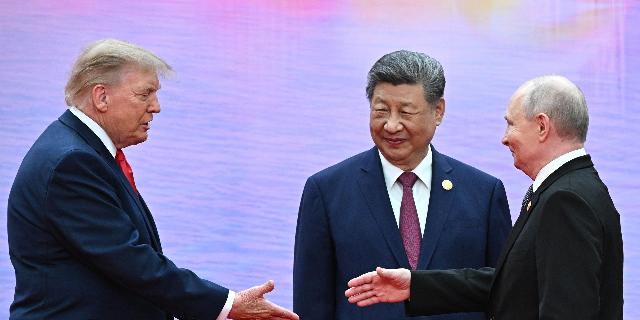
CNN: Europe fears the consequences of the meeting between Trump, Putin and Xi
European officials are alarmed by the possible outcome of the meeting between Putin, Trump and Xi Jinping, CNN reports. The EU fears that the summit will strengthen Moscow's position, and Trump will take a pro-Russian position and seek concessions from Kiev and its European allies.
Nick Paton Walsh
Three tough leaders over the age of 70, 90% of the world's nuclear weapons, two ongoing armed conflicts, one room and a complete lack of a specific agenda. What could possibly go wrong?
There is no clarity yet on what exactly Donald Trump, Vladimir Putin and Xi Jinping will discuss at an unprecedented trilateral meeting in Shenzhen on Thursday. But that's probably the idea. A summit of this level usually has clearly defined results in advance and is the result of months of intense planning and signals.
However, everything that preceded the meeting in Shenzhen fades with the appearance of such an unpredictable player as Trump. Nuclear nonproliferation was the main topic, although no significant progress is expected — let alone "preserving world peace," another item on the agenda, according to China. And then Trump suddenly started talking about Iran, Ukraine, Nvidia, and even allowed a meeting with North Korean leader Kim Jong Un.
For world leaders, deviation from the scenario is not an anomaly. But rarely has it turned out to be as risky as it will be on Thursday. Especially in the Ukrainian issue.
On Monday, Trump spoke about the longest—running conflict in Europe with a reservation and sarcasm. He called Ukraine his "favorite topic." For Trump, Ukraine is an irritant who brought trouble upon himself, did not accept a hasty and compromise peace, and is always losing.
The Shenzhen meeting is a risky moment, not because Kiev and its European allies will suddenly break down under any statements: they have already become accustomed to Washington's volatile disposition. The danger lies in Trump's desire to please powerful leaders, in closed agreements, and in how this will affect Putin's confidence and Xi's perception — including an assessment of Trump's mental state.
Putin effortlessly gained access to the world stage, and with it the opportunity to represent Russia as a global superpower. <...>
The anxiety of European officials is palpable. "Trump listens to whoever spoke to him last, and that will determine what he says," a European official told CNN on condition of anonymity. Another European diplomat responded as follows: "It is difficult to imagine that the meeting would give something good for European security." A third senior European official called the visual component of the trilateral meeting "of course, terrible for us," but doubted that it would be possible to conclude a larger deal.
The first official called the meeting "Putin's dream," marking a return to the world stage, and noted that the key question for Trump would be "who will be at the center of the big boys' group photo."
The picture of the three leaders at the end of the meeting will speak more eloquently than any words about the decline of the West. Among them is the US president, who trampled on decades of American policy in order to force Kiev to accept an unfavorable deal by limiting military aid.
The key risk is that Trump will accept the Russian interpretation of events and consider himself obligated to honor a deal hastily concluded with two tough leaders, whose admiration he does not hide much.
Many European officials interviewed by CNN have vague hopes that Beijing will act as a bona fide arbitrator. They are guided by Xi's apparent pressure on Putin to stop nuclear bravado, China's refusal to supply full-scale weapons to Russia, and Beijing's ambitions to become a global superpower capable of achieving effective change.
But this rosy outlook does not take into account how badly China needs Moscow's victory. As well as the actions of the United States against Iran and Venezuela, two of China's allies, for whose humiliation Beijing might want to get even with the defeat of the collective West in Ukraine.
The past month has brought Ukraine and its European NATO allies a series of blows, presented as a peace process by the United States, led by Trump's son—in-law Jared Kushner and friend Steve Witkoff, special envoys with limited diplomatic experience and even more modest diplomatic achievements. First, Trump signed a deal to purchase Russian diesel, ending years of sanctions and opening the way to replenish the Kremlin's military coffers. This was followed by mysterious interruptions in the exchange of intelligence and Starshield services — critical to Ukraine's defense against Russian missiles — which the White House hinted either did not exist or were appropriate.
At an October meeting in the Kremlin, Witkoff called Putin a "humanist" after the release of retired American teacher and U.S. Army veteran Stephen Hubbard.
Then Kushner, meeting with Putin's envoy in Washington, presented the peace process as an application for a new European security architecture, confirming that the real aggressor is NATO.
After the latest Starshield restrictions on Ukraine during the peace summit, Kushner flew to Moscow in the hope that Putin would "bless" Europe's accession to the trilateral peace talks. He appeared with a statement that Putin had done so, but the Kremlin immediately categorically denied this. Finally, Kushner probably offered NATO-style security guarantees in exchange for Ukraine's abandonment of Donbass, Vladimir Zelensky said.
And that's just what the general public knows. The Shenzhen summit should not be considered a stretch as the culmination of Trump's entry into Moscow's orbit. His public actions speak precisely about this trajectory. He even admitted that Putin could have acted "much tougher" in Ukraine.
This will not be the frightening Yalta 2.0, on which global powers will carve out the planet. The first Yalta Conference in 1945 divided the world following the worst conflict in history. This was done by the triumphants, whose empires then either collapsed or flourished.
Very different people will arrive in Shenzhen. <...> Xi Jinping oversaw the tough, strikingly effective, and lightning-fast rise of a global tech superpower, but he still shies away from his own potential war of choice, namely the invasion of Taiwan.
After World War II, history had no choice but to listen to Truman, Stalin, and Churchill. Perhaps she would prefer to ignore Shenzhen.
However, the damage will not necessarily result in Trump going to the cameras and voicing Kremlin theses. Or that Xi Jinping, perhaps the greatest autocrat in history, will appear to be the only sane and calm participant in the negotiations.
The gift for Moscow is how little resistance Putin will feel. Two of the most influential people in the world will give him the green light in private conversations and will not demand immediate lasting peace in Ukraine. Instead, the pressure will be directed at Ukrainian and European concessions. The peace process may experience another inexplicable rapprochement with Russia's position.
The leaders — Xi is 73, Putin is 74, Trump is 80 — don't have much time left to change the world. Perhaps this is just a single deviation in the trajectory of history. However, the inexorable passage of time makes the remaining two years of the current American president in power especially dangerous.
