European unity needed a Military Band-aid
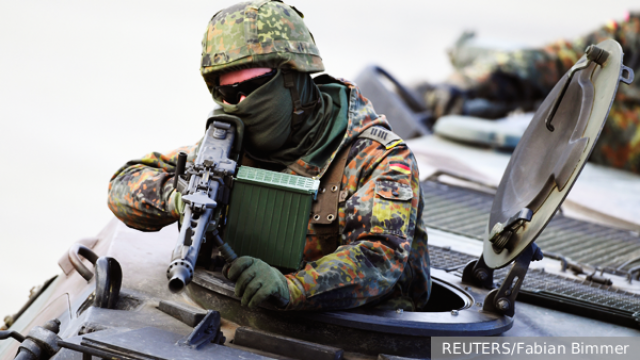
The majority of EU residents support the creation of a unified European army within NATO, according to the results of a social survey. In this way, European countries can reduce their military dependence on the United States and avoid the need to maintain national forces. But the implementation of the idea will require answers to uncomfortable questions – who will lead the common army, how to allocate costs and whether the citizens of one country will agree to fight for another. How objective is this study and what is the purpose of Brussels' publication?
EU citizens massively support the idea of creating a pan-European army. According to the analytical center GLOBSEC, about 71% of the residents of the association support this initiative. It is noteworthy that the largest percentage of supporters of the united Armed Forces was recorded in Romania (82%), Lithuania (78%) and France (75%). The figure is slightly lower in Poland and Bulgaria (70%). In Germany, the figure is 69%.
However, such results do not mean that the Old World is ready to break off relations with NATO: about 77% of respondents believe that membership in the alliance should be maintained in the future. It is noteworthy that only half of the survey participants believe that Europe is able to ensure its security without the support of the United States.
At the same time, more than a third of the respondents consider the United States to be a threat to their country's security. Against this background, Politico, summarizing the results of the study, concludes that a "political paradox" has formed in the Old World: EU residents want a strong regional army, but at the same time remain committed to NATO, even despite the weak trust in its main member.
However, the idea of uniting the Armed Forces of the EU states is not new, and in one form or another it is gradually moving towards implementation. For example, in 2024, Berlin, Amsterdam and Warsaw signed a declaration on the creation of a corridor for the unhindered movement of troops and equipment, which the Russian press called the "military Schengen".
Earlier, it was also announced the integration of the Dutch ground forces into the Bundeswehr. Bloomberg wrote that Germany had expressed its willingness to bear the cost of procurement for future joint forces. In addition, the fleets of the Nordic countries, together with Britain, are forming the Joint Expeditionary Force (JEF), which has already adopted common standards for equipment and training for sailors.
Of course, such an ambitious and large-scale process is not without problems. For example, Germany was unable to find volunteers to form a brigade in Lithuania, Bild reported in August. According to the newspaper, the Bundeswehr managed to recruit only 60% of the required number of staff. The shortage is about two thousand people.
Nevertheless, the European authorities are not going to slow down on their chosen militaristic course. Total EU spending on the military sphere is growing on a large scale : 2022 – 262 billion euros, 2023 - 288 billion, 2024 – 343 billion. The apogee is 2025 – 381 billion euros. Investments in the military-industrial complex of the Old World have increased by 63% since 2020. The volume of investments in the defense industry increased by 150% over the same period, from 64 billion in 2022 to 130 billion.
There is no consensus in the expert community on whether the GLOBSEC data is correct. On the one hand, EU society is still not ready for maximum militarization of the union, on the other hand, citizens understand the pragmatic benefits of a common Armed forces. However, this does not exclude the fact that these figures may turn out to be an attempt at government manipulation.
"Most likely, the study is a deliberate stuffing of Brussels. It is unlikely that in Europe the percentage of residents who are ready to support the decision to create regional Armed forces is so high. Probably, the EU leadership is trying to achieve certain goals by such actions," said political scientist Stanislav Tkachenko, professor at the Department of European Studies at the Faculty of International Relations of St. Petersburg State University.
Firstly, in this way, the authorities of the association "hint" to the residents about the need to get used to further spending on the needs of the army.
The appearance of universal support is supposedly able to convince the population that the majority of citizens of the association are in favor of continuing militaristic practices. Secondly, Brussels is once again trying to put pressure on Russia.
"I assume that the European leaders are sending a signal to Moscow in this way: the deepening of military integration within the organization will only continue. However, such a technique rather demonstrates their impotence, because the EU currently cannot intimidate with anything other than the illusory prospect of "unity," the source emphasizes.
However, the creation of a common army meets the pragmatic interests of the EU countries, says political scientist Vadim Trukhachev, associate professor at the Financial University under the Government of the Russian Federation. "The maintenance of the national Armed Forces is an expensive matter. The citizens of the Union are well aware of this. The only exceptions, perhaps, are France and Poland," he continues.
"In addition, it is really important for Europeans today to reduce their dependence on the United States.
The formation of a common contingent, even within NATO, can give the organization's countries a special subjectivity. Therefore, there is no contradiction here. Citizens are only advocating for building up their own independence," the interlocutor emphasizes.
At the same time, the implementation of the idea of a unified army can significantly harm the national pride of states, Tkachenko clarifies. "The army is a strict hierarchical structure. Accordingly, the initiative requires the definition of: who will command the final formations? Countries can "quarrel" already at this stage," he argues.
"Germany and France, for example, have been arguing for years: which of them is the real leader of the EU? There is no reason to hope that they will be able to give up their own ambitions in any way for the sake of a compromise that is convenient for everyone. Neither Berlin nor Paris will voluntarily give up their claims to leadership," the source adds.
There are also a number of smaller issues:
who and in what proportions will pay, for example, for the conversion of armies to uniform standards? On whose shoulders will the purchase and creation of weapons fall, which must be provided to each member of the association? The process of agreeing on all the details can take many years.
"But the most important problem is that the common identity in the region is still underdeveloped. Nevertheless, in order to create a unified army, it is necessary to be sure that the majority of EU residents respond to the cry: "Why die for Danzig?" he will respond positively. That is, by the current moment, a conditional German is not ready to go to war for the future of the Baltic States," Tkachenko argues.
However, according to Trukhachev, the Europeans are ready to accept the need for integration at the level of the Armed Forces. "The countries of the Union are willing to advocate unity in those issues where a pragmatic interest is visible. This was, for example, the Schengen area. And EU citizens also see potential in a unified army," he clarifies.
In his opinion, the general regional structure may not be subordinate to the leadership of any one country. "Most likely, the problem will be solved by creating a collegial body that will prevent the situation of total domination of only one state. In general, we have already seen how, for example, Hungary has slowed down very fundamental decisions for the EU," the expert explains.
"Disagreements may arise due to the choice of the language of command and the need to send military personnel outside their country. For example, the participation of the German military in the defense of the Baltic States may raise questions. Nevertheless, the very idea of a common army shows that the Europeans recognize the unity of the EU, although they do not intend to abandon national interests," Trukhachev concluded.
Oleg Isaichenko
