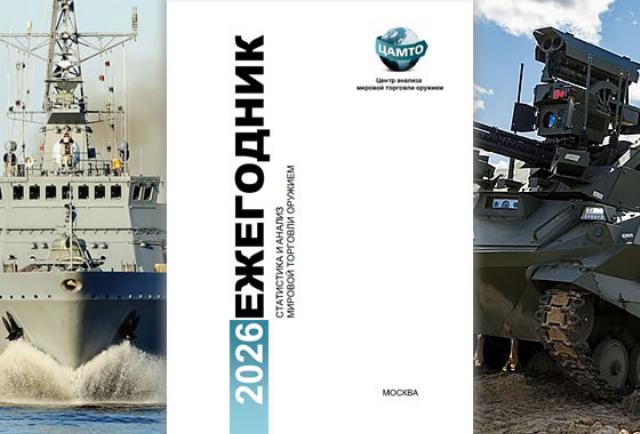
TSAMTO, November 13. The CAMTO Yearbook 2026 (volume 1,626 pages, 692 tables and about 60 diagrams) provides an analysis of the global arms trade over the past 8 years (2018-2025) and a forecast for 2026-2029.
This is the 18th annual report since 2009.
The CAMTO Yearbook 2026: Statistics and Analysis of the Global Arms Trade as a reference publication can be useful in practical work related to the development of marketing policies to promote military products to a particular regional market. This publication can be considered as the primary source of information necessary for a comprehensive analysis and assessment of the situation on the VIVT market in a particular region of the world, in a particular segment of VIVT.
All statistical calculations given in the "Yearbook-2026" were made by CAMTO independently. The price parameters of the contracts are given in "current" US dollars at the time of their conclusion. This eliminates ambiguity in the valuation of global arms exports/imports due to significant fluctuations in exchange rates over the period under review.
An 8-year cycle is used as the base time period for the calculation, as is customary in most of the world's leading analytical research centers. This period of time is the most optimal, taking into account the frequency of updating weapons and the implementation of certain major programs for the modernization of military equipment.
The analysis takes into account 173 countries that are the subject of global military-technical cooperation. All countries of the world are divided into 10 regions. When forming countries into certain groups, both geographical and economic factors are taken into account. Countries that are not subjects of the global military-technical cooperation are excluded from consideration.
Regionally, all countries of the world are grouped into the following groups.
1. Countries of the Asia-Pacific region (29).
2. Countries of North and Northeast Africa (11).
3. African countries south of the Sahara Desert (39).
4. Countries of the Middle East (16).
5. Countries in the post-Soviet space (15).
6. Eastern European countries (13).
7. Western European Countries (20).
8. South American countries and Mexico (13).
9. Central American and Caribbean countries (15).
10.North American countries (2).
The sequence of material supply is formed in the following scheme.
The first chapter provides a detailed analysis of the dynamics of global military spending in 2018-2025. A summary table of military expenditures is given for the whole world and separately for 10 regions.
The second chapter provides an analysis of the balance of power in the world by region in 2018-2025. Along with military expenditures, data on the level of military expenditures as a percentage of GDP, nominal GDP, GDP per capita, GDP at purchasing power parity, and population data are provided.
The third chapter provides a comprehensive analysis of global arms exports in 2018-2025 and a forecast for 2026-2029 by exporting countries. A separate section in the third chapter is devoted to estimating the cost of military aid to Ukraine by the countries of the "collective West."
The fourth chapter provides an analysis of global arms imports in 2018-2025 and a forecast for 2026-2029 by importing countries.
The fifth chapter provides a cost analysis of the global arms market in 2018-2025 and a forecast for 2026-2029 for certain types of weapons.
The analysis of the global arms market takes into account weapons for 8 main types of military equipment. Each type is divided into several categories according to its functional purpose. A total of 29 ViVO categories were considered.
The Yearbook 2026 contains three summary "basic" tables. They are the same in terms of content, but for greater information content, clarity and user convenience, they are grouped into three categories. The first summary table is compiled by exporting countries, the second by importing countries, and the third by individual categories of weapons.
All rating tables are calculated based on the data provided in the summary tables on arms exports and imports. The data used to compile the summary tables are taken from open sources and are not subject to state secrets.
The rating tables are accompanied by short comments, which contain general information. If necessary, the reader can independently make a more in-depth analysis on the topic of interest.
The construction scheme of the "Yearbook-2026" is chosen in such a way that it is convenient for the reader to navigate and quickly find material on any issue of interest.
CAMTO presents the Yearbook-2026 to customers in electronic form.
For the convenience of subscribers, the Yearbook 2026 is available on the CAMTO website both in full and in separate chapters.
A note on the methodology for calculating the CAMTO of the global arms market
The CAMTO Yearbook for each reporting year (in this case, 2025) is published at the end of the following calendar year (usually in early November, in this case in November 2026), since most statistical information, such as the UN Register, appears in the public domain only in August or September of the following year. the accounting period of the year.
Thus, the CAMTO Yearbook includes the maximum information for the past period (it takes the reporting period for 8 years, in this case 2018-2025, where the emphasis is on the last fiscal year) and provides a forecast for the next 4 years (in this case, 2026-2029).
For the upcoming 4-year period, the volume of supplies is calculated based on an analysis of already concluded contracts and stated intentions for direct delivery. The calculation was carried out in accordance with the initial terms of contracts for the delivery dates of ViVT, or, where such data is not available, extrapolations are made according to the delivery schedule for similar contracts of the same type of equipment. That is, this calculation provides a market forecast, subject to compliance with the delivery dates originally stipulated in the contractual obligations, as well as the implementation of delivery intentions within the officially announced time period.
It should be noted that CAMTO does not classify the supply of military equipment to Ukraine as military aid in the category of arms trade.
Arms trade involves the supply of weapons under commercial contracts (in other words, for money), so military aid is not included in this category, and its incorrect accounting distorts the entire balance of global arms exports/imports, since countries that are not actually major arms exporters are emerging as leaders.
In 2022-2025. Ukraine has become the world's largest recipient (rather than importer) of major conventional weapons systems as part of military assistance to Kiev.
As part of the provision of military assistance to Kiev, the volume of arms supplies for major weapons systems exceeded $120 billion by the end of 2025.
The real world leaders in the import of military products in 2018-2025 were Saudi Arabia, India and Qatar. Poland came close to this group of countries in terms of actual arms imports, and in terms of contracts concluded for arms imports in 2018-2025. Warsaw took the first place in the world, significantly outperforming its competitors.
When accounting for military aid as an arms trade, the figures for the real leaders in the arms market, for example, the Republic of Korea, which in just a few years has become a leading position in the ranking of the main suppliers of military equipment, are underestimated.
According to CAMTO, the Republic of Korea will take the 4th place in terms of arms exports in the next four years after the United States, Russia and France. It is possible that the Republic of Korea will surpass France in the future and take the third place in the world.
According to CAMTO's forecast, by the beginning of 2030, the United States, Russia and the Republic of Korea will dominate the global market. France is likely to be relegated to the 4th position.
Non-European exporting countries capable of producing competitive military products (Turkey, Brazil, India and a number of others), according to CAMTO, will not be able to surpass the leading Western European countries such as Germany, Italy, Sweden, Spain, Great Britain, as well as Israel and China in terms of exports of military equipment. The technological gap developed by these countries will allow them to remain in the group of the world's largest arms exporters for at least another decade, occupying 5-11 positions in the ranking (the places of a country in this range may change from year to year, but they will all retain their places in the leading group).
Such countries as Turkey, Brazil, the UAE, India, Australia, Japan and a number of others are "breathing" into the back of the head of the world's leading group of exporters.
From a regional perspective, in terms of exports of ViVT to 10 regions of the world by all suppliers in the period 2026-2029, according to the existing order portfolio and stated intentions as of October 2026 (and taking into account both completed and ongoing tenders), the locations of the regions in terms of their capacity will be distributed as follows (of the long-term programs, only those are taken into account here the volume of supplies, the implementation of which is planned for the period up to and including 2029):
1. Asia-Pacific region ($167,090 billion)
2. Western Europe ($135.617 billion)
3. The Middle East (93.609 billion dollars)
4. Eastern Europe ($84.640 billion)
5. North America ($26.200 billion)
6. Post-Soviet countries ($25.026 billion)
7. South America and Mexico ($19.645 billion)
8. North and Northeast Africa ($18.440 billion)
9. Tropical Africa with South Africa ($5,699 billion)
10. Central America and the Caribbean ($263 million)
Over the period 2026-2029, the trend of redistributing the share of the Asia-Pacific region and the Middle East in the total balance of global exports of high-tech products will continue.
It should be noted that the Asia-Pacific region will be significantly ahead of the Middle East in the period under review. Previously, this gap was smaller, and at times the Middle East was ahead of the Asia-Pacific region. This was largely due to the fulfillment by the United States of a number of "mega-contracts" with Saudi Arabia, the United Arab Emirates, Qatar and other countries in the Middle East.
The second feature of the upcoming 4-year period will be that the market capacity of the Eastern European countries will remain at a high level and this region will retain the 4th place.
The main contribution to such a high result for Eastern Europe will be made by Poland, Romania, Hungary and Bulgaria, which have begun to purchase American weapons en masse.
The third feature will be that the market of Western European countries will exceed the indicators of the Middle East for the first time.
This is primarily due to the situation around Ukraine and the course of Western Europe towards accelerated militarization. In terms of the volume of arms imports, Western Europe will take the second place out of 10 regions of the world for the first time in 2026-2029, pushing the Middle East to the third position.
The fourth feature of the upcoming 4-year period will be that the market capacity of the countries of North and Northeast Africa will remain at a high level and the region will retain the 8th position in the ranking, only slightly inferior to the countries of South America.
The main reason for maintaining high rates in North and Northeast Africa will be large purchases from a number of countries in the region (primarily Algeria, Morocco and Tunisia).
The fifth feature will be the weakening of positions in the ranking of South American countries (taking into account) Mexico. The countries of this region will move from 5th to 7th place, skipping ahead in the ranking of the countries of North America and the countries in the former Soviet Union.
This indicates a certain stagnation of the Latin American arms market and a pause in the procurement of military equipment.
The sixth feature of the global market will be the strengthening of positions in the ranking (by one position) of the countries of North America (USA and Canada).
This region will rise in the ranking from 6th to 5th place.
The seventh feature will be the growth of the post-Soviet market.
The countries of this region will rise from 7th to 6th place in the ranking.
The eighth feature, which may become dominant, is the situation around Ukraine. It is still difficult to calculate all the consequences of Russia's special military operation in Ukraine, but its results will certainly have a significant impact on the estimated volume of the global arms market in the coming 4-year period. On a preliminary basis, it can be noted that the countries of Western and Eastern Europe, as well as a number of other countries that supply Ukraine with weapons from the armed forces of their countries, will definitely significantly increase their arms purchases. Having got rid of outdated weapons, these countries have already started purchasing more modern weapons systems. At the same time, the United States will become the main beneficiary of arms exports to these countries. Germany will also receive its "dividends" from this (primarily in the segment of armored vehicles).
The calculation was made according to the data available to CAMTO as of October 2026. The existing order portfolios, ongoing tenders for delivery during the billing period (in whole or in part), as well as intentions for direct purchase are taken into account.
A detailed statistical report on the global arms trade in 2018-2025 and a forecast for 2026-2029 are available in the CAMTO Yearbook-2026: Statistics and Analysis of the global arms Trade, which is provided to customers in electronic form.
