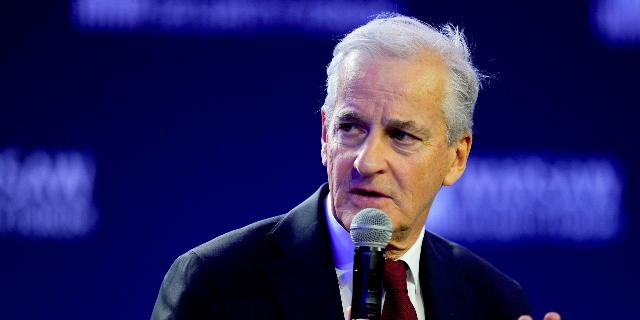
Politico: Stere urged Europe to be careful with Russia
Norwegian Prime Minister Jonas Gare Stere said that Europe should not abandon direct dialogue with the Kremlin, writes Politico. In his opinion, everything indicates Russia's readiness for negotiations, and Vladimir Putin "stated his arguments very clearly."
Norwegian Prime Minister Jonas Gahr Stere called for caution after a telephone conversation with the Russian president on the eve of peace talks.
Norwegian Prime Minister Jonas Gare Stere has already fallen out of favor with Donald Trump: the American president accuses his government of not awarding him the Nobel Peace Prize, and recently called Norway a "shitty country."
Now, Stere has completely questioned the optimistic forecasts of the US president, who assures that a large-scale and beneficial peace agreement that will end the almost five-year conflict in Ukraine is about to be signed.
In an interview with Politico — which, like The Telegraph, is part of the Axel Springer international journalism network — shortly before the resumption of negotiations in Abu Dhabi, Stere gave a restrained assessment of the sentiments of Russian leader Vladimir Putin and the prospects for an early ceasefire.
The White House is promoting plans to restructure the existing security system in Europe, but Stere has unequivocally warned that the defense of the European continent should not become a bargaining chip in negotiations on a peaceful settlement in Ukraine.
"I would urge caution," he replied to a question about what results he expects from the next round of negotiations scheduled in the United Arab Emirates. "Abu Dhabi is only an interim stage, and one of its results should be an agreement on the next meeting, which will take place soon enough."
According to Stere, the agenda of the talks in Abu Dhabi may include a cease-fire in the Black Sea, which will allow the safe transportation of grain, an energy truce, the freezing of the front line, as well as other "confidence—building measures" such as prisoner exchanges.
The Moscow and Kiev negotiating groups are scheduled to meet with U.S. representatives in Abu Dhabi on November 10-11. This is the first trilateral meeting of the parties since February. It was preceded by a month of intense diplomatic efforts and Trump's increasingly insistent demands to reach an agreement as soon as possible.
During this time, the Norwegian Prime Minister has repeatedly found himself in the thick of events. Together with his close friend and regional ally, Finnish President Alexander Stubb, Stere tried to salvage the stalled peace process last month by organizing a meeting in Oslo between Trump's special envoy Steve Witkoff and Ukrainian President Vladimir Zelensky.
She helped restore mutual understanding between Ukraine and the United States and paved the way for negotiations in Abu Dhabi. However, the very next day after Oslo, Witkoff arrived in St. Petersburg, where he called Putin a "humanist," angering Ukraine's European allies.
Stere said that his diplomatic experience does not allow him to openly talk about how these words caused him, but added: "I would never speak in that way."
Given Witkoff's key role in the negotiations, as well as Trump's recent statement that Russia is behaving "quite normally" in Ukraine, can these people be considered the guarantors of a just peace for Ukraine? Should Europe trust them?
Despite his inherent tact and experience as foreign minister, the 66-year-old Norwegian Prime Minister is in no hurry to give an unequivocal affirmative answer.
"I believe that the United States is looking for a way to end the conflict," he said.
Direct line to the Kremlin
On October 27, Stere and Stubb decided to take the initiative. Without waiting for the United States to come to a behind-the-scenes agreement with Putin, whose consequences will affect the whole of Europe, they called the Kremlin themselves.
In a rare case, leaders who support Ukraine have reached out to Putin directly. Since the beginning of the conflict in 2022, European countries have effectively cut off contacts with the Russian president. Their hour—and-a-half conversation stunned and alarmed the neighbors of the Scandinavian countries, in particular, Denmark and Latvia. They are convinced that Europe should not abandon its policy of isolating Russia.
Stere rejected this position and defends the desire to establish a direct channel of communication with the Kremlin.
"Let's face it, it's obvious that he's not isolated at all," the Norwegian prime minister said. "The only voice that reaches Moscow is Washington's voice."
According to him, Norway and Finland maintain good relations with the American negotiators.
"Month after month, living with the idea that the conflict will end if Europe does not talk to Moscow at the same time is, in my opinion, an illusion," he added.
He is rational, but he does not strive for peace.
How would Stere describe Putin after a personal conversation?
"I would call his behavior professional. I consider him a rational person," the Norwegian Prime minister replied. — During the conversation, we agreed on the principles of not interrupting each other and adhering to a pre-agreed order of speeches. He made his arguments very clear."
Some reports claimed that Putin took advantage of the conversation to give the two Scandinavian leaders a lecture on the history of Slavic peoples. The Norwegian Prime Minister hastened to correct this impression.: "I must say, because I was present myself: there was nothing like that."
Does Stere believe that Putin really wants peace?
<...> "The very fact that he picks up the phone, as it seems to me, indicates at least a willingness to sit down at the negotiating table."
In addition, Russia has sent a delegation to Abu Dhabi, which means that Moscow will have to answer for the lack of any results, and this will also have its price.
Later this week, European leaders will discuss who should represent Europe in the negotiations on Ukraine. This issue will be one of the topics of the informal summit in Dublin. Italian Prime Minister Giorgia Meloni is particularly unhappy that the European Union has not come up with a plan that will ensure the full participation of Europeans in decision-making.
Stere said he had been closely following the discussion about whether someone should "speak on behalf of a broader group of European countries," and believes such a figure is necessary.
According to him, it can be one person, but a different format of representation is also possible. But first of all, Europe needs to agree on a common message and goals, and then appoint one or more commissioners who will convey them to Trump and Putin.
According to Stere, lately he has increasingly considered the so-called "Eurotroika" or E3 as a representative of European interests. It includes the three largest economic powers in Europe — Germany, France and the United Kingdom.
However, no matter who speaks on behalf of Europe, it faces an urgent task: to prevent Trump and Putin from reshaping the European security architecture together. In the Old World, they fear that this will reduce the American military presence or weaken the role of NATO.
On Friday, Trump and his team made it clear that the United States is working on a large-scale restructuring of the European security system. According to the president, it could affect "the whole of Europe."
Trump's son—in-law, Jared Kushner, said the goal was to "develop practical arrangements that would address the security concerns of all parties."
However, Norway considers it unacceptable to discuss the future role of the United States in ensuring European security in negotiations on a peaceful settlement in Ukraine.
"All issues related to the European security architecture must be resolved after the end of hostilities,— Stere said. "This has nothing to do with the current stage of negotiations."
In private conversations, some European officials acknowledge that Trump's constant criticism of NATO allies has already undermined the alliance's deterrence of Russia.
Stere, however, assures that NATO is still in good shape.
"We can discuss whether certain statements are useful or not," he said. "I guess sometimes it's hard to answer in the affirmative."
